
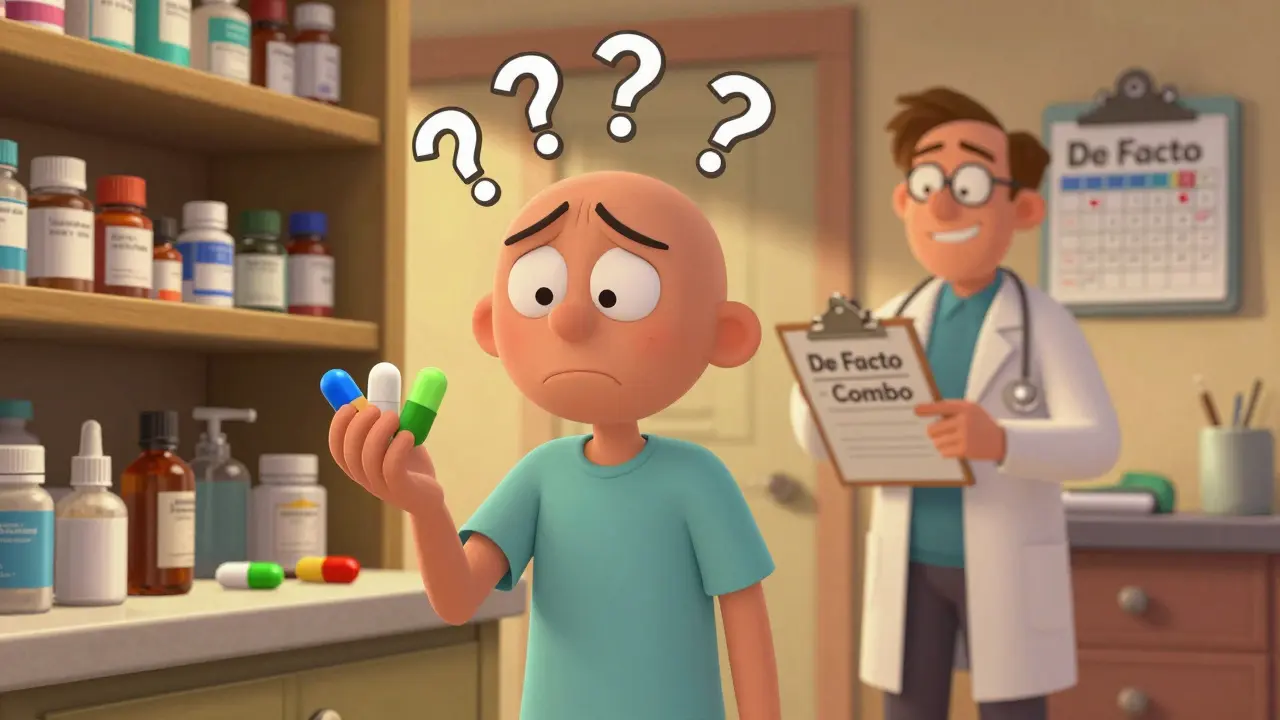
Imagine you’re on three different pills just to control your blood pressure. One blue, one white, one green. You forget which one to take when. You skip a dose. Your doctor says it’s cheaper this way - but is it really better?
This isn’t rare. Across the U.S., Europe, and parts of Asia, doctors are prescribing separate generic drugs instead of single-pill fixed-dose combinations (FDCs). It’s called a de facto combination. You’re getting the same active ingredients - say, amlodipine and valsartan - but in two or three different pills. No one approved this combo. No safety studies were done on how they interact in your body. Yet it’s happening every day.
What Exactly Is a De Facto Combination?
A fixed-dose combination (FDC) is one pill that contains two or more drugs in a fixed ratio. Think of it like a pre-mixed smoothie: you get the exact blend the manufacturer tested for safety and effectiveness. Examples include pills that combine metformin and sitagliptin for diabetes, or tenofovir and emtricitabine for HIV.
A de facto combination is what happens when you take those same drugs - but as separate pills. No one designed the combo. No one studied how they work together in your body. You’re essentially creating your own drug cocktail.
The difference isn’t just technical. FDCs go through strict testing by the FDA and EMA. They must prove that all ingredients work better together than alone, that the doses are safe when combined, and that the pill stays stable over time. De facto combinations? None of that. Just a prescription scribbled on a pad.
Why Do Doctors Prescribe Separate Generics?
There are three main reasons: cost, flexibility, and habit.
First, cost. In some places, especially where generics are heavily competed, buying two separate pills can be cheaper than the branded FDC. In India, for example, a 2012 parliamentary report found many FDCs offered no real advantage - and separate generics were often less expensive. Even in the U.S., patients with high-deductible plans sometimes choose separate generics to save $10-$15 a month.
Second, dosing flexibility. Not everyone needs the same amount of each drug. Say your blood pressure needs 5 mg of amlodipine, but the only FDC available comes with 10 mg. Your doctor can’t split the pill - or it might not even be scored. So they prescribe the 5 mg amlodipine by itself, plus the valsartan. Same result, but now you’re taking two pills instead of one.
Third, habit. Many doctors learned to prescribe this way before FDCs were widely available. They’re used to it. And if a patient says, “I’ve been taking these two pills for years,” it’s easier to keep doing it than to switch.
The Hidden Risks You’re Not Being Told
Here’s the part no one talks about: you’re flying blind.
FDCs are tested for stability. That means the drugs don’t break down inside the pill over time. They’re tested for bioavailability - how much of each drug actually gets into your bloodstream. They’re tested for interactions - does one drug make the other work too well? Or not at all?
With de facto combinations? None of that. You’re mixing two separate pills from different manufacturers. One might be a quick-release version. The other might be extended-release. They might have different fillers, coatings, or absorption rates. The FDA found in 2020 that 12.7% of generic drugs differ significantly in how they’re absorbed compared to the original brand. That’s not a small number. That’s enough to throw off your whole treatment.
And then there’s adherence.
Every extra pill you take lowers your chance of sticking to your regimen. A study published in PubMed found that each additional pill reduces adherence by about 16%. FDCs improve adherence by 22% compared to separate pills. On PatientsLikeMe, 63% of people on separate generics said they forgot which pill to take when. Only 31% of FDC users said the same.
One Reddit user wrote: “My doctor switched me from a single Amlodipine/Benazepril pill to separate generics to save $15/month. I missed doses twice because I couldn’t remember which blue pill was which.”
That’s not just inconvenient. Missed doses mean uncontrolled blood pressure, higher risk of stroke, more hospital visits.

When Separate Generics Might Actually Be Better
It’s not all bad. There are real cases where de facto combinations make sense.
Take diabetes. A patient with kidney disease might need lower doses of metformin. The only FDC available has 1000 mg metformin and 100 mg sitagliptin - too much for their kidneys. But separate generics let the doctor drop the metformin to 500 mg while keeping the sitagliptin at 100 mg. That’s precision. That’s good medicine.
Or HIV. Some patients need dose adjustments based on weight, liver function, or drug interactions. In those cases, separate pills give doctors the control they need. In fact, 89% of HIV patients in the U.S. still use FDCs - but that’s because the regimens are so tightly standardized. When you need flexibility, de facto combinations fill a gap.
The problem isn’t the practice itself. It’s the lack of oversight.
What You Can Do to Stay Safe
If you’re on a de facto combination, here’s how to protect yourself:
- Ask your doctor why. “Is this because it’s cheaper? Or because my dose needs to be adjusted?” If they can’t give you a clear clinical reason, push back.
- Use a pill organizer. Color-code your pills. Use a smartphone app that reminds you what to take and when. The Institute for Safe Medication Practices recommends synchronized refill schedules - so all your pills come in at the same time.
- Check your pharmacy. Are all your generics from the same manufacturer? If not, ask if they can switch to one brand. Different manufacturers = different absorption rates.
- Ask about FDC alternatives. There might be another FDC on the market with a dose that fits you better. New ones come out every year. AstraZeneca, for example, just patented a modular FDC system that lets you adjust doses without switching to separate pills.
- Get your blood tested. If you’re on blood pressure or diabetes meds, ask for regular lab checks. Are your levels stable? Or are they creeping up because the combo isn’t working as expected?

The Bigger Picture: Regulation Is Catching Up
Regulators are starting to take notice.
In January 2023, the FDA issued a safety warning about untested drug combinations after 147 adverse events were linked to de facto combinations. The EMA launched a multi-year study in 2023 to evaluate off-label combinations - results expected by late 2024.
Meanwhile, electronic prescribing systems are being updated to flag inappropriate combinations. A 2022 Health Affairs study predicted that within 10 years, unmonitored de facto combinations will drop by 60% because systems will auto-suggest FDCs when appropriate.
Pharmacies are stepping in too. PillPack by Amazon launched a Combination Therapy Support Program in 2021. They pre-sort pills by time of day, include color-coded labels, and offer free counseling. Patients using the service saw a 41% drop in missed doses.
Bottom Line: Flexibility Isn’t Free
De facto combinations aren’t evil. Sometimes they’re necessary. But they’re not safer just because they’re cheaper. They’re not smarter just because they’re flexible.
The truth is, FDCs were invented for a reason: to make treatment simpler, safer, and more effective. When you break them apart, you’re undoing years of research - and putting yourself at risk.
If you’re on separate generics, don’t assume it’s the default. Ask why. Push for a better option. And if your doctor says, “It’s just easier this way,” ask them: “Is it easier for you - or for me?”
Because your health shouldn’t be a cost-cutting experiment.




So let me get this straight - we’re letting doctors play pharmacist because it’s $15 cheaper? And we call this "healthcare"? I swear, if I had to guess which blue pill was which every morning, I’d just start wearing a lab coat and calling myself Dr. Chaos.
My grandma took three pills at once and still remembered them better than I do. Guess who’s in the ER now?
The real issue isn’t the pills - it’s the epistemological collapse of medical authority. We’ve outsourced clinical judgment to cost algorithms and inertia. FDCs exist because pharmacology is systemic, not additive. When you take separate generics, you’re not just taking drugs - you’re taking a gamble on bioequivalence, dissolution kinetics, and manufacturer variability. The FDA’s 12.7% absorption variance statistic isn’t a footnote - it’s a red flag waving in a hurricane.
This isn’t personal flexibility. It’s systemic negligence dressed up as patient choice.
I used to be on separate generics for my BP meds. I’d forget which pill was which, take two of the green one by accident, then panic for three hours thinking I overdosed. My pharmacist finally said, ‘Honey, you’re not saving money - you’re paying for anxiety.’
Switched to the FDC. Same price. One pill. No more panic. No more color-coded chaos. I didn’t even know I was this stressed until it was gone. Why is this still a thing?
I’ve seen this in clinic. Some patients are on five separate meds just for hypertension and diabetes. It’s not that they can’t afford the combo - it’s that their doctor never checked if a combo existed. Sometimes it’s just… easier to keep doing what you’ve always done. But that doesn’t make it right.
Maybe we need a checklist: ‘Have you considered an FDC?’ before writing the script.
Oh this is classic Big Pharma brainwashing. FDCs? They’re not safer - they’re just more profitable. The real reason they push FDCs is because they lock you in. Separate generics? That’s freedom. You can swap brands, adjust doses, avoid allergens. The FDA? They’re just here to protect the patents.
And don’t even get me started on PillPack. Amazon’s getting into your medicine cabinet now? Next they’ll be tracking your pill intake via Alexa. Wake up, sheeple.
ok so i took the blue one then the green one then the white one and now i think i just took 3x my dose??
my doc said ‘its fine’ and i believe him bc hes a doctor but also i think he just doesnt care anymore. i missed 3 doses last week because i thought the white one was for my heart but it was for my kidneys??
also why is my pharmacy giving me different blue pills every time?? one time they were round, next time oval. i feel like i’m in a drug heist movie.
I’ve been on a de facto combo for two years. I didn’t realize how much stress it was adding until I switched to an FDC. The difference wasn’t just in adherence - it was in peace of mind. No more guessing. No more panic when the pill color changes. I’m not anti-generic. I’m pro-safety. If you’re taking multiple pills, ask: ‘Is this helping me live better - or just making my life more complicated?’
In Nigeria we don't even have FDCs for most things. You take what you can get. You think America has it bad? We get generics from India, China, and sometimes even Russia. Pills that look like candy. Pills that dissolve in your hand. Pills that taste like metal and regret.
At least you have a choice. We have survival. If you miss a pill? You pray. If your pills don't match? You take them anyway. You don't get to complain about color-coded chaos when your country can't afford to test them at all.