
Drug Withdrawal Timeline Calculator
Understanding Drug Withdrawals
Based on FDA data, drugs approved under accelerated pathways may be withdrawn if they don't prove clinical benefit. The 2023 reforms significantly shortened withdrawal timelines. This calculator estimates the time to withdrawal for drugs approved under different systems.
Estimated Withdrawal Timeline
Select options to see results...
Key Insight: Under the old system (2010-2022), the average withdrawal time was 46 months. The 2023 reforms established a 6-month maximum timeline for withdrawal proceedings.
When a drug you’ve been taking suddenly disappears from pharmacy shelves, it’s not just a supply issue. It’s often the result of a safety alarm that went off too late. Between 2010 and 2020, about 12.7% of drugs approved under the FDA’s accelerated pathway were pulled from the market - not because they were fake, but because they didn’t actually work. And in some cases, patients kept getting them for years after the evidence proved they were useless.
How a Drug Gets Approved - and Why That’s Not the End of the Story
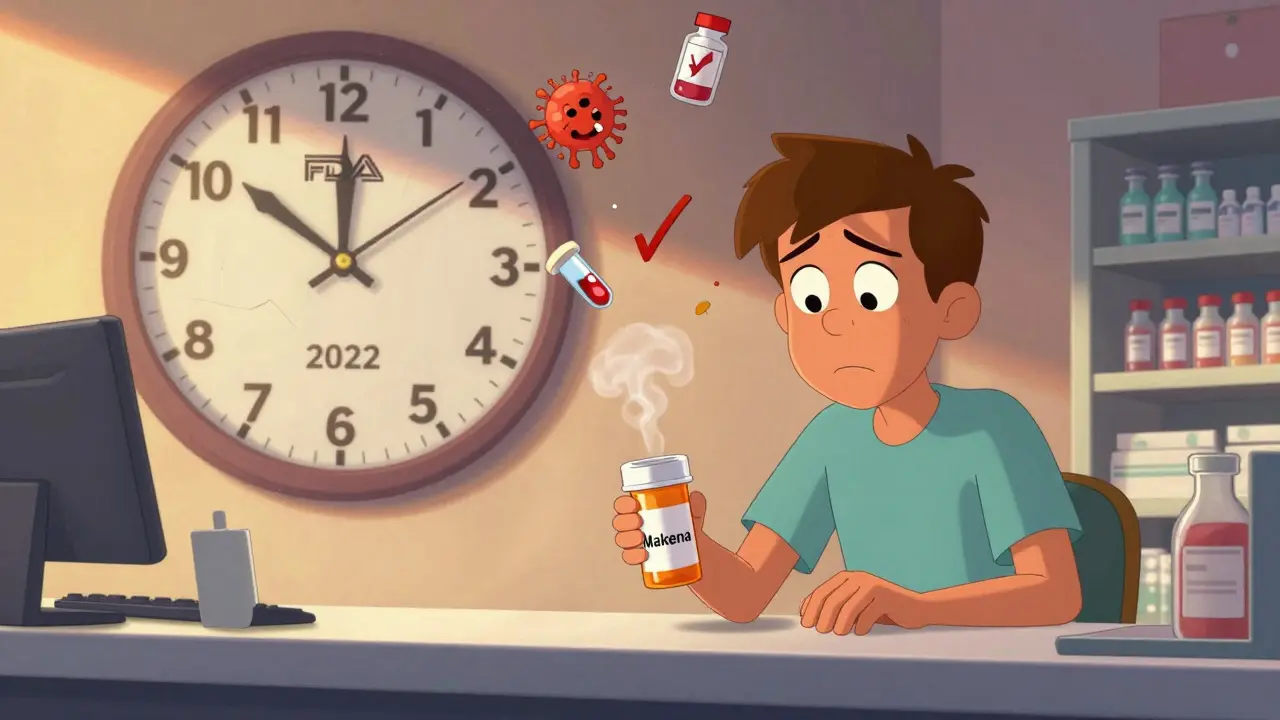
The FDA doesn’t approve drugs because they’re perfect. It approves them because, at the time, the benefits seem to outweigh the risks. For life-threatening illnesses like cancer or ALS, that bar is lower. That’s where accelerated approval comes in. Instead of waiting years for proof that a drug extends life or improves quality of life, the FDA lets companies use a surrogate endpoint - like tumor shrinkage or a blood marker - as a stand-in for real-world benefit. It’s a fast track. But fast tracks need brakes. And for decades, the brakes were broken. Take Makena, a drug approved in 2011 to prevent preterm birth in women with a history of early delivery. The approval was based on a small study showing it reduced preterm births. But a much larger, more rigorous trial in 2020 proved it didn’t work. The FDA didn’t pull it until 2022 - over two years after the evidence was clear. During that time, an estimated 150,000 women received a drug that offered no benefit. This wasn’t an accident. It was the system working as designed - poorly.The Old System: Years of Waiting After the Evidence Was In
Before 2023, the FDA had no clear timeline for pulling drugs. Once a drug was approved, even under accelerated terms, the agency had to wait for the sponsor to complete a post-approval study. Then, if the study failed, the FDA had to review the data, notify the company, give them time to respond, hold meetings, and sometimes even convene an advisory committee. The whole process took an average of 46 months - nearly four years. That’s longer than the time it takes to get a PhD. And during that time, doctors kept prescribing. Patients kept taking. And the data kept piling up: a 2023 study from Penn LDI found that 26% of patients eligible for these drugs received them even after the confirmatory trial failed. In small cell lung cancer cases, that number jumped to 41%. One patient, diagnosed with metastatic breast cancer, wrote on a patient forum in 2022: “I was on [withdrawn drug] for 18 months before the trial failed. My oncologist said it was standard of care. Now we know it didn’t help.” That’s the human cost of a slow system.The 2023 Fix: A New Way to Pull Dangerous or Useless Drugs
In December 2023, Congress passed the Consolidated Appropriations Act - and with it, a major overhaul of how the FDA handles drug withdrawals. For the first time, the agency got clear authority to move quickly when drugs fail to deliver. Under the new rules, the FDA can start withdrawal proceedings if:- The drug sponsor doesn’t conduct required post-approval studies on time
- The confirmatory study doesn’t prove the drug works
- Real-world data or independent studies show the drug is unsafe or ineffective
- The company promotes the drug with false or misleading claims
Voluntary vs. Mandatory: Who Pulls the Plug?
Not all withdrawals are forced. Sometimes, companies pull their own drugs. This is called a voluntary withdrawal. It can happen for many reasons - declining sales, manufacturing issues, or even a change in business strategy. But the FDA only considers a drug “withdrawn from sale” if the reason is safety or effectiveness. A temporary stockout? Not a withdrawal. A recall because of a bad batch? Not a withdrawal. But if the drug is pulled because it doesn’t work - or causes unexpected harm - that’s a withdrawal, no matter who initiates it. The key difference? Voluntary withdrawals don’t trigger the same public notices or Orange Book updates as mandatory ones. That’s why pharmacists and doctors still get confused. A 2022 survey found 63% of pharmacists struggled to interpret the Orange Book’s withdrawal listings - the official federal list of drugs pulled for safety or effectiveness reasons.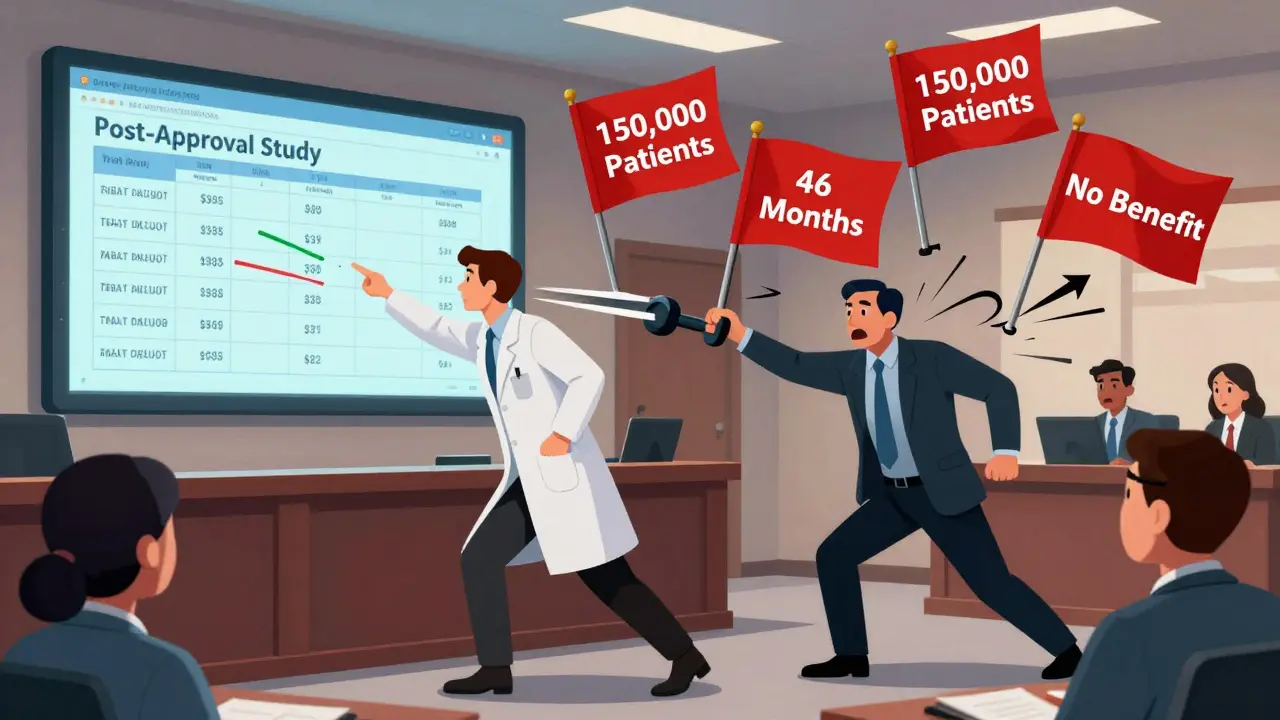
Who’s Affected - and How?
The biggest impact? Cancer patients. Oncology drugs make up 40% of all accelerated approvals. And they’re also the most likely to be withdrawn. About 26% of accelerated approval cancer drugs have been pulled since 2010. That’s nearly one in four. Patients don’t always know. Many are told their treatment is “standard of care.” They trust their doctors. They don’t check the FDA’s website. And even if they did, the information isn’t always easy to find. Doctors face their own challenges. When a drug is withdrawn, they have to switch patients - fast. A 2023 ASCO guide found oncology clinics needed an average of 72 hours to develop new treatment plans. For someone with aggressive cancer, those 72 hours matter. And then there’s the emotional toll. Reddit threads like “How many of you have been on drugs later withdrawn?” have hundreds of comments. Most express anger - not at the drug, but at the system that let them take it for years.How the U.S. Compares to the Rest of the World
The U.S. isn’t alone in pulling drugs. The European Medicines Agency (EMA) and Health Canada have long used conditional approval - where drugs are approved with strict conditions, and failure to meet them means automatic withdrawal. The FDA didn’t have that power. It relied on Postmarketing Required (PMR) studies, which were slow and rarely enforced. The 2023 law changed that. Now, the FDA is borrowing from the EMA’s playbook. It’s not perfect, but it’s closer to international standards. The big difference? Speed. In Europe, if a drug fails its confirmatory trial, it’s often pulled within months. In the U.S., it used to take years. Now, it’s moving faster - but only for drugs approved after 2023. The old ones? They’re still stuck in the slow lane.What’s Next? Real-World Data and Faster Decisions
The FDA is now testing a new system using real-world data from Flatiron Health - a database of electronic health records from cancer clinics across the U.S. Instead of waiting for a formal clinical trial, regulators can now look at how drugs are performing in the real world. If a drug shows no benefit in thousands of real patients, the FDA can act - without waiting for a sponsor’s study. This could cut withdrawal times even further. The goal? Reduce the average withdrawal time from 46 months to under 12. Commissioner Robert Califf says it’s possible. And with 12 dedicated scientists now working on withdrawal cases, they’re trying.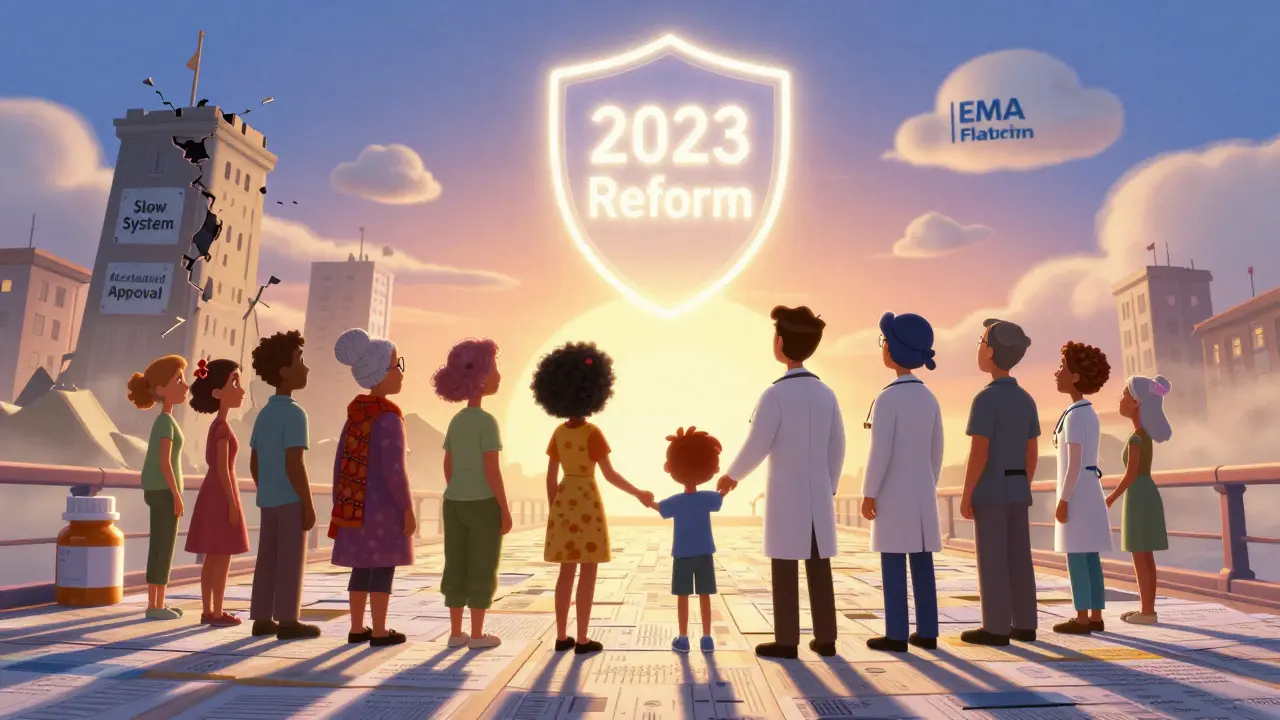
The Big Risk: Too Fast, Too Harsh?
Not everyone is cheering. Pharmaceutical companies warn that faster withdrawals could scare off innovation. If a drug for a rare disease is pulled too quickly, will companies still invest in developing it? That’s a real concern. But the data suggests the opposite. The drugs being pulled aren’t breakthrough cures. They’re drugs that were approved on weak evidence, then failed when tested properly. The system didn’t need to be more lenient - it needed to be smarter. The real danger isn’t removing ineffective drugs. It’s letting them stay on the market for years while patients suffer side effects for no benefit.What You Should Know If You’re Taking a New Drug
If you’re prescribed a new cancer drug, ALS treatment, or any medication approved under accelerated approval:- Ask: “Is this approved under accelerated approval?”
- Ask: “What’s the confirmatory study? When will results be available?”
- Ask: “Will I be notified if this drug is pulled?”


This is wild. I had no idea drugs could stay on the market for years after being proven useless. My aunt was on one of these for 2 years before they pulled it. She lost so much time and money. Why the hell did it take so long?
Someone needs to make a public tracker for this stuff. Like a Reddit-style dashboard where you can see what drugs are flagged and why.
Let me get this straight. The FDA approved a drug based on tumor shrinkage - not survival, not quality of life - and then waited nearly a decade to pull it? That’s not regulation. That’s negligence dressed up as bureaucracy.
And yet, somehow, we’re still surprised when pharmaceutical companies profit off human suffering. The system isn’t broken - it’s working exactly as intended for someone.
Big Pharma owns the FDA. Always has. They pay the regulators, they write the guidelines, they silence the whistleblowers. You think this is about safety? Nah. It’s about stock prices.
They let 150,000 women take Makena because the shareholders wanted quarterly profits. Now they’re pretending they fixed it? Wake up. This is all theater. The same people are still in charge.
Real-world data is the future. Flatiron Health is already showing us what’s happening out there - not in some controlled trial bubble, but in real clinics with real people.
We need to stop pretending RCTs are the only truth. If thousands of patients aren’t benefiting, that’s data too. The system’s finally catching up to reality. Long overdue.
People are so naive. They think the FDA is there to protect them. HA! The FDA is a revolving door for Big Pharma execs. They get a PhD, work for a drug company, then get hired by the FDA to approve the same drugs they helped design. Then they retire and go back to the company with a bonus.
And you wonder why people are sick? It’s not the medicine. It’s the people. The system is corrupt. End of story.
Let’s be precise: the issue isn’t just the withdrawal timeline - it’s the lack of mandatory post-market surveillance infrastructure. The FDA didn’t fail because of slow processes - they failed because they never had a functional system to monitor real-world outcomes in the first place.
And now, suddenly, they’re ‘borrowing from the EMA’s playbook’? They should’ve done this 20 years ago. The delay isn’t an oversight - it’s institutional incompetence.
They’re gonna pull every drug now. You wait. First it’s cancer meds, then it’s blood pressure pills, then your antidepressants. Next thing you know, your insulin gets pulled because some study says ‘no statistically significant improvement in HbA1c over 18 months.’
They don’t care about you. They care about lawsuits. You’re just a number in their risk assessment spreadsheet. And soon, you won’t even have the placebo to hold onto.
I’m so glad we’re finally fixing this. I used to work in oncology and saw patients cry because their ‘miracle drug’ got pulled after 14 months. They felt betrayed. Like their hope was a mistake.
We need better communication. Doctors need training. Patients need plain-language alerts. This isn’t just about policy - it’s about dignity. Let’s make sure no one else feels that way.
Back home in India, we don’t have the luxury of accelerated approval - we have the luxury of nothing at all. People wait years just to get a generic version of a drug that’s been around for decades. Meanwhile, in the U.S., they approve something based on tumor shrinkage and then wait five years to pull it.
It’s not about speed. It’s about priorities. We need drugs. You need truth. Both matter. But one of you has the money. The other has the pain.
The 2023 law is a step in the right direction but don’t get it twisted - this isn’t reform. It’s damage control. The FDA was forced to act because of public outrage, not because they suddenly got ethics.
They still don’t require transparency in surrogate endpoints. They still let companies cherry-pick data. The fix is real but shallow. We need structural change, not procedural tweaks.
My mom’s on a drug that got pulled last year. We found out because her pharmacy called. Not her doctor. Not the FDA. The pharmacy.
That’s the problem. This stuff should be automatic. Like a recall notice on your phone. If your medicine’s unsafe, you should get a text. Not a letter. Not a blog post. A text.
Let’s be clear: the entire U.S. healthcare system is a capitalist farce. The idea that profit-driven corporations should be trusted to self-regulate the safety of life-saving drugs is not just flawed - it’s morally indefensible.
And now we’re patting ourselves on the back because they cut the withdrawal time from 46 months to 180 days? That’s not progress. That’s a 1% improvement on a system that should never have existed in the first place.
I read this whole thing and just cried. I was on one of these drugs for 11 months. My oncologist said it was the best option. I trusted him. I didn’t know to ask about accelerated approval.
Now I know. And I’m scared for everyone else who doesn’t.
It’s laughable that we’re treating this as a regulatory failure. It’s a philosophical failure. We’ve elevated pharmaceutical innovation to the status of religion - and now we’re shocked when the priests turn out to be frauds.
Stop worshipping the pill. Start questioning the altar.