
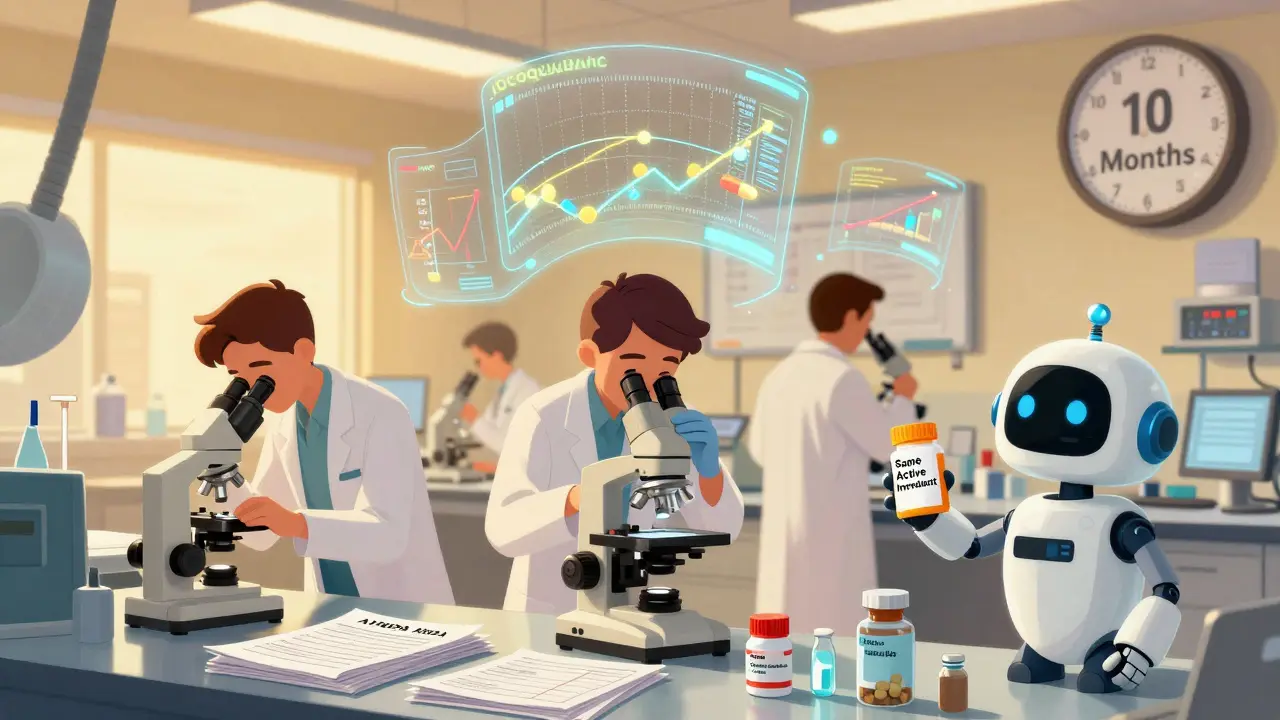
The U.S. Food and Drug Administration (FDA) doesn’t just approve brand-name drugs. In fact, nearly 90% of all prescriptions filled in the U.S. are for generic drugs. Behind this massive system is the FDA Office of Generic Drugs (OGD) - a specialized unit within the Center for Drug Evaluation and Research (CDER) that makes sure these affordable medications are safe, effective, and available when patients need them.
What the FDA Office of Generic Drugs Actually Does
Most people don’t realize that a generic drug isn’t just a copy. It has to meet the exact same standards as the brand-name version: same active ingredient, same strength, same dosage form, same way it’s taken. But proving that takes science, data, and a rigorous review process. That’s where OGD comes in.
OGD reviews thousands of applications every year - specifically, Abbreviated New Drug Applications (ANDAs). These are the forms generic drug makers submit to prove their product works just like the brand-name drug. OGD doesn’t just check paperwork. They evaluate bioequivalence studies, manufacturing quality, labeling accuracy, and even potential safety risks. If a generic drug doesn’t meet the bar, it doesn’t get approved.
OGD also handles patent and exclusivity issues under the Hatch-Waxman Act. This 1984 law created the modern generic drug system. It lets generic companies challenge patents or wait for exclusivity periods to expire before entering the market. OGD tracks these legal timelines, decides when a generic can launch, and ensures no one cuts corners to get ahead.
How OGD Is Structured: Five Key Divisions
OGD isn’t a small team tucked away in a corner. It’s a full-scale operation with five specialized offices, all reporting up through the Immediate Office, which sets strategy and coordinates everything.
- Office of Bioequivalence (OB): This group decides whether a generic drug behaves the same way in the body as the brand version. They review clinical data from studies where volunteers take both drugs and measure how much enters the bloodstream. If the levels are within strict limits, the drugs are considered bioequivalent. Led by John Peters, OB includes the OGD Safety and Surveillance Team that monitors adverse events after approval.
- Office of Generic Drug Policy: This office interprets the law. They handle complex questions about patent certifications, exclusivity periods, and how the Hatch-Waxman Act applies to new situations. Their work directly affects when a generic drug can hit the market.
- Office of Regulatory Operations (ORO): This is the engine room. ORO houses the Regulatory Project Managers (RPMs) who oversee every ANDA review from start to finish. They assign reviewers, track deadlines, and make sure OGD meets its GDUFA goals. They also handle labeling reviews and filing checks to ensure applications are complete before they’re even reviewed.
- Office of Research and Standards (ORS): This team develops the scientific standards for generic drugs. They design new testing methods, model how drugs behave in different populations, and study how manufacturing changes might affect performance. Led by Rob Lionberger, ORS helps OGD stay ahead of emerging science.
- Office of Safety and Clinical Evaluation: This group works closely with CDER’s safety teams to review post-market reports. If a generic drug shows unexpected side effects, they investigate whether it’s a manufacturing issue, a formulation problem, or something else.
Plus, the Immediate Office includes the Division of Legal and Regulatory Support - the legal experts who advise on Hatch-Waxman compliance - and the Global Generic Drug Affairs Team, which works with regulators in Europe, Canada, India, and beyond to align standards and avoid delays caused by conflicting international rules.
How GDUFA Keeps the System Running
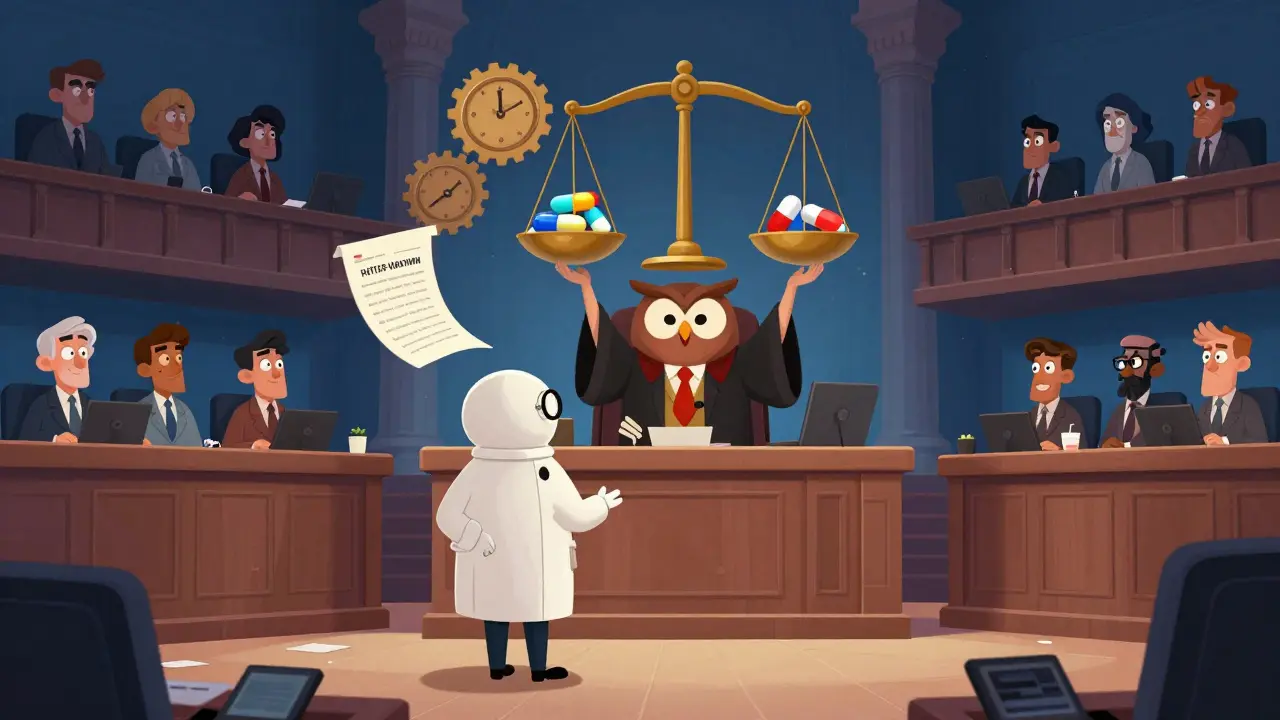
Before 2012, the FDA’s generic drug review process was slow. Backlogs grew. Patients waited longer for affordable medicines. To fix this, Congress passed the Generic Drug User Fee Amendments (GDUFA) in 2012.
Under GDUFA, generic drug manufacturers pay fees to fund the review process. That money pays for more staff, better technology, and faster timelines. OGD is responsible for using those funds efficiently. GDUFA sets clear goals: for example, 90% of first-time ANDAs must be reviewed within 10 months. OGD tracks performance against these targets publicly.
Since GDUFA began, the average time to approve a generic drug dropped from over 30 months to under 12. That’s not just a number - it means thousands more patients get access to cheaper meds every year.
Why OGD Matters to You
Think about your last prescription. If it was a generic - and chances are it was - OGD played a role in getting it to you. They didn’t invent the drug, but they made sure it worked just as well as the brand-name version at a fraction of the cost.
OGD also steps in during drug shortages. If a brand-name drug runs out and a generic is the only alternative, OGD fast-tracks its review. They’ve approved emergency generics for insulin, antibiotics, and cancer drugs during critical shortages.
And they don’t just approve drugs - they help shape how they’re made. OGD’s research has led to better testing methods for complex generics like inhalers and injectables, which used to be harder to replicate. Today, even those drugs are being approved faster and with more confidence.
Global Influence and Public Trust
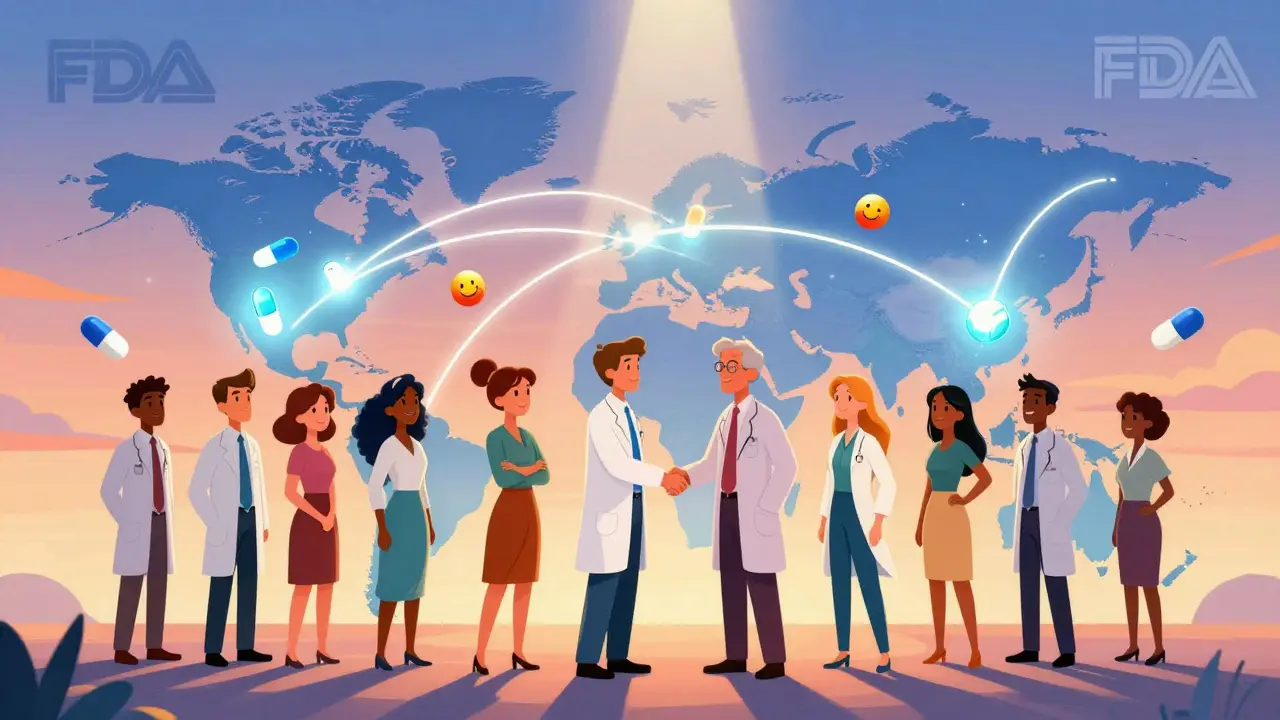
OGD doesn’t work in isolation. Its standards are used as a model by regulatory agencies around the world. When India or Brazil approves a generic drug, they often look to OGD’s guidance. The Global Generic Drug Affairs Team helps coordinate this alignment, reducing duplication and speeding up global access.
Public trust is critical. People need to believe that a $5 generic pill works just like a $50 brand-name one. OGD’s transparency - publishing review decisions, explaining scientific rationale, and holding industry accountable - helps maintain that trust.
Every time a patient chooses a generic, they’re saving money. OGD makes sure that choice isn’t a compromise on safety or effectiveness.
What is the difference between a brand-name drug and a generic drug?
A brand-name drug is the original version developed by a pharmaceutical company and protected by patents. A generic drug contains the same active ingredient, in the same strength and dosage form, and works the same way in the body. The only differences are in inactive ingredients (like fillers or dyes) and packaging. Generics are not cheaper because they’re lower quality - they’re cheaper because their manufacturers didn’t pay for the original research and development.
How long does it take for the FDA to approve a generic drug?
Under GDUFA goals, the FDA aims to review and approve 90% of standard Abbreviated New Drug Applications (ANDAs) within 10 months of submission. Complex applications, like those for injectables or inhalers, may take longer - up to 18 months. First generics (the first to challenge a patent) often get priority review and are processed faster to increase competition.
Can a generic drug be less effective than the brand-name version?
No. To be approved, a generic drug must prove it’s bioequivalent - meaning it delivers the same amount of active ingredient into the bloodstream at the same rate as the brand-name drug. The FDA allows only a small range of variation (usually 80-125% of the brand’s levels). Thousands of studies and real-world use have shown that generics perform just as reliably as brand-name drugs.
What is the Hatch-Waxman Act and why does it matter for generics?
The Hatch-Waxman Act of 1984 created the legal framework for generic drug approval in the U.S. It balances two goals: protecting innovation by granting brand-name companies patent exclusivity, and encouraging competition by letting generic manufacturers challenge those patents or wait for exclusivity to expire. It also created the ANDA pathway, which lets generics skip expensive clinical trials by proving bioequivalence instead. OGD is the office that interprets and enforces this law.
Does the FDA inspect generic drug manufacturing plants?
Yes. All manufacturing facilities - whether for brand-name or generic drugs - are subject to FDA inspections. OGD works with the FDA’s Office of Regulatory Affairs to prioritize inspections based on risk. Plants producing complex generics or those with past compliance issues are inspected more frequently. The FDA has inspected over 1,000 generic drug manufacturing sites globally each year in recent years.
How does OGD handle drug shortages?
When a brand-name drug faces a shortage, OGD identifies any approved generics that could fill the gap. If none exist, they fast-track the review of pending ANDAs for that drug. They also work with manufacturers to resolve supply chain issues and may issue temporary approvals for overseas facilities if needed. In 2024 alone, OGD helped expedite over 80 generic approvals to address critical shortages in antibiotics, cancer drugs, and anesthetics.
Final Thoughts: The Quiet Force Behind Affordable Medicine
OGD doesn’t make headlines. But without it, millions of Americans would pay far more for essential medications. It’s a complex, science-driven machine that balances regulation, innovation, and public health. From the bioequivalence lab to the legal desk handling patent disputes, every part of OGD plays a role in keeping generics safe, effective, and accessible.
Next time you pick up a generic prescription, remember: someone at the FDA made sure it was just as good as the brand - and you didn’t have to pay extra for it.
wow i had no idea the FDA had a whole office just for generics. i always thought they just stamped 'approved' and called it a day. this is actually kinda cool.
also, i just realized my $3 insulin is probably thanks to these folks. thanks, o.g.d. 🙏
this is the kind of behind-the-scenes gov work that actually saves lives.
people complain about bureaucracy but when you need a $5 generic instead of a $150 brand-name, you’re gonna be glad someone checked the bioequivalence data.
OGD = unsung heroes. 🥳
the Hatch-Waxman Act is the real MVP here. Without that legal scaffolding, we’d be stuck in a patent-troll purgatory where generics couldn’t even get a foot in the door. OGD doesn’t just review pills-they mediate between capitalism and public health.
Also, the fact that they’re harmonizing standards globally? That’s next-level regulatory diplomacy. India’s generic exports? They’re basically OGD’s shadow army.
as someone who’s watched a family member struggle with drug costs, this means more than you know.
OGD’s work isn’t glamorous, but it’s the quiet reason my mom can afford her blood pressure med.
we need more systems like this-science-based, transparent, patient-first.
and yes, i cried reading the part about insulin shortages. 🫂
let’s be honest-this whole system is a performative illusion.
bioequivalence thresholds? 80-125%? That’s a 45% swing. In pharmacology, that’s not equivalence-that’s a gamble.
And don’t get me started on overseas manufacturing. You think a plant in Hyderabad is held to the same standard as a U.S. facility? Please.
It’s cheaper, yes. But ‘safe’? That’s a narrative.
generic drugs are just as good. period.
so you’re telling me the FDA approves a drug that might be 20% less effective and calls it ‘bioequivalent’?
bruh.
next they’ll say ‘close enough’ is a valid clinical endpoint.
why not just call it ‘budget medicine’ and stop pretending it’s the same?
this is why i hate America.
we let a bunch of bureaucrats decide what’s ‘good enough’ for people who can’t afford the real thing.
if you can’t pay $500 for a drug, you deserve the cheap version? That’s not healthcare. That’s rationing with a smile.
and don’t give me that ‘it’s the same active ingredient’ crap. My body knows the difference.
there’s a quiet dignity in this system.
it doesn’t shout. It doesn’t need applause. It just ensures that when a child needs antibiotics, or an elderly person needs insulin, they don’t have to choose between medicine and rent.
OGD is the quiet hum beneath the noise of healthcare politics.
we should all be grateful-and silent about it, because gratitude doesn’t need to be performative.
i’m literally tearing up.
this is the stuff that keeps families together.
my dad’s cancer med? Generic. Saved us $2k/month.
OGD didn’t just approve a pill-they gave him more time with us.
thank you to every scientist, reviewer, and legal advisor in that office. 🤍❤️🫶
the notion that foreign manufacturing facilities meet U.S. standards is misleading.
the FDA inspects over 1,000 sites annually? That’s statistically impossible without compromising rigor.
the system is fundamentally compromised by global outsourcing.
we are not safe. We are merely convenient.
you know what’s really ironic? All these people talking about how great generics are, but if you look at the actual data-over 70% of drug recalls in the last decade originated from overseas generic manufacturers.
and don’t even get me started on the fact that the FDA’s inspection rate is less than 2% of facilities per year.
they’re not keeping up. They’re just pretending.
and now you want me to believe that a pill made in a factory with no running water is bioequivalent?
the entire system is a house of cards built on optimism and taxpayer money.
and you people are just happy you got your $3 statin.
pathetic.