
Medication Safety Checker
Your Medical Conditions
Medications
Safety Check Results
Every time you pick up a prescription or grab a bottle of over-the-counter medicine, you’re holding a legal document that could save your life-or hurt you if you don’t understand it. The tiny print on the label isn’t just filler. It’s the FDA’s way of telling you exactly when not to take a drug, what could go wrong, and how to stay safe. But most people skip it. They see a wall of text and assume it’s for doctors only. That’s a mistake.
What Contraindications Really Mean
Contraindications aren’t suggestions. They’re red lights. If your drug’s label says contraindicated for a condition, it means: do not use this drug if you have this. There’s no gray area. The FDA requires these to be based on hard evidence-clinical trials, post-market reports, or long-standing medical knowledge. It’s not guesswork.
For example, the blood thinner rivaroxaban (Xarelto) has a clear contraindication: patients with active pathological bleeding. If you’re currently bleeding from a stomach ulcer or just had brain surgery, taking this drug could kill you. That’s why the label says it plainly. No sugarcoating.
Look for Section 4 in your prescription label. That’s where contraindications live. It might say things like:
- “Contraindicated in patients with known hypersensitivity to any component of the product”
- “Not for use in severe hepatic impairment”
- “Avoid in pregnancy”
These aren’t vague. They’re specific. If your doctor prescribes a drug with a contraindication that matches your health history, ask: Why are you still recommending this? Sometimes, the risk is worth it-but you need to know why.
Boxed Warnings: The FDA’s Most Serious Alert
Before you even get to Section 4, look at the very top of the prescription label. There’s a black rectangle. That’s the boxed warning-formerly called a black box warning. This is the FDA’s highest level of safety alert. It’s reserved for risks that can cause death or serious injury.
Warfarin (Coumadin) has one: “Risk of major or fatal bleeding.” Bupropion (Wellbutrin) has one: “Increased risk of suicidal thoughts in young adults.” These aren’t rare. About 40% of new drugs approved between 2008 and 2012 got a boxed warning within five years of hitting the market.
Here’s the key: Boxed warnings override everything else. If a drug has one, it means the risk is serious enough that even if you don’t think you’re at risk, you still need to pay attention. Doctors rely on these. If your doctor ignores a boxed warning, get a second opinion.
Warnings and Precautions: The Fine Print That Matters
Section 5 is where things get more complicated. This is called “Warnings and Precautions.” Unlike contraindications, these aren’t absolute “don’ts.” They’re “be careful.”
Take adalimumab (Humira), used for rheumatoid arthritis. Its label says: “Serious infections including sepsis, tuberculosis, and invasive fungal infections have occurred.” That doesn’t mean you can’t take it. But it means you need to be monitored. Your doctor should check for TB before you start. You should report any fever, night sweats, or unexplained weight loss right away.
These warnings are ordered by severity. The most dangerous risks come first. So if you see “risk of liver failure” near the top, that’s more urgent than “may cause mild headache.”
Also watch for phrases like:
- “Use with caution in patients with…”
- “Monitor liver function monthly”
- “Discontinue if…”
These aren’t just reminders. They’re instructions. Skipping a monitoring step because you “feel fine” could lead to irreversible damage.
OTC Labels Are Different-But Just as Important
Over-the-counter drugs don’t have sections. They have a Drug Facts label. It’s simpler, but the information is just as critical.
Look for the “Warnings” section. Here’s what to scan for:
- “Do not use” - This is the OTC version of a contraindication. If you have asthma and the label says “Do not use if you have asthma,” don’t use it.
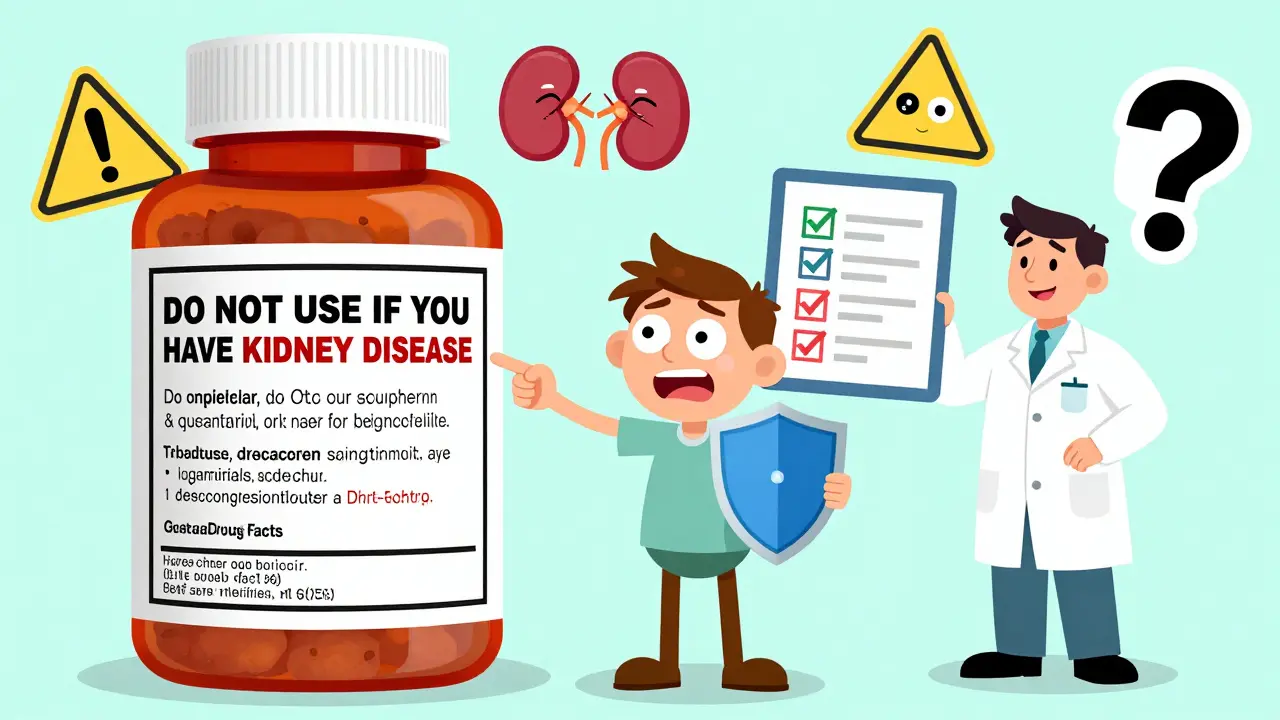
- “Ask a doctor before use if…” - This is a precaution. Maybe you have high blood pressure, kidney disease, or are pregnant. The label is telling you to check in first.
- “Stop use and ask a doctor if…” - This tells you when to stop taking it. If you get a rash, dizziness, or stomach pain, don’t push through it.
A 2022 FDA study found only 52% of people could correctly identify absolute contraindications on OTC labels without help. That’s alarming. A common mistake? Taking painkillers like ibuprofen if you have kidney disease. The label says “do not use if you have kidney disease.” But many people think, “I feel fine, so it’s probably okay.” It’s not.
How to Actually Use This Information
Reading the label isn’t enough. You need to act on it. Here’s how:
- Always read the label before taking any new medication-even if you’ve taken it before. Labels change.
- Start with the boxed warning. If there’s one, read it twice.
- Check contraindications. Does any of your medical history match? If yes, ask your doctor or pharmacist why they’re still prescribing it.
- Scan Warnings and Precautions. Look for things you need to monitor or avoid.
- Write down questions. Before your next appointment, write: “What are the long-term risks? How likely are they? What should I watch for?”
One patient on Reddit shared how they were prescribed amiodarone for heart rhythm issues. They had mild lung disease. The pharmacist refused to fill it because the label said “contraindicated in severe pulmonary disease.” The patient’s cardiologist explained: “Mild is not severe. I’m monitoring you closely.” The patient got the medication and stayed safe-because they asked.
Why This Matters More Than You Think
The Institute of Medicine estimates that poor drug labeling contributes to 1.3 million injuries in the U.S. every year. That’s not a small number. It’s not rare. It’s systemic.
Doctors don’t always have time to explain every warning. Pharmacists are rushed. Patients are overwhelmed. But the label is your last line of defense. It’s the only document that’s legally required to tell you the truth about risk.
And here’s something most people don’t know: drug labels are updated constantly. The FDA’s Sentinel Initiative tracks real-world data from millions of patients. If a new risk shows up-say, a drug causes sudden liver failure in people over 70-the label gets updated within 30 days. That means the label you read last month might be outdated now.
Always check the date on the label. If it’s more than a year old, ask your pharmacist for the latest version.
What’s Changing in Drug Labels (And Why You Should Care)
The FDA is trying to fix this. In 2024, they made a big change: every new drug must now include a “Highlights of Prescribing Information” section. This is a one-page summary at the front of the label, with bolded contraindications and boxed warnings. It’s designed to be read in under 30 seconds.
They’re also testing color-coded risk levels-red for high, yellow for moderate, green for low. And they’re starting to include numbers: “Increases risk of heart attack by 1.8 times in patients over 65.” Numbers stick better than words like “may increase risk.”
But until these changes are universal, you still need to read the full label. Don’t wait for the FDA to make it easier. Do it yourself.
When to Walk Away
There are times when the label tells you to stop. If:
- Your doctor prescribes a drug with a contraindication that applies to you-and they can’t explain why,
- You develop a new symptom and the label says “discontinue if…” and you ignore it,
- You’re told “it’s fine” but the label says “do not use,”
-then it’s time to get a second opinion. Your life isn’t a gamble. The label is there to protect you. Use it.
What’s the difference between a contraindication and a warning?
A contraindication means you should not take the drug at all under certain conditions-like having active bleeding or a known allergy. A warning means you can take it, but you need to be careful. Warnings tell you to monitor for side effects, adjust your dose, or avoid other drugs. Contraindications are absolute; warnings are conditional.
Why do some drugs have boxed warnings and others don’t?
Boxed warnings are only added when the FDA determines a drug carries a risk of death or serious injury that’s significant enough to require the strongest possible alert. It’s not about how common the side effect is-it’s about how severe. For example, a drug that causes mild nausea won’t get one, but a drug that can trigger fatal liver failure will-even if it only happens in 1 out of 1,000 patients.
Can I still take a drug if I have a listed contraindication?
Only under very rare circumstances and with expert supervision. Sometimes, a doctor may decide the benefit outweighs the risk-for example, if no other treatment works. But this is never done lightly. If your doctor prescribes a drug with a contraindication that applies to you, ask for the reasoning in writing. Never assume it’s safe just because your doctor said so.
How often are drug labels updated?
Drug labels are updated whenever new safety data emerges. The FDA requires manufacturers to update labels within 30 days of new evidence showing serious risks. Between 2020 and 2023, over 147 label changes were made based on real-world patient data. Always check the date on your label-older versions may not include critical updates.
Are OTC drug labels as reliable as prescription ones?
Yes. OTC labels are regulated by the FDA under the same strict standards as prescription labels. The format is different-they use “Drug Facts” instead of sections-but the rules for contraindications and warnings are just as rigorous. The problem isn’t reliability-it’s readability. Many people don’t read them, which is why so many avoidable injuries happen.
Honestly I just scan the box warning and call it a day. If my doctor says it's okay I trust them. Life's too short to read every tiny line. 🤷♂️
I read the whole damn label. Every. Single. Word. Because if I don't, someone else's profit margin will be my funeral bill. 😤
The FDA's labeling paradigm is fundamentally flawed due to its reliance on categorical dichotomies-contraindications versus precautions-when pharmacokinetic interactions exist on a multidimensional risk spectrum requiring Bayesian risk stratification. You're not just reading labels; you're decoding pharmacovigilance ontologies.
I work in a pharmacy in rural Tennessee. I see people ignore the warnings every day. One guy took ibuprofen for his back pain even though he had stage 3 kidney disease. He ended up in the ER. The label didn't lie. People just don't want to hear it. I always point to the 'Do not use' part and say, 'This ain't a suggestion, sir.'
The FDA is a puppet of Big Pharma. Boxed warnings? Just PR theater. They want you to think they care while they let drugs with 37 documented deaths stay on the market because shareholders demand quarterly growth. 😒
You think it's just about reading labels? Nah. It's about the systemic collapse of medical literacy. We've been conditioned to outsource our health to strangers in white coats who don't have time to explain why they're prescribing you a drug that can turn your liver into a brick. The FDA updates labels because people die. People die because they trust. And trust? Trust is the opiate of the masses. 🌑💊
It is imperative, nay, non-negotiable, that every individual who ingests pharmaceutical agents-whether prescribed or over-the-counter-engages in a rigorous, disciplined, and conscientious review of all labeling documentation. This is not a suggestion; it is a moral and civic duty. The consequences of negligence are not merely medical-they are existential. Please, for the love of all that is holy, read the label. And if you cannot comprehend it? Seek guidance. Do not gamble with your life as if it were a lottery ticket.
I know someone who died because they didn't read the label. They took meloxicam for arthritis. Had a history of ulcers. The label said 'avoid in GI bleeding history.' They didn't read it. They thought, 'I'm fine.' They weren't. Now their family has to live with it. I don't care if you're busy. You have five minutes. Five. Minutes. To read a label. Your life is worth it.
In my village in Nigeria, we say: 'The hand that holds the bottle must also hold the mind.' This truth transcends borders. Whether you are in Lagos, LA, or Lusaka, the label is the silent guardian who speaks in ink, not in voice. To ignore it is to invite chaos into the temple of your body. Let no fear of complexity silence your curiosity. Learn. Ask. Read. Your ancestors did not survive plagues so you could ignore a paragraph written in 8-point font.