
Anesthesia Medication Safety Checker
Check Your Anesthesia Safety
Malignant hyperthermia is a rare but serious reaction to certain anesthesia drugs. This tool helps you understand which medications may pose risks based on your situation. Remember: This is not a medical diagnosis. Always discuss with your anesthesiologist before surgery.
Common Anesthesia Medications
Important Safety Information
Your results are based on general knowledge. Always discuss your specific medical situation with your anesthesiologist. Some patients with MH risk factors may still require certain medications with appropriate precautions.
Medication Safety Results
When you go in for surgery, you trust that the anesthesiologist has everything under control. But there’s a rare, silent threat lurking in some operating rooms - one that can turn a routine procedure into a life-or-death emergency within minutes. This is malignant hyperthermia (MH), a genetic condition triggered by common anesthesia drugs. It doesn’t affect most people. But if you have it, and no one knows, the results can be catastrophic.
What Exactly Is Malignant Hyperthermia?
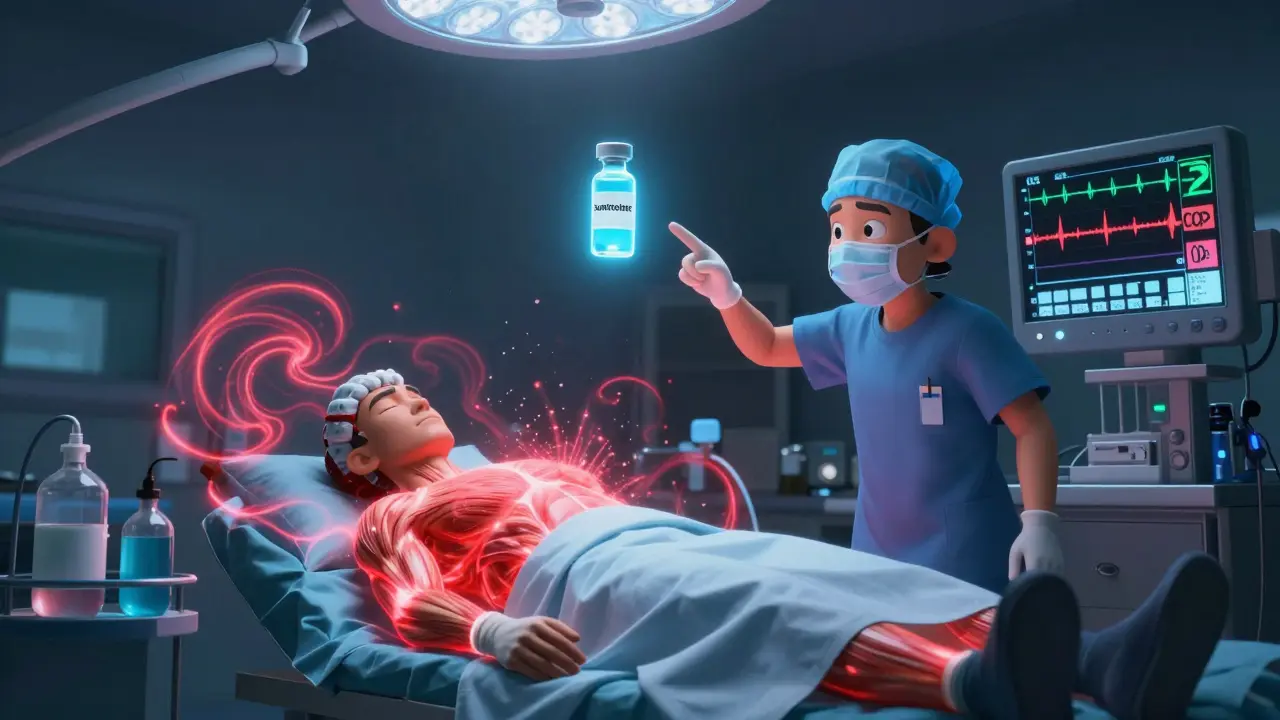
Malignant hyperthermia isn’t a fever or infection. It’s a genetic muscle disorder that flips a switch in your body when you’re exposed to certain anesthetics. The trigger? Volatile gases like sevoflurane, desflurane, or isoflurane - the very drugs used to keep you asleep during surgery. Or the muscle relaxant succinylcholine, often given to help insert the breathing tube.
When these drugs hit a susceptible person’s system, calcium floods out of muscle cells. Muscles lock up. Your body starts burning energy like a furnace. Oxygen gets sucked up. Carbon dioxide piles up. And your core temperature? It can spike from normal to over 109°F (43°C) in under an hour.
This isn’t theoretical. In the 1960s, four young patients in Australia died during routine surgeries with no clear cause. That’s when Dr. Denborough first linked it to anesthesia. Today, we know it’s tied to mutations in the RYR1 gene - found in about 70% of cases. Another 1% involve the CACNA1S gene. These aren’t rare mutations. About 1 in 2,000 people carry them. But most never know - until it’s too late.
How Do You Know It’s Happening?
Early signs are subtle. That’s why so many cases are missed. The first red flag? A sudden, unexplained rise in heart rate - over 120 beats per minute. Then, breathing gets faster. Not because you’re anxious. Because your muscles are screaming for oxygen.
Next comes the carbon dioxide spike. Anesthesia machines monitor end-tidal CO2 (ETCO2). If it climbs above 55 mmHg - especially when you’re breathing fine - that’s a major alarm. Then comes muscle rigidity. Not full-body stiffness. Often, just a locked jaw. That’s called masseter muscle rigidity. It’s one of the earliest and most specific signs. If a patient’s jaw won’t open after succinylcholine, stop everything. Don’t wait.
By now, the body is in full meltdown. Temperature shoots past 104°F. Blood tests show acidosis, potassium levels over 5.5 mEq/L, and creatine kinase (CK) above 10,000 U/L - a sign of muscle breakdown. Urine turns dark, like cola. That’s myoglobin from dying muscle cells. Kidneys start failing. Heart rhythm gets unstable. Without action, death follows fast.
And here’s the scary part: 29% of MH cases happen in people with no family history. No one warned them. No one tested them. They walked into surgery thinking they were fine.
The Lifesaving Drug: Dantrolene
There’s only one drug that stops malignant hyperthermia: dantrolene. It’s not a miracle cure. It’s a targeted muscle relaxant that blocks calcium release. Give it early, and survival jumps to nearly 100%. Delay it, and mortality soars.
The standard dose? 2.5 mg per kilogram of body weight, given straight into the vein. If symptoms don’t improve in 5-10 minutes, give another dose. Repeat up to 10 mg/kg total. That’s 700 mg for a 70 kg adult - or 28 vials of the old formulation.
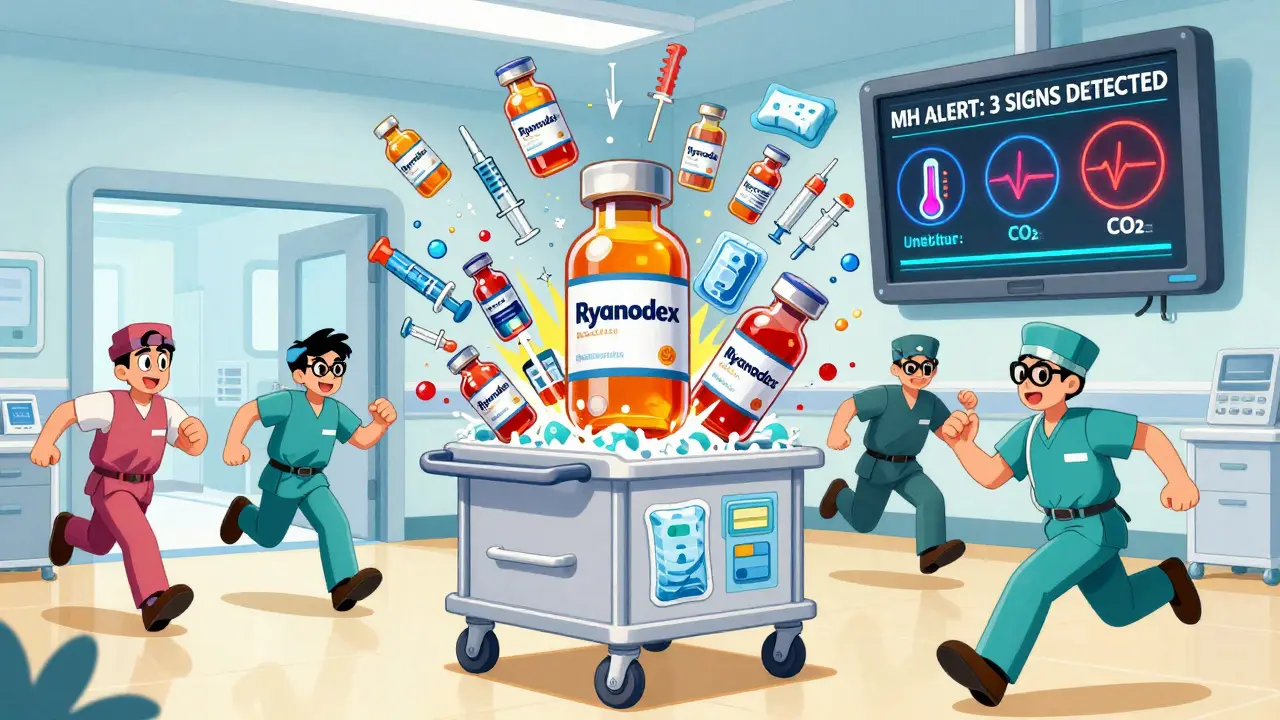
But here’s the game-changer: Ryanodex. Approved in 2014, this version of dantrolene dissolves in 1 minute. The old version, Dantrium, took 22 minutes to mix. In a crisis, those 21 minutes are a death sentence. Ryanodex is now the standard. Each vial costs about $4,000. A full MH cart - 36 vials - runs over $144,000. That’s why many hospitals don’t stock it.
But they should. The FDA mandated MH emergency kits in all facilities performing general anesthesia in 2021. Yet, only 63% of rural centers comply. Academic hospitals? Near 100%. Why? Because they’ve seen what happens when you’re unprepared.
What Happens After the Trigger?
Stopping the anesthetic is step one. But that’s not enough. You need to cool the patient. Ice packs on the neck, armpits, groin. Cold IV fluids. Maybe even a cardiopulmonary bypass machine if the temperature won’t drop.
You need to fix the chemistry. Sodium bicarbonate to reverse acidosis. Insulin and glucose to push potassium back into cells. Mannitol and furosemide to protect the kidneys from myoglobin damage. You need blood gas tests every 15 minutes. You need to monitor for arrhythmias. You need a team that knows what to do.
And you need to act fast. If dantrolene is given within 20 minutes of the first sign, survival is nearly guaranteed. Past 40 minutes? Mortality hits 50%. That’s why some hospitals now have MH carts - pre-loaded with dantrolene, syringes, sterile water, cooling packs - within 30 seconds of any operating room. Mayo Clinic cut response time from 22 minutes to under 5 minutes. Survival rates climbed.
Why So Many Cases Go Undetected
A MHAUS survey of 312 MH survivors found 68% had never heard of the condition before their own crisis. That’s not just ignorance. It’s systemic failure.
Pre-op screening is supposed to catch risk factors: family history of MH, unexplained anesthesia deaths, certain muscle diseases. But many patients don’t know their family history. Or they’re told it’s “not a big deal.” Some facilities skip the mandatory airway assessment that includes MH risk evaluation. In one case, a 28-year-old man had a perfectly normal history. Then, during induction, his ETCO2 hit 78 mmHg and his heart rate spiked to 142. The anesthesiologist recognized it immediately - because he’d trained for it.
Training matters. Anesthesiology residents need at least three simulation drills to reliably spot MH. Yet, many hospitals don’t do them annually, as required by the American Society of Anesthesiologists since 2018. Without practice, even experienced providers miss the signs.
What’s New in 2026?
The field is evolving fast. In 2023, the FDA approved a new intranasal form of dantrolene - meant for use before the patient even reaches the hospital. Expected to hit the market in mid-2024, it could save lives in ambulances or ERs.
Genetic testing is more accessible too. RYR1 screening costs $1,200-$2,500 and catches 95% of known mutations. If you’ve had a suspected MH reaction, or have a close relative who did, testing is recommended. Some people get tested before elective surgery.
And AI is stepping in. Epic Systems rolled out real-time MH detection in its 2024 anesthesia software. If three signs - high CO2, fast heart rate, rising temperature - appear together, the system flashes an alert. It doesn’t replace human judgment. But it gives a second pair of eyes.
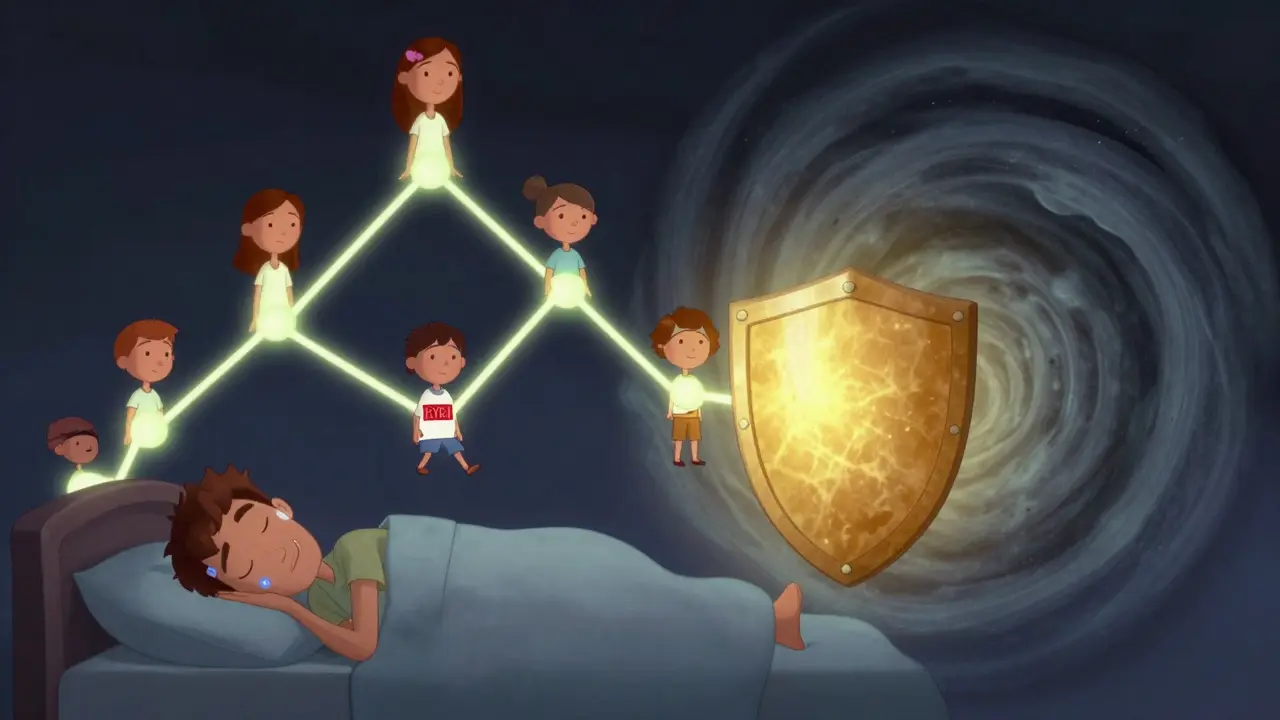
Long-term, gene editing may one day fix the root cause. CRISPR trials targeting RYR1 mutations are expected by 2027. But for now, dantrolene remains the only shield.
What You Can Do
If you’ve had a bad reaction to anesthesia - even if it wasn’t diagnosed as MH - tell your doctor. If a close family member died unexpectedly during surgery, ask about genetic testing. If you’re scheduled for surgery, ask: “Do you have dantrolene on hand? Is your team trained for MH?”
Hospitals that treat MH like a code blue - with drills, carts, and protocols - have near-zero deaths. Those that don’t? They’re gambling with lives.
You can’t control the drugs. But you can ask the questions. And sometimes, that’s enough to save your life.
Can malignant hyperthermia be inherited?
Yes. Malignant hyperthermia is inherited in an autosomal dominant pattern. If one parent carries a mutation in the RYR1 or CACNA1S gene, each child has a 50% chance of inheriting it. But not everyone with the gene will have a reaction - only when exposed to triggering anesthetics. Family history is a major red flag, but 29% of cases occur in people with no known family history.
What anesthetics trigger malignant hyperthermia?
The main triggers are volatile inhalational anesthetics like sevoflurane, desflurane, and isoflurane. The muscle relaxant succinylcholine is also a known trigger. Nitrous oxide and local anesthetics like lidocaine do not trigger MH. Many patients mistakenly believe all anesthesia is risky - but only these specific drugs pose a danger to susceptible individuals.
Is dantrolene safe to use repeatedly?
Yes, dantrolene is safe for repeated dosing during an MH crisis. The maximum recommended initial dose is 10 mg/kg, and additional doses can be given as needed. The main side effect is muscle weakness, which is expected and reversible. Liver toxicity is rare and typically only seen with long-term use, not during acute treatment. In an MH emergency, the benefits far outweigh the risks.
How long does dantrolene last in the body?
Dantrolene has a half-life of about 6-8 hours, but its effects on muscle calcium release can last longer. Because MH can recur 24-72 hours after the initial episode, patients must be monitored in an intensive care unit for at least 24 hours after symptoms resolve. Repeat doses may be needed during this window.
Can you have malignant hyperthermia without anesthesia?
No. Malignant hyperthermia only occurs in response to specific triggering agents used in general anesthesia. You cannot spontaneously develop MH without exposure to these drugs. However, some people with RYR1 mutations may experience heatstroke or exertional rhabdomyolysis under extreme conditions - which is a related but distinct condition.




What strikes me most about malignant hyperthermia isn’t just the biology - it’s the ethics of preparedness. We have the tools. We have the science. We have dantrolene. Yet hospitals still gamble because of cost. That’s not a medical failure - it’s a moral one. If your hospital doesn’t have a pre-loaded MH cart, they’re not just under-resourced - they’re negligent. And patients? They walk in trusting the system. That trust is being broken silently, one surgery at a time.
It’s not enough to say ‘it’s rare.’ Rare doesn’t mean harmless. It means when it hits, it hits like a freight train - and if you’re not ready, you’re not just unprepared - you’re complicit.
We don’t need more studies. We need mandates. We need audits. We need consequences for hospitals that skip the basics. This isn’t theoretical. It’s survival. And survival shouldn’t be a lottery.
Let’s stop calling it a ‘rare complication’ and start calling it what it is: a preventable death waiting to happen.
Man, this post hit different. I had no idea MH could sneak up like that - no family history, no warning. I’m a paramedic, and I’ve seen my fair share of chaos in the field, but this? This is the kind of thing that keeps me up at night.
That bit about Ryanodex? 21 minutes vs. 1 minute? That’s not just a tech upgrade - that’s a life-or-death race. Imagine being the anesthesiologist who’s got to mix 28 vials while the patient’s melting down. No wonder some places still use the old stuff. It’s not laziness - it’s bureaucracy. But that’s no excuse.
And the AI alert system? Finally, tech is helping instead of just billing. I hope every OR gets this soon. We need more eyes, not fewer.
Let’s be real - most people who ask about MH are either hypochondriacs or people who read too many medical blogs. The fact that 29% of cases occur without family history? That’s statistically insignificant. If you’re not a bodybuilder or have a relative who died during surgery, you’re not at risk.
And dantrolene? It’s expensive. Hospitals aren’t charities. If a patient can’t afford genetic testing, they shouldn’t get elective surgery. That’s just common sense. Why should taxpayers fund a 1-in-2,000 chance of disaster? We’ve got real problems - opioid crises, ER overcrowding - and now we’re spending $144,000 on a cart that might never be used?
It’s not negligence. It’s prioritization. And if you can’t handle that, maybe you shouldn’t be near an operating room.
im so glad someone finally talked about this. i had a cousin who almost died during a tonsillectomy when she was 12. they thought it was just a bad reaction, but now i think it was MH. she never got tested. i cried reading this. my mom says ‘we don’t talk about medical stuff’ but now i’m gonna push for testing. if u have surgery, ask about dantrolene. seriously. it could save u. i’m not a doctor but i know what i know. thanks for sharing this.
I’ve been an OR nurse for 18 years. I’ve seen MH once. It was terrifying. The team reacted perfectly - dantrolene on board, cooling packs ready, everyone knew their role. But I’ve also seen places where the cart was locked in storage because ‘no one’s ever needed it.’
It’s not about fear. It’s about respect. Respect for the patient. Respect for the job. Respect for the fact that one moment of preparation can mean the difference between a routine surgery and a funeral.
I don’t say this to scare anyone. I say it because I’ve held a patient’s hand while their temperature hit 108. And I will never forget the silence after the dantrolene kicked in.
Ask. Always ask.
As an Aussie, I’ve got to say - this whole thing started here. Dr. Denborough’s work in the ‘60s was groundbreaking. But we still don’t have a national registry for MH susceptibility. That’s crazy. We’ve got universal healthcare - why aren’t we tracking gene carriers? It’s not like it’s rocket science.
Also, the cost argument? I get it. But here, every public hospital has a full MH cart. No exceptions. Because we decided: one life lost is one too many. We can’t afford not to. Maybe the US needs to stop treating healthcare like a marketplace and start treating it like a public good.
Also - the intranasal dantrolene? That’s genius. If we can get it into ambulances, we could stop MH before it even hits the OR. That’s the future. And we’re not far off.
Blimey, this is proper sobering stuff. I had a mate’s brother die during a wisdom tooth extraction back in ‘09. They said it was ‘cardiac arrest’ - never mentioned MH. Now I wonder… was it? We’ve got so many silent killers in medicine.
Love the bit about AI alerts - feels like the system’s finally catching up. But honestly? The real hero here is the anesthesiologist who’s trained, alert, and trusts the numbers. Not the machine. Not the cart. *Them.*
And yeah - dantrolene’s expensive. But so’s a lawsuit, a funeral, and a family that never recovers. We need to stop being cheap and start being smart. Cheers for the post - made me rethink everything I thought I knew about ‘routine’ surgery. 🙏
Let me preface this by saying I am a board-certified anesthesiologist. I have personally managed two MH cases. Both survived. Why? Because our facility has a protocol, a cart, and mandatory quarterly simulations. We don’t wait for someone to die to act.
The FDA mandate in 2021 was a start - but enforcement is non-existent. No one audits. No one checks. Hospitals self-report. And guess what? They lie.
Genetic testing should be standard pre-op for elective procedures. Not because everyone has it - but because we can. And we should. It’s not a luxury. It’s due diligence.
And yes - dantrolene is safe. Repeated dosing? Absolutely. Liver toxicity? Rare. The risk of not giving it? Death. The math is simple.
If you’re reading this and you’re scheduled for surgery - ask your anesthesiologist if they’ve ever treated MH. If they say ‘no,’ ask why not. If they hesitate - walk out. Your life is worth more than their convenience.