
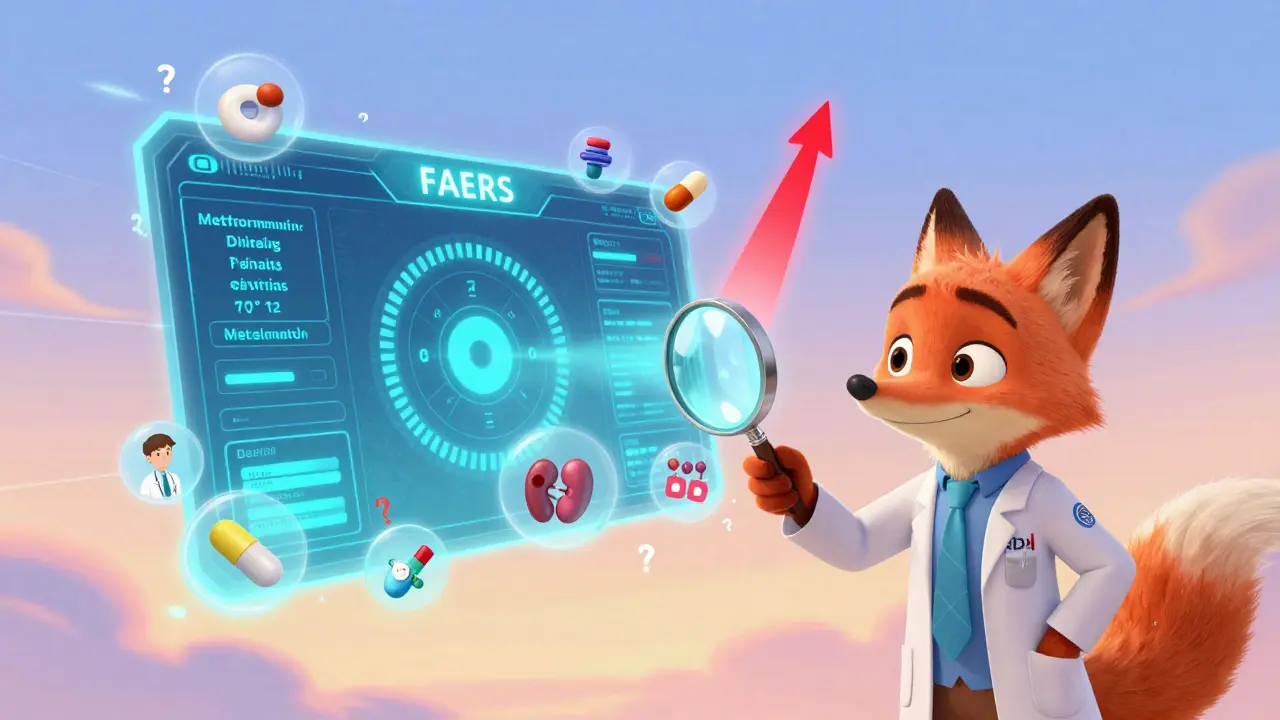
FAERS Report Risk Calculator
Understand FAERS Report Significance
FAERS reports don't directly show risk. The same number of reports means different things depending on how many people took the drug. This calculator demonstrates why context matters when interpreting FAERS data.
When you hear about a drug being pulled from the market or getting a new black box warning, chances are it started with a pattern found in the FAERS database. The FDA Adverse Event Reporting System isn’t a list of confirmed dangers - it’s a massive, real-time collection of reports about possible side effects, medication errors, and product issues. Millions of reports are in there. But if you’re not sure how to search it, you’ll miss the signal in the noise.
What FAERS Actually Shows (And What It Doesn’t)
FAERS stands for the FDA Adverse Event Reporting System. It collects reports from doctors, pharmacists, patients, and drug manufacturers about problems linked to medicines and biologics. Since August 2024, the FDA updated FAERS to show data in real time, instead of waiting months for quarterly updates. That means if a new pattern of liver damage pops up with a common diabetes drug, regulators can see it within days - not quarters.
But here’s the catch: FAERS doesn’t prove a drug caused a side effect. It only shows what people reported. If 100 people say they felt dizzy after taking Drug X, that doesn’t mean Drug X caused the dizziness. Maybe they were dehydrated. Maybe they took it with another medicine. Maybe they were already dizzy. FAERS doesn’t verify any of it.
The FDA uses FAERS to find signals - unusual spikes in reports that suggest something worth looking into. That’s why it’s a tool for scientists and regulators, not a definitive safety guide. If you’re a patient wondering if your headache is from your blood pressure pill, FAERS won’t give you a clear answer. But if you’re a researcher or a concerned consumer digging deeper, it’s one of the most powerful public resources available.
How to Search FAERS: The Public Dashboard
The easiest way to explore FAERS is through the FAERS Public Dashboard. It’s free, web-based, and designed for non-experts. Here’s how to use it:
- Go to the dashboard and click the blue search bar at the top.
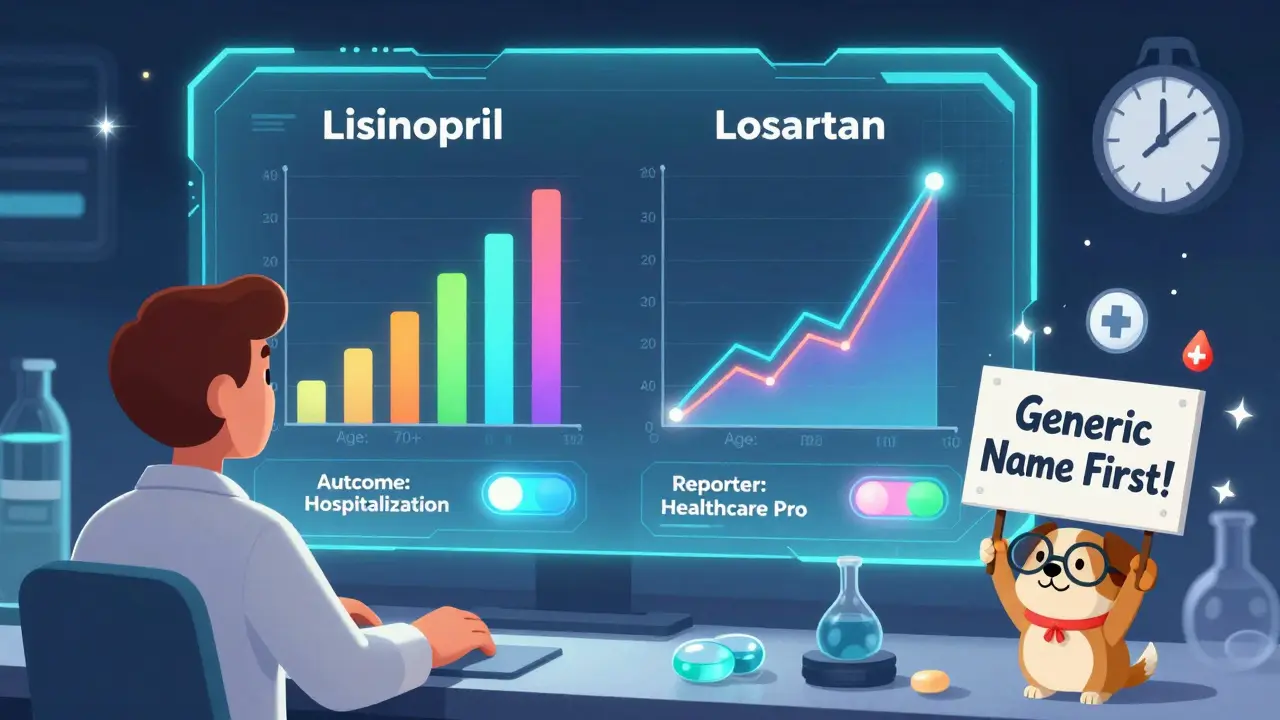
- Type in the generic name of the drug - not the brand name. For example, search “metformin,” not “Glucophage.”
- Click search. The default view shows how many reports were filed each year.
- Look to the right of the graph. Click the drop-down menu and select “Cases by Reaction.”
- You’ll now see a list of side effects reported with that drug, ranked by frequency.
Important: The dashboard lets you search up to five drugs at once. If you’re comparing two medications - say, lisinopril vs. losartan - you can do it side by side. But if you’re looking for all versions of a drug, you’ll need to search each brand name separately. For example, “ibuprofen” and “Advil” are the same thing, but FAERS treats them as different entries unless you search both.
Advanced Filters That Matter
Beyond just drug names, the dashboard lets you narrow results using filters:
- Outcome: Select “Death,” “Hospitalization,” or “Disabling” to focus on serious events.
- Reporter Type: Filter by “Healthcare Professional” to see reports from doctors or pharmacists - these tend to be more detailed than patient reports.
- Age: See if side effects cluster in older adults or teens.
- Year: Use this to spot trends. Did reports of muscle pain go up after 2022?
These filters help you cut through the clutter. For example, if you’re researching a new cholesterol drug and notice 300 reports of joint pain, but 280 of them are from patients over 70 and 90% were filed in 2024, that’s a different story than if the reports were evenly spread across ages and years.
Why You Need to Use Generic Names
Drug manufacturers often submit reports under brand names. But the FDA codes all reports using the generic name in the background. If you only search “Lipitor,” you’ll miss reports coded as “atorvastatin.”
And here’s a real-world example: The diabetes drug “Januvia” (sitagliptin) has a long list of reported side effects. But if you search only “Januvia,” you’ll miss reports filed under “Zituvio” (a newer brand name) or “sitagliptin” (the generic). Always search the generic name first, then add brand names as separate searches.
What About Medical Devices?
FAERS is for drugs and biologics only. If you’re looking for problems with pacemakers, insulin pumps, or joint replacements, you need the MAUDE database - the Manufacturer and User Facility Device Experience system.
MAUDE is trickier. Device names are messy. A single knee replacement might have 12 different model numbers. A ventilator might be sold under three brand names and five product codes. If you’re searching MAUDE, use exact terms from medical records. If you don’t remember the device name, contact your provider - your records will have the exact model and serial number.
Tools That Make FAERS Easier
Most people find FAERS overwhelming. That’s why tools like VisDrugs were built. VisDrugs takes raw FAERS data and turns it into visual charts - pie graphs showing the most common side effects, forest plots comparing risk levels, and tables breaking down reports by age and gender.
For example, if you want to know whether women over 65 report more nausea with a certain antidepressant than men, VisDrugs can generate that comparison in seconds. It doesn’t replace FAERS - it just makes it readable.
Another option is PharmaPendium by Elsevier. It lets you search drug groups using logic like “drug A AND drug B NOT drug C.” It also shows comparative data across multiple drugs - useful if you’re trying to pick between two similar medications.
What FAERS Can’t Tell You
Let’s say you find 5,000 reports of kidney issues with Drug Y. Does that mean 1 in 100 people on the drug have kidney damage? No. FAERS doesn’t tell you how many people took the drug. That’s the denominator problem. If 10 million people took Drug Y and 5,000 reported kidney issues, that’s 0.05%. If only 10,000 people took it, that’s 50%. Without knowing usage rates, you can’t calculate risk.
Also, reporting is biased. People are more likely to report serious events - like hospitalizations - than mild ones. Older adults report more than teens. People with access to doctors report more than those without. And manufacturers submit most reports - not patients. So FAERS is skewed toward what pharma companies notice, not what patients experience.
That’s why the FDA warns: “Do not use FAERS to calculate how common a side effect is.” Use it to find patterns. Then look for peer-reviewed studies or clinical trial data to confirm.
When to Dig Deeper
If you’re a patient, FAERS can help you ask smarter questions. If you see a rare but serious side effect listed, talk to your doctor. Ask: “Is this something I should watch for? What’s the actual risk?”
If you’re a researcher, combine FAERS with other data sources - like electronic health records, clinical trials, or international databases. FAERS alone is not enough.
If you’re involved in legal cases involving drug harm, FAERS can help build context - but always pair it with medical records. A report in FAERS is just one piece of evidence. Your medical chart, lab results, and doctor notes are the real proof.
Final Tips for Better Searches
- Always start with the generic drug name.
- Use filters - outcome, age, reporter type - to narrow results.
- Compare drugs side by side. Don’t just look at one.
- For devices, use MAUDE, not FAERS.
- Don’t assume more reports = more dangerous. Look at context.
- Use VisDrugs or PharmaPendium if you need visual analysis.
- Remember: FAERS finds signals. It doesn’t prove cause.
The real-time FAERS system is a game-changer. It’s faster, more transparent, and more useful than ever. But it’s not magic. It’s a starting point. The best answers come when you combine what FAERS shows with real-world context - your doctor’s advice, your medical history, and trusted scientific studies.
Can I use FAERS to prove a drug caused my injury?
No. FAERS contains unverified reports. A single report doesn’t prove causation. Legal cases require medical records, lab results, expert testimony, and often clinical studies. FAERS can help show a pattern, but it’s not evidence on its own.
Why are there so many reports for some drugs and so few for others?
It’s not about safety - it’s about usage. Common drugs like ibuprofen or metformin have millions of users, so they naturally have more reports. Rare drugs may have fewer reports simply because fewer people take them. Also, newer drugs get more attention from doctors and patients, leading to more reports early on.
Do I need to create an account to use FAERS?
No. The FAERS Public Dashboard is completely free and doesn’t require registration. You can search, filter, and download charts without signing in. Only the raw data files require technical skills to use - not the dashboard.
How often is FAERS updated now?
As of August 2024, FAERS updates in real time. Reports are added to the public dashboard within days of being received by the FDA. This replaced the old quarterly system, which delayed data by up to three months.
Can I report a side effect directly to FAERS?
Yes. Patients and healthcare providers can submit reports through the FDA’s MedWatch portal. You don’t need to wait for your doctor to do it. Visit fda.gov/medwatch to file a report. Your input helps improve drug safety for everyone.
Next Steps
If you’re a patient: Use FAERS to understand what’s been reported, then talk to your provider. Ask for clarification on risk levels and alternatives.
If you’re a researcher: Combine FAERS with clinical trial data, epidemiological studies, and international databases like EudraVigilance. Don’t rely on one source.
If you’re a legal professional: Use FAERS to identify potential patterns - but always anchor your case in medical records, not just database entries.
The goal isn’t to scare you. It’s to empower you. FAERS is a tool. Like a stethoscope - it doesn’t diagnose. It helps you listen better.



Love this breakdown! I’ve been using the FAERS dashboard for my toxicology reports and it’s been a game-changer. The real-time updates mean we catch patterns way faster now - like that spike in liver enzyme elevations with GLP-1 agonists last month. Seriously, if you’re in pharma or public health, this is your new best friend.
YES!! 🙌 I just used the 'Cases by Reaction' filter last week to compare metformin vs. semaglutide - mind blown! 😍 And don’t even get me started on how much easier it is when you use the generic names first!! 💡💡💡 Also, VisDrugs? Absolute lifesaver!! I made a pie chart for my clinic meeting and everyone was like 'WOW' - seriously, this post is PERFECT!! 💌
so uhm... you're telling me we have this massive database of people saying 'i felt weird after taking this' and we're treating it like science? 🤡
next you'll tell me 'i sneezed after eating broccoli' means broccoli causes allergies. wow. groundbreaking. 🤦♂️
also why are we letting patients report stuff? my cat could file a report and it'd get equal weight. lol. what a circus.
The distinction between signal detection and causal inference is critical. While FAERS provides valuable epidemiological data, its limitations must be acknowledged in both clinical and research contexts. The denominator problem remains a persistent challenge in pharmacovigilance. A systematic review of reporting bias would further strengthen this framework.
FAERS is a joke
you think some guy in Ohio saying 'my head hurts' after taking Advil means anything?
the system is broken and everyone knows it
but hey at least the FDA gets to feel like they're doing something
Why do Americans make everything so complicated? In India we just trust our doctors. If they say the medicine is safe, it is safe. FAERS? Too much data. Too many filters. Too many words. We need less analysis, more faith.
Also, why is everyone using English? Shouldn't this be in Hindi? Or at least Spanish?
OMG I JUST FOUND OUT MY ANTI-DEPRESSANT HAS 1,200 REPORTS OF WEIGHT GAIN 😱
I KNEW IT!! I KNEW IT WASN’T JUST ME!! 😭
AND THE FACT THAT MOST OF THEM ARE FROM WOMEN OVER 50??
THAT’S MY PEOPLE!!
I’M TELLING EVERYONE!!
MY THERAPIST IS GOING TO HAVE A HEART ATTACK!!
WAIT WAIT WAIT - DID YOU KNOW YOU CAN SEARCH BY GENDER??
I’M SO EXCITED I’M CRYING!!
This is exactly the kind of info we need to make smarter choices - not fear-based, not hype-driven, just clear, practical steps.
I showed this to my sister who’s on three meds and she’s now using the dashboard to track her own side effects. No panic. Just awareness.
And VisDrugs? That thing is pure magic. I made a chart comparing two blood pressure drugs for my dad - he said, 'Finally, something I can actually understand.'
Keep this energy going. This is how we empower people.
FAERS is just a glorified complaint box
if you wanna know if a drug is safe ask your doctor not some website
also why are we letting patients report anything
they dont even know what a liver enzyme is
There is a critical flaw in the assumption that increased reporting equates to increased risk.
Man, I used to think FAERS was just a bunch of bureaucratic noise - until I dug into the data on my own meds.
Turns out, the 'rare' side effect I was terrified of? It was barely a blip.
But the one I never heard about? The one that showed up in 15% of reports from people over 70? That’s the one I asked my doc about.
Turns out, it’s manageable. And now I’m not scared. Just informed.
This tool? It’s not magic. But it’s the closest thing we got to a truth serum for drug safety.
Use it. Don’t fear it. And please, for the love of all things holy - search by generic name.
FAERS is a Western obsession
In India we have Ayurveda
Why do you need databases when you have centuries of wisdom
Also why is everyone so obsessed with data
Medicine is not math