
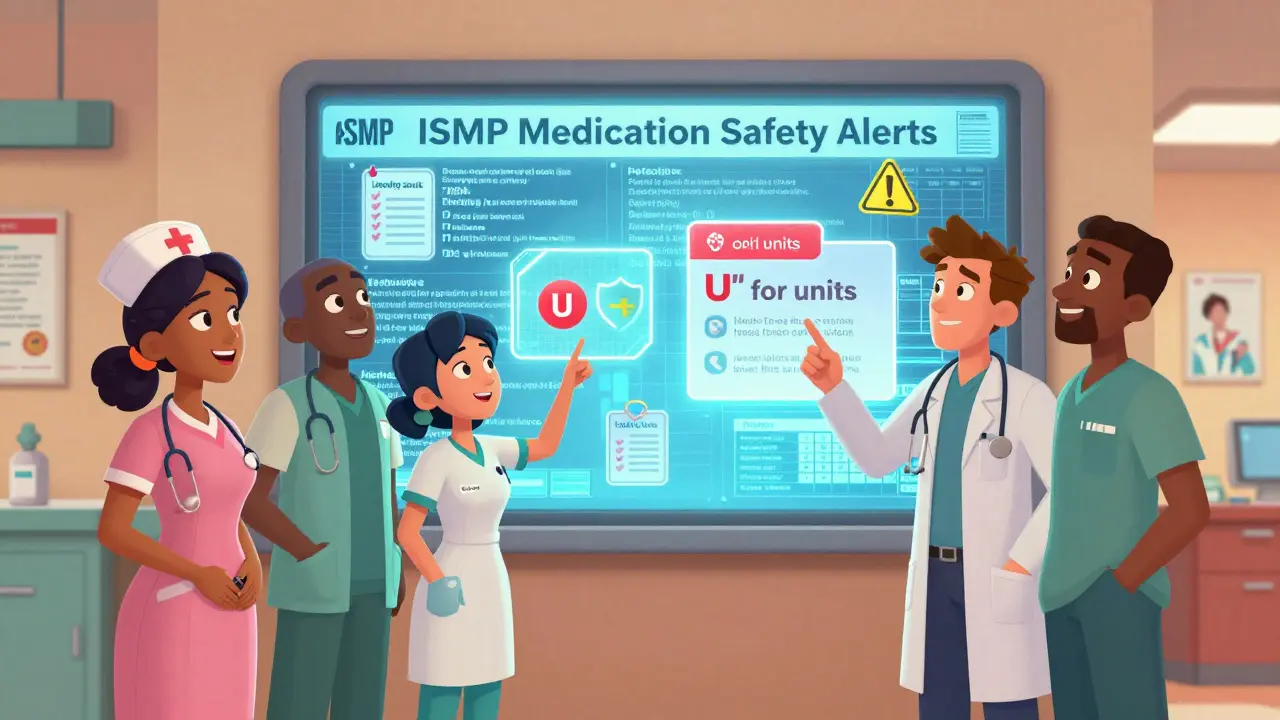
Every year, thousands of patients are harmed because a doctor, nurse, or pharmacist didn’t know about a new safety warning on a medication. Not because they didn’t care - but because they didn’t know where to look. The truth is, staying up to date on medication safety isn’t optional anymore. It’s part of your job. And if you’re not actively following professional society updates, you’re flying blind.
Why You Can’t Rely on One Source
You might think, "I just check the FDA website once a month. That’s enough." But here’s the problem: the FDA only acts after harm has already happened. Their alerts come after a drug has caused injuries, sometimes after dozens of cases. By then, the damage is done. Meanwhile, organizations like the Institute for Safe Medication Practices (ISMP) are watching for errors before they hurt anyone. They collect reports from hospitals, pharmacies, and clinics - over 2,800 in 2022 alone - and turn them into practical steps you can use tomorrow.ISMP doesn’t just send out vague warnings. They publish Targeted Medication Safety Best Practices every two years. The 2024-2025 version added two new rules: one for AI tools that help with medication dosing, and another for compounding pharmacies that mix custom drugs. These aren’t theory. These are fixes used in real hospitals to stop errors.
And then there’s AORN - the Association of periOperative Registered Nurses. Their updates are laser-focused on surgery. If you work in an operating room, their October 2023 Medication Safety guideline changed how teams verify drugs before they go into a patient. New rules on electronic labeling, double-checks during handoffs, and who’s responsible for documenting each step. If you’re not reading AORN’s updates and you’re in surgery, you’re operating with outdated rules.
The Top 5 Sources You Actually Need
You don’t need to follow every organization. But you do need five. Here’s what works:- ISMP Medication Safety Alert! - Published every week. It’s short. It’s direct. It tells you exactly what went wrong last week and how to stop it. Over 45,000 healthcare workers get this. 92% say they’ve used at least one tip to prevent an error. Subscription: $299/year.
- FDA Drug Safety Communications - Free. Go to the FDA’s Drug Safety and Availability page and sign up for email alerts. In 2023 alone, they issued 47 alerts. These aren’t optional. If a drug gets a black box warning, you need to know before the next patient walks in.
- ASHP Medication Safety Resource Center - Free basic access. Premium ($99/year) gives you tools to audit your own pharmacy or unit. Their Medication Safety Self-Assessment tool helps you find weak spots in your workflow. Hospitals that use it cut errors by up to 40%.
- AORN Guidelines - If you work in surgery or anesthesia, this is non-negotiable. Their guidelines are updated every two years, but starting in 2024, they’re moving to quarterly micro-updates. That means you’ll get changes faster. No more waiting 24 months for a fix.
- WHO Medication Without Harm - This isn’t just for global health workers. WHO’s framework sets the global standard. Their 2023 toolkit on handoff communications is now used in 137 countries. Even if you’re in a small clinic, their advice on clear verbal checks and written documentation applies to you.
Dr. Michael Cohen, former president of ISMP, put it bluntly: "Relying on a single source for medication safety updates is as dangerous as using a single verification step in medication administration - redundancy saves lives."
How to Actually Use These Updates
Reading the alerts isn’t enough. You have to act. Here’s how:- Assign one person - In your unit or pharmacy, pick one person to be the "safety watcher." They’re responsible for checking ISMP weekly, FDA daily, and ASHP monthly. They don’t have to be a pharmacist. It could be a nurse, a tech, even an admin. Just make sure someone owns it.
- Turn alerts into action - When ISMP says, "Stop using the abbreviation \"U\" for units," don’t just file it away. Change your EHR templates. Update your training manual. Put up a poster in the med room. That’s how you turn a warning into prevention.
- Use the tools - ASHP’s self-assessment tool takes 20 minutes. Do it. It will show you if your unit is missing basic checks like double-checking high-risk drugs. AORN’s checklist for surgical meds? Use it in your pre-op huddle. These aren’t paperwork. They’re your safety net.
- Train quarterly - Don’t wait for an error to happen. Every three months, hold a 15-minute huddle. Show your team one recent ISMP alert. Ask: "Could this happen here? How would we stop it?"
Hospitals that do this - assign ownership, turn alerts into actions, train regularly - cut medication errors by 60% or more. It’s not magic. It’s discipline.
What You’re Probably Missing
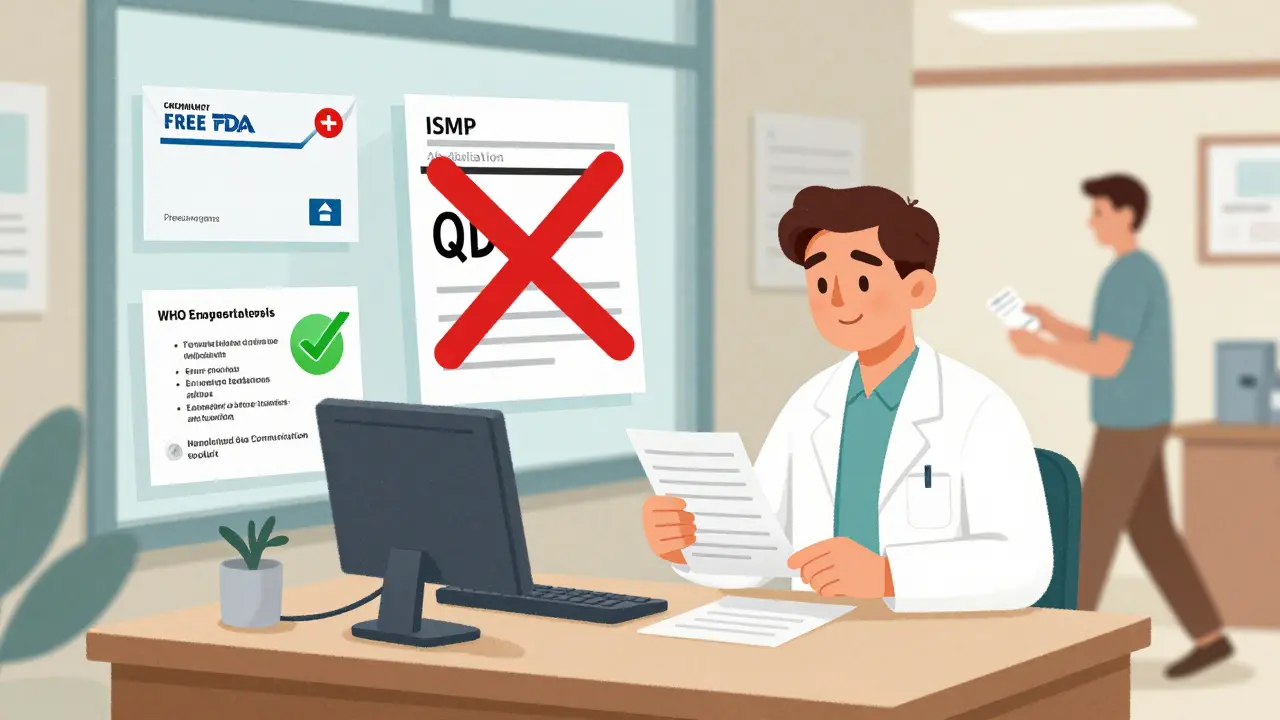
Most people think they’re covered if they subscribe to one thing. But here’s what’s often overlooked:- ISMP’s List of Error-Prone Abbreviations - Updated every year. It’s free. It lists things like "QD" (which can be misread as "QID") and "U" for units. If your EHR still lets people type "QD," you’re at risk.
- NCC MERP Index - This is how experts rate how bad an error is. Level I is no harm. Level H is death. If you don’t know what level your near-miss was, you can’t fix the system.
- Specialty society updates - If you’re a cardiologist, check the American Heart Association. If you’re an OB-GYN, ACOG releases drug safety guidance. These aren’t "nice to have." They’re tailored to your practice.
And here’s the hard truth: 38% of community-based providers don’t regularly check any of these sources. Why? Time. The AMA says primary care docs have 17 minutes a week to read guidelines. That’s less than two emails. But if you spend 10 minutes a week on ISMP’s newsletter, you’re already ahead of most.

The Future Is Here - And It’s Automated
The good news? Systems are catching up. Epic and Cerner - the two biggest EHR platforms - are now building ISMP’s best practices directly into their software. Starting in 2024, if you try to order a drug with an error-prone abbreviation, the system will block it. If a high-risk medication is about to be given without a second check, it will pop up a warning.This doesn’t mean you can stop reading. It means your job is shifting. You’re no longer just a reader. You’re a validator. You’re the person who checks: "Did the system catch what we need?" And if it didn’t - you fix it.
By 2025, the International Coalition of Medication Safety Organizations plans to release a unified update taxonomy. That means all these organizations - ISMP, ASHP, WHO - will start using the same language. No more confusion between "best practice," "guideline," and "recommendation." It’s a big step toward clarity.
What Happens If You Don’t Act?
In 2023, the Joint Commission found that 22% of hospitals failed safety audits because staff didn’t follow updated guidelines. Not because they were careless. Because they didn’t know they changed.And the cost? Medication errors cost the global healthcare system $42 billion a year. Most of it preventable. If you’re not staying current, you’re part of the problem - even if you didn’t mean to be.
You don’t need to be a safety expert. You just need to be consistent. One newsletter a week. One alert a month. One checklist per quarter. That’s all it takes to turn information into protection.
Do I need to pay for all these updates?
No. ISMP’s weekly newsletter costs $299/year, and ASHP’s premium content is $99/year, but the FDA, WHO, and basic ASHP resources are free. Start with the free ones. Subscribe to FDA alerts and download ISMP’s free error-prone abbreviations list. If you see value, then consider paid options. Most hospitals pay for ISMP - but you don’t have to be part of a hospital to benefit.
How often should I check for updates?
Check FDA daily - they post alerts as soon as they’re approved. ISMP comes out every Monday. Read it in 10 minutes. ASHP and AORN update every few months - mark your calendar. If you’re in surgery, AORN’s quarterly updates mean you should check every three months. Don’t wait for a crisis. Make it part of your routine.
What if my hospital doesn’t provide these updates?
Take charge yourself. Subscribe to ISMP and FDA alerts using your personal email. Print out the latest ASHP self-assessment and share it with your team. Many nurses and pharmacists have started safety improvements this way - even in hospitals that ignore the issue. Your patients depend on you, not your employer’s policy.
Are these updates only for hospitals?
No. ISMP’s best practices apply to clinics, long-term care, pharmacies, and even home care. WHO’s guidelines on handoff communication are used by family doctors worldwide. If you prescribe, dispense, or administer medication - you need these updates. Location doesn’t matter. Responsibility does.
Can I rely on drug company safety notices?
No. Drug companies are required to report safety data to the FDA - but they don’t always warn you clearly. Their notices are often buried in dense documents. Professional societies like ISMP and ASHP analyze those reports, simplify them, and tell you exactly what to do. Don’t trust the manufacturer. Trust the independent safety experts.

Yo, this is the most practical guide I've seen in years. I started sharing ISMP alerts in our nurse huddles last month. We caught a mislabeled insulin vial because someone remembered the 'U' abbreviation warning. No one got hurt. That's a win.
Also, if your hospital won't pay for it, subscribe yourself. $299 is cheaper than a malpractice lawsuit. 💪
One must contemplate the epistemological foundations of clinical safety paradigms. The reliance upon institutionalized knowledge dissemination-whether via ISMP, FDA, or WHO-presupposes a hierarchical epistemic authority that may, in fact, obfuscate the distributed nature of tacit clinical expertise. In truth, safety is not transmitted through bulletins; it is emergent through vigilance, ritualized double-checks, and the quiet humility of the practitioner who acknowledges fallibility.
Look, I get it. We're all drowning in alerts. But here's the thing no one talks about: the real problem isn't that we don't read these updates. It's that we're expected to read them on top of 12-hour shifts, charting, and 30-minute patient visits. I read ISMP every Monday. I do. But if I'm running late because my EHR froze and I had to redo three med reconciliations, guess what? That newsletter gets saved for 'later.' And 'later' never comes.
So yeah, the advice is solid. But the system is broken. We need institutional support-not just another thing to check off a list. And if you're a manager and you think 'just subscribe' solves this, you're part of the problem.
As someone who works in a rural clinic, I want to say thank you for including WHO and AORN. We don’t have a pharmacy team, but we do have nurses who prescribe. The handoff communication toolkit from WHO? We printed it, laminated it, and taped it to the med cart. It’s changed how we talk to each other. No more 'Oh, she said it was 500mg'-now we say, 'I heard 500mg, confirm with me.' Small thing. Big difference.
Also, AORN’s checklist? We use it for every procedure, even if it’s just a simple joint injection. It’s become part of our rhythm. Not a chore. A habit.
...I’ve been monitoring this for months...and I must ask: Who funds ISMP? Who owns the data? Are these 'independent' organizations truly independent-or are they quietly funded by pharma conglomerates who want to control the narrative? The FDA is compromised...the WHO is politicized...and now we’re told to trust 'ISMP' like it’s gospel? I’ve seen the reports. They suppress adverse event data. They downplay drug interactions. This isn’t safety. It’s corporate propaganda dressed in scrubs.
And don’t even get me started on Epic and Cerner… they’re not 'fixing' anything-they’re locking us into proprietary systems that track our every move. You’re being surveilled. Wake up.
Just wanted to say this post saved my butt. Last week, I almost gave a patient metformin after they told me they had a kidney issue. I remembered ISMP’s alert from two weeks ago about how metformin can be risky with even mild renal impairment. I double-checked their labs-creatinine was 1.8. I held it. Called the doc. Saved a hospitalization.
And yeah, I don’t pay for ISMP. I read their free PDFs on their site. The error-prone abbreviations list? I printed it. Put it on my desk. My coworkers laugh. But they don’t laugh when they catch a mistake before it happens. Thanks for this.
I think this is all nonsense. Why do we even need all these updates? I’ve been doing this for 20 years. I know what I’m doing. If a drug is dangerous, the FDA will say so. Why do we need a newsletter every week? It’s just more stress. I don’t have time for this. I’m tired. Just let me do my job.
My team started doing the 15-minute quarterly huddle after reading this. We picked one ISMP alert each time. Last quarter, it was about IV insulin labeling. We changed our protocol. No more handwritten labels. Now we use pre-printed ones. No one’s messed up since.
It’s not about being perfect. It’s about being consistent. One small change. One week at a time. You don’t have to be the safety expert. Just be the one who shows up. That’s enough.
Wow. Just... wow. Another 'professional' telling us how to do our jobs. You know what? I’ve been a nurse for 18 years. I’ve seen 12 different 'safety initiatives' come and go. All of them were paperwork. None of them stopped a single error. This? Same thing. You’re selling fear. And you’re charging $299 for it. Pathetic.
Valid points. But let’s be real: most hospitals don’t care. I work in a 200-bed facility. They gave us a 30-second safety video last year. That’s it. No training. No follow-up. No budget. The person who was supposed to monitor alerts? Quit. No one replaced them.
So yeah, the advice here is perfect. But if your employer won’t back you? You’re on your own. And that’s not fair. We need systemic change-not individual heroism.
I cried reading this. I’ve been so scared. I thought I was the only one who felt this pressure. I’m a new grad. I read everything. I’m terrified I’ll make a mistake. This list… it’s like a lifeline. I printed it. I keep it in my scrubs. Thank you. I’m not alone.
There’s a deeper layer here, isn’t there? We’re not just talking about medication safety. We’re talking about how modern medicine has outsourced its moral responsibility to databases, alerts, and checklists. We’ve turned care into compliance. And in doing so, we’ve stripped away intuition, experience, and the human judgment that once guided us.
Is a checklist preventing errors? Yes. But are we becoming less capable of thinking for ourselves? That’s the question no one asks.
Just wanted to add: ASHP’s self-assessment tool is free. I used it last month. Found out we weren’t double-checking insulin at all. We had a policy, but no one enforced it. We fixed it in two days. No budget needed. Just someone who cared enough to look.
Also, if you’re in a clinic, don’t ignore the WHO handoff toolkit. Even if you’re alone with a patient, say the med name out loud. Say the dose. Say the route. Say it like you’re explaining it to a family member. It changes everything.
This entire article is a Western-centric fantasy. In India, we don’t have ISMP alerts. We don’t have Epic systems. We have one nurse for 50 patients. We use handwritten notes. We reuse syringes because we can’t afford new ones. Your 'best practices' are irrelevant. This isn’t safety. It’s privilege dressed as professionalism.
As a clinical pharmacist, I must commend the author’s thoroughness. The integration of institutional frameworks with actionable, evidence-based protocols represents a paradigmatic shift in medication safety governance. That said, the omission of the American Society of Health-System Pharmacists’ (ASHP) formal position statements on automation and clinical decision support is a notable lacuna. While the self-assessment tool is indeed valuable, its efficacy is contingent upon organizational buy-in and workflow integration-two variables frequently unaddressed in such recommendations. One must also consider the cognitive load imposed upon non-pharmacist staff tasked with implementing these protocols without adequate training or authority. The solution, therefore, must be systemic-not merely procedural.