

Vitamin K Intake Calculator for Warfarin Patients
Track Your Vitamin K Intake
Enter your daily portions to calculate total vitamin K intake
Daily Vitamin K Results
Why Consistency Matters
Studies show patients who maintain 90-120 mcg daily vitamin K spend 75-80% of time in therapeutic INR range (2.0-3.0). Wild swings cause dangerous INR fluctuations.
Key Tips
- Stick to same portion Daily
- Cooking increases vitamin K Know your foods
- Track with apps Recommended
When you're on warfarin, your diet isn't just about eating healthy-it's about eating consistent. One day you eat a big salad with spinach and kale, the next you skip greens entirely, and suddenly your INR drops like a stone. That’s not luck. That’s a dangerous fluctuation caused by how much vitamin K you’re getting-and whether it changes from day to day.
Why Vitamin K Matters So Much on Warfarin
Warfarin works by blocking vitamin K from helping your blood clot. It doesn’t stop vitamin K from working entirely, but it slows it down enough to keep dangerous clots from forming. That’s why it’s used for conditions like atrial fibrillation, deep vein thrombosis, and after mechanical heart valve replacements. But here’s the catch: vitamin K fights back. Every time you eat foods rich in vitamin K, your body gets more of the fuel it needs to make clotting factors. That directly counters warfarin’s effect. A single cup of cooked spinach has nearly 900 micrograms of vitamin K. That’s more than your entire daily recommended intake-and it can knock your INR down by 0.5 to 1.0 within just a few days. The goal isn’t to avoid vitamin K. It’s to keep your intake steady. Studies show patients who eat about 90-120 micrograms of vitamin K every day, give or take a little, spend 75-80% of their time in the safe INR range (2.0-3.0). Those who swing between low and high intake? They’re lucky to hit 60%.High-Vitamin K Foods You Need to Track
Not all greens are created equal. Some are safe in moderation. Others? They’re landmines if you’re not careful.- Cooked spinach: 889 µg per cup
- Cooked kale: 547 µg per cup
- Cooked collard greens: 772 µg per cup
- Cooked broccoli: 220 µg per cup
- Cooked Brussels sprouts: 219 µg per cup
- Raw lettuce: 45 µg per cup
- Green beans: 14 µg per half-cup
- Asparagus: 70 µg per half-cup
Consistency Over Restriction: The Real Rule
For years, doctors told patients to avoid green vegetables entirely. That advice is outdated-and dangerous. Why? Because when you suddenly eat a small amount of vitamin K after avoiding it for weeks, your INR can crash. That’s when clots form. Patients who restrict vitamin K often end up with wild INR swings because their bodies aren’t used to it. One study found 78% of users improved their stability after switching from restriction to consistency. The American Heart Association, American College of Cardiology, and American Society of Hematology all agree: don’t cut out vitamin K. Keep it steady. The ideal target? Around 90-120 µg per day. That’s not a lot. One cup of raw spinach, or half a cup of cooked broccoli, or a small serving of kale with your dinner-just make it the same every day. Dr. John Fanikos from Brigham and Women’s Hospital puts it bluntly: “Patients who try to eliminate vitamin K often end up more unstable than those who eat it daily.”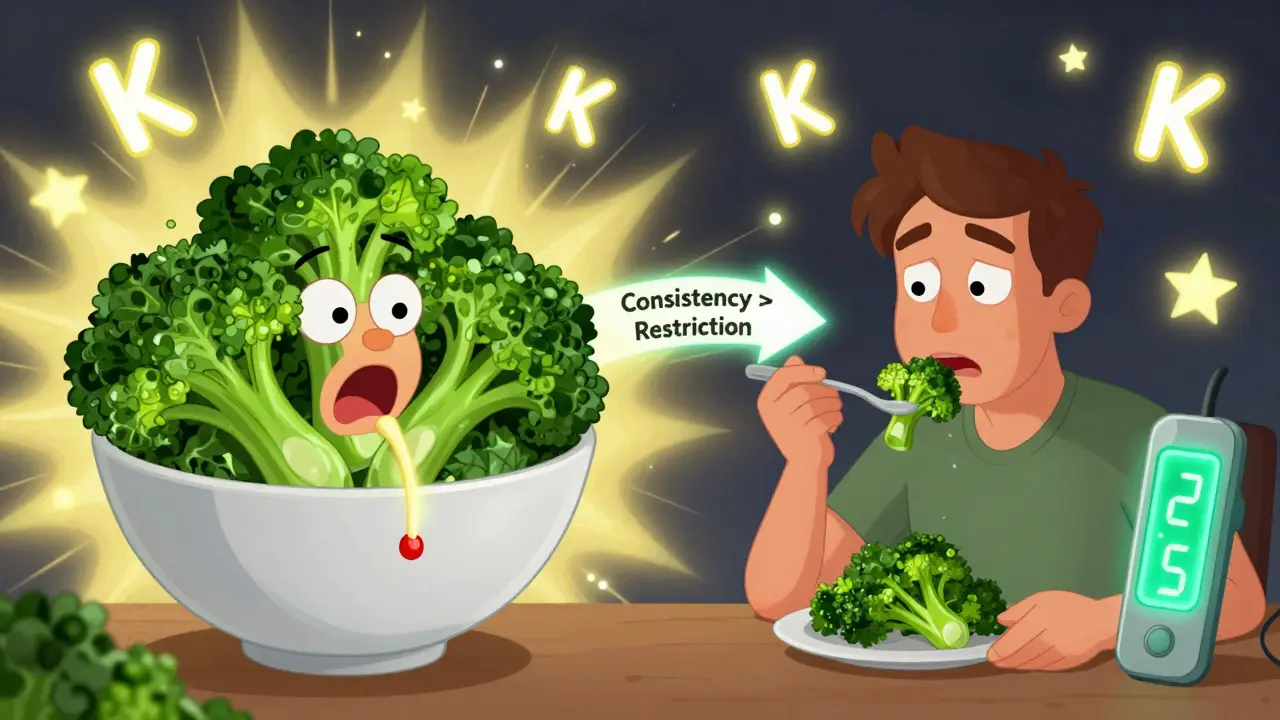
How to Build a Consistent Routine
You don’t need to be a nutritionist. You just need a simple plan.- Pick one high-K food and eat the same portion every day. Example: 1 cup raw spinach in your morning smoothie. Or ½ cup cooked broccoli with dinner. Stick to it.
- Avoid wild variations. Don’t eat kale salad three days in a row, then nothing for a week. That’s a recipe for an emergency visit.
- Plan meals weekly. Cook your greens on Sunday and portion them out. If you know you’ll eat the same thing Tuesday and Thursday, your INR stays predictable.
- Use an app. MyFitnessPal, CoumaDiet, or INR Tracker Pro let you log vitamin K intake. Most track USDA data accurately. 37% of stable warfarin users rely on these tools.
- Keep a food diary. Even a simple notebook with dates and portions helps your doctor spot trends. Anticoagulation clinics report 89% of successful patients keep one.
What Else Can Throw Off Your INR?
Vitamin K isn’t the only player. Other things can shift your INR too-and they’re easy to miss.- Antibiotics: They kill the good bacteria in your gut that make vitamin K2. That can drop your vitamin K levels by up to 70%. If you’re on antibiotics, your INR might rise. Tell your doctor.
- Illness: If you’re sick and not eating, your vitamin K intake drops. That can cause your INR to creep up. The WARFARIN-ILLNESS trial showed INR jumps of 0.3-0.6 in just 48 hours during illness.
- Alcohol: Heavy drinking can increase warfarin’s effect. Even moderate amounts can interfere with liver processing.
- Supplements: Many multivitamins, fish oil, and herbal products (like ginseng, garlic, or green tea extract) interact with warfarin. Always check with your provider before starting anything new.
Why Some People Still Get Bad Advice
You’d think doctors would all be on the same page. But they’re not. A 2022 study found that 63% of patients got conflicting advice from different providers. Nearly half were told to “avoid all green vegetables.” That’s not just wrong-it’s harmful. Older patients, especially those over 65, are more likely to get outdated advice. And that’s one reason why elderly warfarin users have 15% lower time in therapeutic range than younger patients. The FDA now requires warfarin packaging to include instructions on consistent intake, not restriction. But old habits die hard. If your doctor tells you to avoid spinach, ask: “Is that based on the 2023 AHA guidelines?” If they don’t know, it’s time to ask for a referral to an anticoagulation clinic.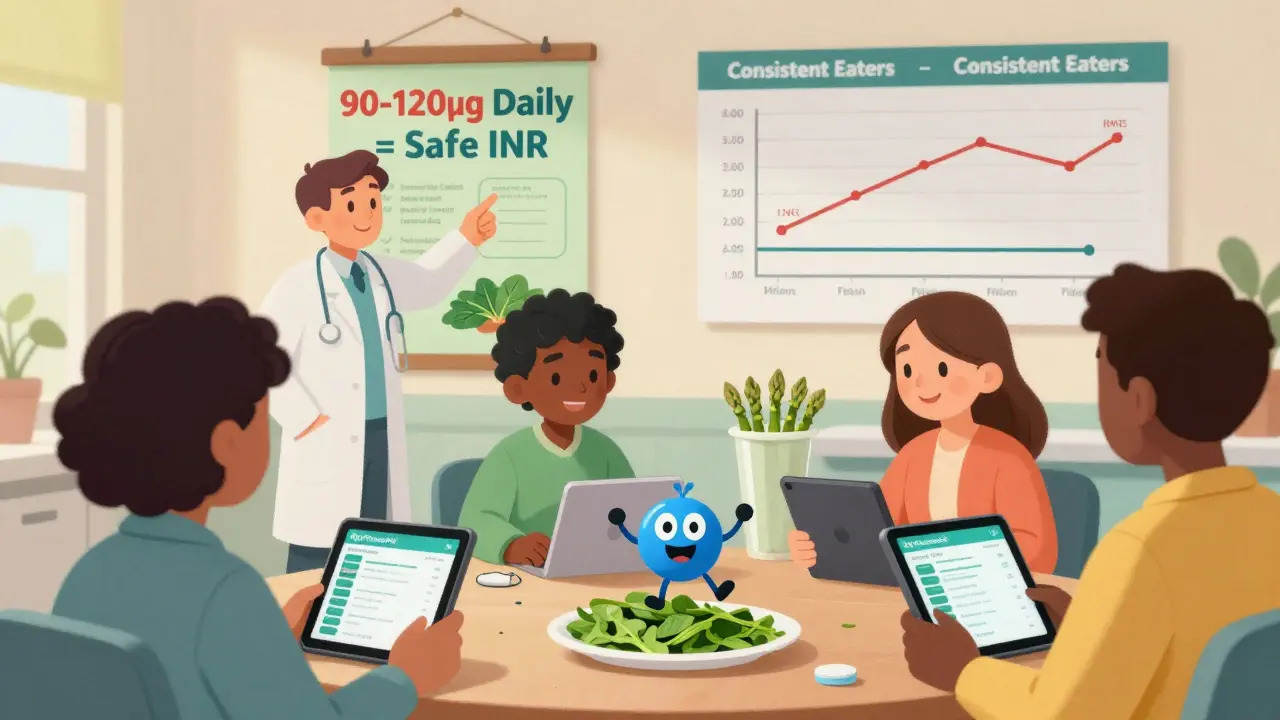
When to Consider Something New
Warfarin isn’t the only option. Newer drugs like apixaban, rivaroxaban, and dabigatran don’t care what you eat. No spinach tracking. No INR checks. Just take your pill. But they cost about 20 times more. Generic warfarin runs $4-$10 a month. DOACs? Around $3,500 a year. For many people, especially on Medicare or without insurance, warfarin is the only realistic choice. If you’re struggling with constant INR swings despite consistent eating, talk to your doctor about switching. But if cost or medical history keeps you on warfarin, mastering vitamin K consistency is your best-and only-path to safety.Real Stories, Real Results
One user on the American Heart Association’s support forum said: “I ate one cup of baby spinach every morning, no matter what. My TTR jumped from 52% to 81% in six months.” Another, on Reddit, wrote: “I had three servings of kale salad in one day. Normally I eat almost no greens. My INR dropped from 2.5 to 1.8 overnight. They had to adjust my dose and I spent three days in the ER.” It’s not about being perfect. It’s about being predictable.What to Do Next
Start today. Here’s your action list:- Check your last three INR results. Are they all over the place? That’s a sign your diet is inconsistent.
- Pick one vitamin K food you like and eat the same portion every day for a week.
- Download a free app like MyFitnessPal and log your vitamin K intake.
- Ask your pharmacist or anticoagulation clinic for a printed guide with vitamin K values for common foods.
- Don’t start any new supplements without checking with your doctor.
Can I eat spinach if I’m on warfarin?
Yes, but only if you eat the same amount every day. One cup of raw spinach (about 90 µg vitamin K) is fine. Eating it one day and skipping it the next will cause your INR to swing. Consistency matters more than avoidance.
Should I avoid all green vegetables on warfarin?
No. Avoiding greens increases your risk of dangerous INR spikes when you accidentally eat them. Current guidelines from the American Heart Association and American College of Cardiology recommend consistent intake, not restriction. Eat your greens, but eat the same amount daily.
How much vitamin K should I eat per day on warfarin?
Aim for 90-120 micrograms per day. That’s roughly one cup of raw spinach, or half a cup of cooked broccoli. Don’t try to hit exactly 100 every day-just keep it within that range and avoid big swings. Stability is the goal, not perfection.
Does cooking affect vitamin K levels in food?
Yes, cooking concentrates vitamin K by reducing water content. One cup of raw spinach has about 145 µg. Cooked, it jumps to nearly 900 µg. That’s why eating cooked greens without adjusting portions can cause sudden INR drops. Always log your food as it’s prepared, not raw.
Can antibiotics affect my warfarin?
Yes. Antibiotics kill gut bacteria that produce vitamin K2. This can lower your vitamin K levels and cause your INR to rise unexpectedly. If you’re prescribed antibiotics, tell your anticoagulation clinic. You may need more frequent INR checks during and after treatment.
Are newer blood thinners better than warfarin?
They don’t require dietary management, which makes them easier for many people. But they cost 20 times more than warfarin. If cost isn’t an issue and you’re a good candidate, DOACs are simpler. But if you’re on warfarin for cost, insurance, or medical reasons, mastering vitamin K consistency is your best path to safety.
What if I miss a day of my vitamin K food?
Don’t panic. One missed day won’t ruin your INR. But don’t try to “make up” for it by eating extra the next day. Just go back to your normal amount. The goal is long-term consistency, not daily perfection. If you miss several days, check your INR and talk to your provider.




Okay, so I’ve been on warfarin for 7 years, and let me tell you-this is the first time anyone’s actually explained it without sounding like a textbook with a caffeine addiction. I eat spinach every. single. morning. Like, I’ve got a ritual. Smoothie. One cup. Raw. No excuses. My INR? Stable as a mountain. But the second I tried kale? Boom. ER. I thought I was being healthy. Turns out, I was being a walking anticoagulant disaster.
This is an exceptionally well-researched and compassionate guide. Too often, patients are left to navigate complex pharmacological interactions without clear, consistent guidance. The emphasis on consistency over restriction aligns with current clinical evidence and reflects a patient-centered approach that prioritizes sustainability over fear. Thank you for sharing this with such clarity and depth.
I’ve been a nurse for 22 years, mostly in cardiology. I’ve seen people panic over spinach like it’s poison. Then I’ve seen others ignore their INR completely. The truth? It’s not about avoiding vitamin K. It’s about knowing your own rhythm. One patient of mine, 81, ate the same half-cup of cooked broccoli every night for 11 years. No swings. No hospitalizations. Just routine. That’s the magic.
Let’s be real-this isn’t just about vitamin K, it’s about the existential fragility of human biochemistry in a world that demands precision from biological systems that were never designed for it. We are, in essence, walking pharmacokinetic experiments, tethered to the whims of leafy greens and gut flora, while our doctors, overwhelmed by insurance forms and EMR alerts, reduce our survival to a number on a screen. And yet-we persist. We log. We measure. We eat the same damn spinach. Not because we want to, but because if we don’t, the clot comes. And it doesn’t ask permission. It just… arrives.
OMG I JUST HAD A KALE SALAD AND MY INR DROPPED TO 1.9!! I THOUGHT I WAS BEING SO HEALTHY!! I’M SO SCARED!! I’M GOING TO DIE!!
Look, I’ve been on warfarin since 2016. I don’t track anything. I don’t use apps. I just eat what I want. My INR’s been stable for 5 years. So yeah, maybe this advice works for some people. But it’s not gospel. Some of us just have good liver enzymes and chill gut bacteria. Stop scaring people into food diaries. You’re not a nutritionist. You’re not my doctor. Stop acting like it.
There’s a lot of misinformation out there about warfarin, and this post cuts through it with real science and practical advice. I especially appreciate the emphasis on consistency-not perfection. Many patients feel guilty when they miss a day or eat something unexpected. But as the post says, one off day won’t ruin you. What ruins you is the cycle of restriction and bingeing. The key is predictability. I’ve recommended this to three patients already. One even started logging with MyFitnessPal and hasn’t had an INR emergency since.
Wow. So now we’re treating vitamin K like it’s a religious sacrament? Eat the same spinach every day or the devil gets your blood? Newsflash: people survived warfarin for decades before apps existed. My grandpa took it for 15 years. Ate whatever he wanted. Lived to 92. You’re overcomplicating it. Stop making people paranoid about broccoli.
Bro i just take my pill and eat tacos. My INR’s fine. Why are you all acting like you’re on a space mission? Also who even measures vitamin K? That’s not a thing. I thought warfarin was just… magic?
Consistency works. I’ve been on warfarin for 10 years. One cup of raw spinach every morning. No more, no less. No apps. Just a notebook. My INR has been in range 87% of the time. The only thing that messed me up? Antibiotics. Never saw that coming. Now I tell every doctor I see: I’m on warfarin. Always.
Spinach? Broccoli? Please. You’re all missing the point. The real problem? Doctors. They still think you’re dumb. They give you a pamphlet from 2008 and tell you to avoid greens. Then they wonder why your INR’s all over the place. It’s not your fault. It’s their laziness. Fix the system. Not your salad.