

To understand this, we first need to define the core concept. Bioequivalent medications is a term used to describe two drug products that reach the same concentration in the bloodstream at a similar rate and to a similar extent. In simpler terms, if two drugs are bioequivalent, your body processes them in the same way, and they deliver the same amount of active medicine to your organs or bloodstream. This is why generic drugs can be swapped for brand names without you needing a new clinical trial every time.
The Math Behind the Medicine: How Bioequivalence is Measured
Regulators don't just take a manufacturer's word for it. To prove a drug is bioequivalent, companies conduct pharmacokinetic studies, usually with 24 to 36 healthy volunteers. They aren't looking for a 100% perfect match-because no two humans process medicine identically-but they are looking for a very tight statistical window.
Scientists track three main metrics to decide if a drug passes the test:
- Cmax: The highest concentration the drug reaches in your blood.
- tmax: How long it takes to hit that peak concentration.
- AUC (Area Under the Curve): The total amount of the drug that your body absorbs over time.
For most drugs, the FDA (Food and Drug Administration) requires that these metrics fall within a 90% confidence interval of 80% to 125% of the brand-name version. You might think a 20% difference sounds like a lot, but for the vast majority of medicines, this variance doesn't change how the drug actually works in your body. In fact, an FDA analysis of over 2,000 applications showed that nearly 99% of generics actually fall within a much tighter range of 90-110%.
Pharmaceutical vs. Therapeutic Equivalence: Not All "Same" is the Same
This is where things get confusing. People often use "generic" and "bioequivalent" interchangeably, but there are three distinct levels of equivalence you should know about.
First, there is pharmaceutical equivalence. This just means the two pills have the same active ingredient, the same dose, and the same form (like a tablet). However, they might have different "inactive" ingredients-fillers, dyes, or binders.
Next is bioequivalence, which we've already covered: the drug actually behaves the same way once it's inside you.
Finally, we reach therapeutic equivalence. This is the "gold medal" of generic drugs. To be rated as therapeutically equivalent (often marked as "AB-rated" in the Orange Book), a drug must be both pharmaceutically equivalent AND bioequivalent. When a drug has this rating, a pharmacist can safely substitute it for the brand name with the expectation that the clinical effect will be identical.
| Term | What it matches | What can differ | Goal |
|---|---|---|---|
| Pharmaceutical Equivalence | Active ingredient & Dose | Fillers, colors, binders | Same basic formula |
| Bioequivalence | Absorption rate & extent | Chemical structure of inactive parts | Same blood concentration |
| Therapeutic Equivalence | Everything (Clinical effect) | Brand name/Price | Safe substitution |

The "Narrow Therapeutic Index" Problem: When 20% Isn't Enough
While the 80-125% rule works for most things, some drugs are incredibly sensitive. These are called Narrow Therapeutic Index (NTI) drugs. For these medications, the gap between a dose that helps you and a dose that is toxic (or ineffective) is tiny.
Think of drugs like levothyroxine for thyroid issues or certain antiepileptic medications. For these, a small shift in absorption can actually matter. In these cases, the FDA often requires a much tighter bioequivalence window-sometimes as narrow as 90-111%.
This explains why some patients report feeling "off" when they switch generic brands for these specific drugs. It's not that the drug is "fake," but rather that their body is sensitive to the very slight differences in how different manufacturers' fillers affect absorption. This is why many pharmacists recommend sticking to one specific generic manufacturer once you've found one that works for you.
Why This Matters for Your Wallet and Your Health
The entire system of bioequivalence was turbocharged by the Hatch-Waxman Act of 1984. Before this, generic companies had to redo expensive safety and efficacy trials. Now, they only have to prove bioequivalence.
This shift has had a massive impact. Generic drugs now make up about 90% of all prescriptions filled in the US. By removing the need to repeat massive clinical trials, the cost of bringing a generic to market is significantly lower-roughly $2.2 million on average. These savings are passed to the consumer, with some estimates suggesting the US healthcare system has saved trillions of dollars over the last few decades.
But is it safe? Data from the FDA's Adverse Event Reporting System (FAERS) suggests that problems with generics are extremely rare, accounting for only 0.3% of all medication reports. For the vast majority of people, the switch is invisible and the results are the same.
Practical Tips for Using Bioequivalent Medications
If you're switching from a brand-name drug to a generic, or switching between different generic brands, keep these points in mind:
- Check the "AB" Rating: If you're worried, you can look up the drug in the FDA Orange Book to see if it is rated as therapeutically equivalent.
- Watch for NTI Drugs: If you are taking medication for seizures, thyroid hormones, or blood thinners, be more mindful of how you feel during a brand switch.
- Consistency is Key: If you notice a difference in how a generic works, ask your pharmacist to provide the same manufacturer every month.
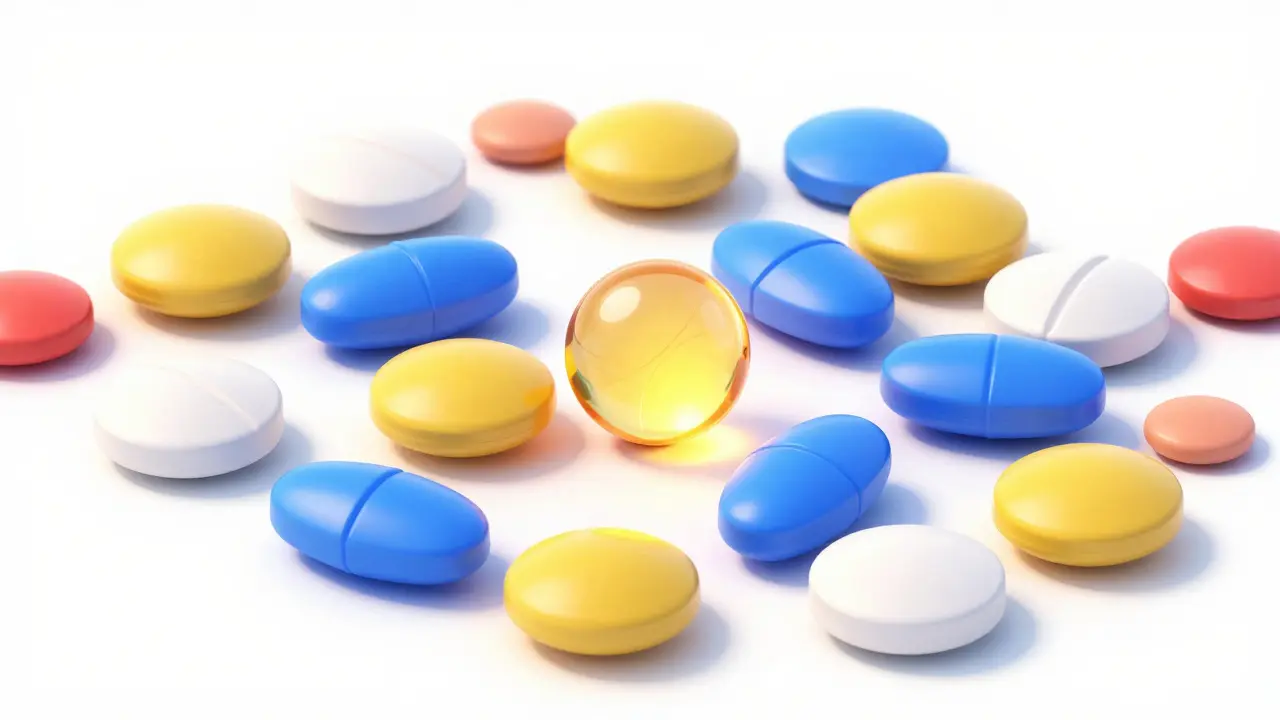
- Don't Panic Over Appearance: A bioequivalent drug can be a different color, shape, or size than the brand name. These are just dyes and fillers; they don't change the active medicine.
Are generic drugs less effective than brand-name drugs?
No. Because of bioequivalence standards, generic drugs must deliver the same amount of active ingredient to the bloodstream at the same rate as the brand name. For the vast majority of medications, there is no difference in clinical outcome.
Why does my generic medication look different from the brand name?
The active ingredient is the same, but the "inactive ingredients" (fillers, binders, and dyes) can vary by manufacturer. These do not affect the bioequivalence of the drug, which is why the pill might be a different color or shape.
Can I always switch from brand to generic?
Most of the time, yes. However, for Narrow Therapeutic Index (NTI) drugs, some doctors prefer a specific brand or generic to ensure absolute consistency in dosing. Always consult your doctor before switching these specific types of meds.
What is the "Orange Book"?
The Orange Book is the official FDA publication that lists approved drug products and their therapeutic equivalence ratings. It tells pharmacists which generics can be safely substituted for a brand-name drug.
How do I know if my drug is bioequivalent?
If your pharmacist is offering a generic substitution, the drug has already passed FDA bioequivalence testing. You can verify the therapeutic equivalence rating (like "AB") via the FDA's Orange Book database.


The Orange Book is basically the only thing that matters here. If it's AB rated, it's the same stuff. Simple as that.
Big Pharma just wants us to trust the 20% window. It's a scam.
It is so cool how science makes meds affordable for everyone!!! 🌟 I love that we can save money and still stay healthy!! ✨💖
We speak of bioequivalence as a triumph of chemistry, but we forget that the human body is not a static vessel. To assume a statistical window governs the chaotic nature of biological absorption is a naive pursuit of order in a fundamentally disordered system. The industry treats us like spreadsheets, ignoring the metaphysical interplay between the mind's perception of a pill's color and its perceived efficacy. Why do we crave the label of 'equivalence' when existence itself is a spectrum of variance? The obsession with the 80-125% range is merely a comfort blanket for those afraid of the void of uncertainty. We quantify the blood concentration but ignore the soul's reaction to the chemical intruder. In the end, the brand name is just a ghost of a patent, a memory of a profit margin that once dictated the terms of survival. We are merely biological machines processing standardized inputs, dreaming of personalized care while swallowing mass-produced pellets of synthetic hope. It's a cycle of reliance that we've rebranded as accessibility. Truly, the generic is the mirror reflecting our own commodification.
who cares about the stats tho.. i always feel diffrent when the pill is a diffrent color lol. its all mind games and big pharma lying about the filler ingredients for profittt.
the distinction between pharmaceutical and therapeutic equivalence is an important boundary to maintain in these discussions
The FDA is basically paid off by the manufacturers. That 99% stat is probably made up to keep people from complaining about the cheap fillers they pump into these generics.
It is truly exhausting to see people ignore the nuance of NTI drugs... Some of you simply lack the discipline to research your own health properly!!! It is a failure of personal responsibility!!!
I'm glad this is explained so clearly. It really helps people who are scared to switch to generics feel better.
Absolutely right!!! Science is amazing and the Hatch-Waxman Act was such a win for all of us!!! Love seeing medicine become more accessible!!!
The mention of the 80-125% interval is basic. Anyone with a rudimentary understanding of pharmacokinetics knows that this is the standard regardless of the drug's class, though the NTI outliers are a trivial exception.
Please stay consistent with your manufacturers.
I think it's really helpful to keep in mind that for most of us, these differences are totally invisible, and that's a wonderful thing because it lets us focus on getting better without stressing over the cost of our prescriptions, but for those few who do feel a difference, especially with things like thyroid meds, it's just about finding that one specific generic that clicks with your body's unique chemistry and then sticking with it for the long haul.
Too much text. Generics are fine.