
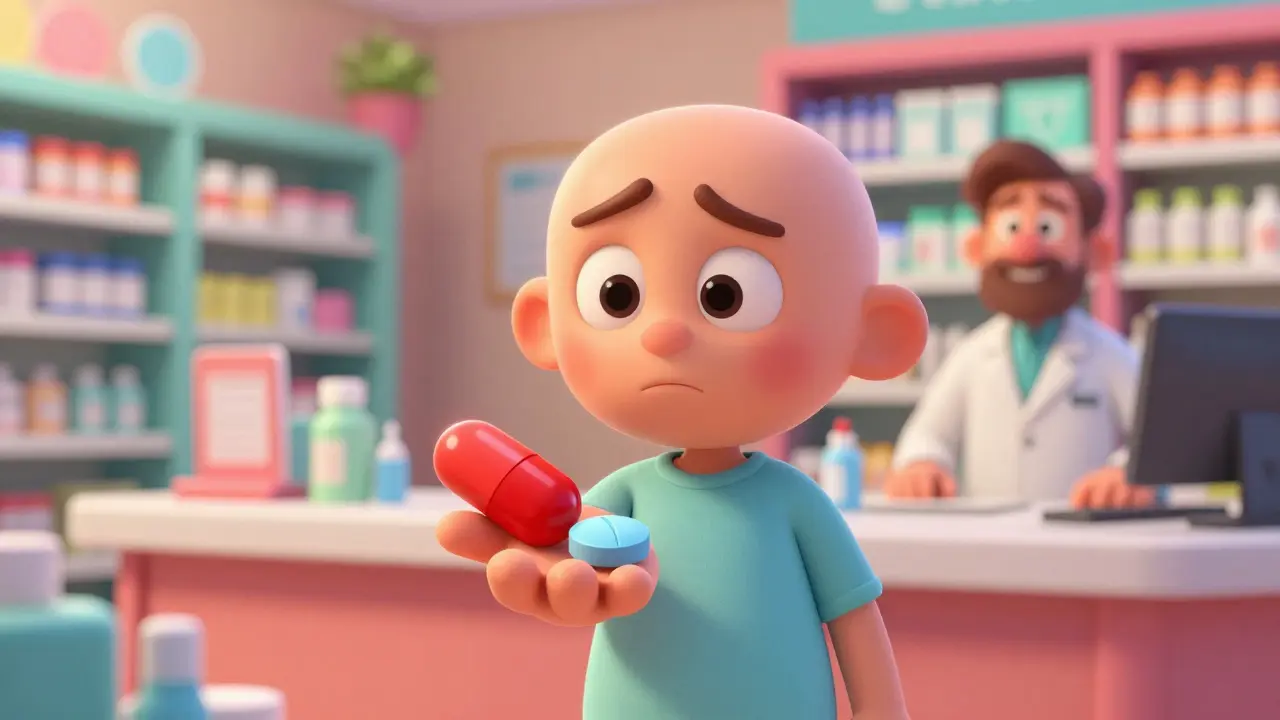
You've probably been there: your pharmacist hands you a pill that looks completely different from the brand-name version you've taken for years. Maybe it's a different color, a different shape, or just a different name on the box. You might wonder, "Is this actually the same thing?" The short answer is that it's designed to be bioequivalent medications, but that doesn't mean the pills are identical twins. It means they behave the same way once they hit your bloodstream.
What does bioequivalence actually mean?
When we talk about bioequivalence, we aren't talking about how a pill looks or tastes. We're talking about how the drug moves through your body. Bioequivalence is a pharmacokinetic standard used to ensure that a generic drug delivers the same amount of active ingredient to the site of action at the same speed as the brand-name version.
Think of it like two different brands of coffee. One might be in a red bag and the other in a blue bag, and the beans might look slightly different. However, if they both give you the exact same caffeine hit at the exact same speed, they are "bioequivalent" in terms of their effect on your nervous system. In medicine, this means that if you take a generic version of a drug, your body should absorb it and react to it almost exactly as it would with the original brand-name product.
The science behind the swap: How it's measured
Regulators don't just take a manufacturer's word for it. To prove a drug is bioequivalent, companies have to run studies, usually with 24 to 36 healthy volunteers. They track three specific numbers to see if the generic matches the Reference Listed Drug the specific brand-name product used as the gold standard for comparison (RLD).
- Cmax: This is the maximum concentration of the drug in your blood. It tells us how "strong" the peak of the dose is.
- Tmax: This is the time it takes to reach that peak. It tells us how fast the drug starts working.
- AUC (Area Under the Curve): This represents the total amount of the drug your body is exposed to over time.
For a drug to be approved, the FDA the U.S. Food and Drug Administration, which regulates pharmaceutical safety and efficacy requires that these measurements fall within a statistical range of 80% to 125% of the brand-name drug's performance. While a 25% window might sound wide, it's based on the fact that for most medicines, a small difference in absorption doesn't change how the drug actually treats your condition.
| Metric | Standard Generic Drug | Narrow Therapeutic Index (NTI) Drug |
|---|---|---|
| Acceptable Range | 80% - 125% | 90% - 111% |
| Risk Level | Low sensitivity to small dose changes | High sensitivity (small change = toxic or ineffective) |
| Example | Common antibiotics | Certain antiepileptics or thyroid meds |

Pharmaceutical vs. Therapeutic Equivalence
These terms get tossed around a lot, but they mean very different things. If a drug is pharmaceutically equivalent, it just means it has the same active ingredient, the same dose, and the same route (like a pill vs. a pill). However, it doesn't guarantee that your body will absorb it the same way.
Therapeutic equivalence is the gold standard. To get an "AB" rating in the Orange Book the FDA's official publication listing approved drug products and their therapeutic equivalence evaluations , a drug must be both pharmaceutically equivalent AND bioequivalent. When a drug has this rating, a pharmacist can swap the brand for the generic with total confidence that the clinical effect and safety will be the same.
Why some people feel a difference
If the science says they're the same, why do some people swear that their generic doesn't work as well? There are two main reasons for this: inactive ingredients and the "narrow window" problem.
While the active ingredient must be the same, the fillers, binders, and dyes (inactive ingredients) can vary. For most people, this doesn't matter. But for someone with a specific allergy or sensitivity to a certain dye, a generic might cause a reaction that the brand-name didn't. This isn't a failure of bioequivalence, but a reaction to the "packaging" of the drug.
Then there are Narrow Therapeutic Index (NTI) drugs medications where a very small change in dose or blood concentration can lead to a significant change in effect or toxicity . For these, the standard 80-125% range is too loose. Research, such as a study published in JAMA Internal Medicine, has shown that a small percentage of patients switching generic antiepileptic drugs experienced breakthrough seizures. This is why doctors often insist on "dispense as written" for medications like levothyroxine or certain seizure meds-because even a 5% shift in absorption can be the difference between stability and a relapse.

The real-world impact on your wallet
The push for bioequivalence isn't just about science; it's about access. By allowing generics to be approved without repeating massive, multi-year clinical trials (since they've already proven they work like the brand), the cost of medicine drops. The Hatch-Waxman Act the 1984 U.S. law that created the modern pathway for generic drug approval basically paved the way for this. It's estimated that generic drugs save the average patient around $313 per prescription. Without these bioequivalence standards, your pharmacy bill would look a lot scarier.
What to do if you're worried about your generic
If you've recently switched to a generic and feel "off," don't just stop taking the medication. Start by tracking your symptoms. Are you feeling more side effects? Is your condition not as controlled? Note the specific manufacturer on the bottle-generics can vary by company.
Talk to your pharmacist. They can tell you if you've switched manufacturers recently. In some cases, they can ensure you stay on the same generic version every month to avoid "yo-yoing" your blood levels. If you're on a high-risk NTI drug, ask your doctor if a specific brand or a single-source generic is safer for your specific chemistry.
Is a bioequivalent drug exactly the same as the brand name?
No, not exactly. While the active ingredient and the way it enters your bloodstream are essentially the same, the inactive ingredients (fillers, colors, binders) can be different. This means the pill may look different and may occasionally cause different mild reactions in sensitive individuals, but the medical effect remains the same.
Why are some generic drugs better than others?
In terms of bioequivalence, most approved generics are expected to perform similarly. However, different manufacturers use different inactive ingredients. For the vast majority of people, this makes no difference, but for those with specific allergies or those taking "narrow therapeutic index" drugs, one manufacturer's version might feel slightly different than another's.
Can I ask my doctor for the brand-name version instead?
Yes, you can always request the brand name. However, depending on your insurance, you may have to pay a much higher co-pay or the full price if the generic is considered therapeutically equivalent. If you have a medical reason (like a reaction to a filler), your doctor can write "Dispense as Written" (DAW) on the prescription.
How do I know if my generic is "AB rated"?
The most reliable way is to check the FDA's Orange Book. This database lists every approved drug and its therapeutic equivalence rating. An "AB" rating means the drug is pharmaceutically equivalent and bioequivalent, meaning it can be substituted for the brand name without significant clinical difference.
Do all generic drugs follow the same rules?
Generally, yes, but some complex drugs (like inhalers or nasal sprays) are harder to measure with a simple blood test. For these, the FDA may require different types of studies, such as clinical endpoint studies, to prove the drug actually works in the lungs or nose, rather than just measuring how much enters the blood.





Basically, the fillers are the only thing that change. It's not magic, it's just chemistry. Most people overthink it when it's really just a different dye in the pill.
Total lies. Big Pharma just wants us on the cheap stuff so they can skim profits!! They don't care about our health!!!
This is such a helpful breakdown!!! It's honestly great that we have these standards to keep things affordable for everyone!!! Truly a win for public health!!!
The irony of human perception is that we value the label over the molecule. We live in a society that worships the brand while ignoring the fundamental truth that a chemical structure doesn't care about a logo. Most people simply lack the intellectual rigor to understand that bioequivalence is a mathematical approximation, not a spiritual identity. It's quite amusing how the masses cling to the idea of a "better" brand when the molecular efficacy is statistically identical. One must wonder if this placebo effect is simply a coping mechanism for those who feel powerless in a medical system they don't comprehend. In the grand scheme of pharmacokinetics, our personal preferences are utterly irrelevant. The drug does its work regardless of your feelings about the color of the tablet. It's just basic science that people choose to complicate for the sake of emotional comfort.
I'm so glad you mentioned the part about talking to the pharmacist. It really helps to know we can just ask them for help when things feel weird.
the concept of an ab rating is a fascinating intersection of regulatory control and biological variability i wonder if we ever reach a point where personalized medicine makes these broad ranges obsolete
Omg, the coffee analogy is so spot on!!! ☕️ It really makes the whole thing way easier to wrap your head around!!! Love seeing science explained like this!!! ✨💖
I've spent a lot of time observing how different people react to medication and it's always a journey. For those of you who feel a bit uneasy, just remember that your body is unique and it's perfectly okay to take your time adjusting to a new manufacturer. I always suggest keeping a little log of how you feel for a few weeks because it gives you so much more power when you finally sit down with your doctor to discuss your options. It's not about being right or wrong, it's just about finding the specific fit for your own chemistry and being patient with the process of trial and error that sometimes comes with generics.
It is simply tragic that some of you actually believe the government's "statistical ranges" are designed for your benefit... I can only imagine the state of your health if you blindly trust a 25% variance!!! Truly appalling!!!