
The core problem is that pharmaceutical markets don't behave like a typical farmers' market. They are shaped by complex laws, patent minefields, and strategic deals between giant corporations. While generic drug competition generally saves billions-FDA estimates suggest over $3 trillion in savings through 2023-the actual effect of adding a second, third, or tenth competitor isn't a straight line down.
The Non-Linear Drop: Why the First Few Competitors Matter Most
When a brand-name drug loses its patent protection, the first generic company to enter the market usually triggers the biggest price crash. According to FDA analysis using Average Manufacturer Price (AMP) data, a single generic competitor can slash prices by 30% to 39% compared to the original brand. When a second competitor joins the fray, that drop often deepens to around 54%.
However, the law of diminishing returns kicks in quickly. While having six or more competitors can eventually drive prices down by a staggering 95%, the jump from two to three competitors doesn't provide nearly as much relief as the jump from zero to one. This creates a "winner-takes-most" environment, especially in the U.S., where the first generic manufacturer often captures about 80% of the market during their 180-day exclusivity period. If the first mover grabs the lion's share, other companies might decide the market isn't worth the investment, leaving us with fewer competitors than we'd like.
| Number of Generic Entrants | Estimated Price Reduction (AMP) | Market Impact |
|---|---|---|
| 1 Competitor | 30% - 39% | Initial steep decline |
| 2 Competitors | ~54% | Significant price pressure |
| 6+ Competitors | Up to 95% | Near-total commoditization |
The Paradox of Generic Competition: When Prices Stay High
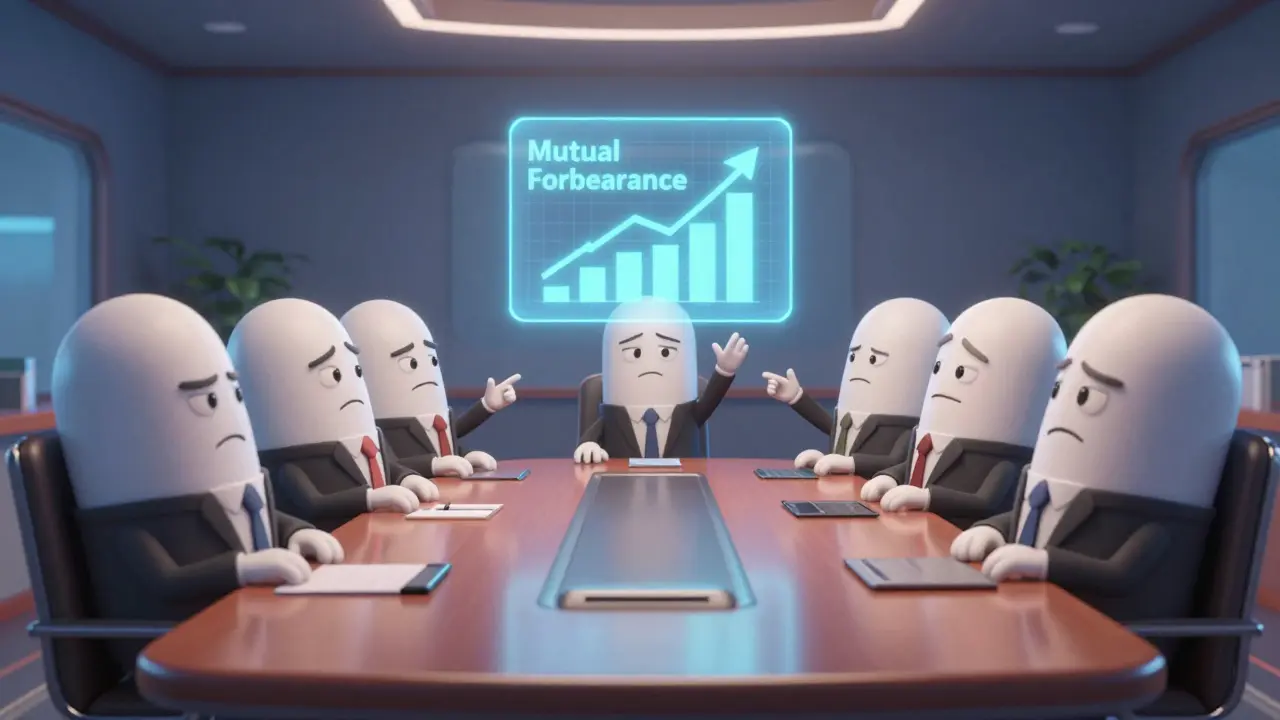
If more competitors usually mean lower prices, why do some drugs stay expensive? This is where we hit the "paradox of generic drug competition." In some markets, companies realize that fighting a price war only hurts everyone's bottom line. This leads to Mutual Forbearance, a strategy where competitors avoid aggressive pricing because they know their rivals will just match the cut, leaving everyone with lower profits and no one with more market share.
We saw this happen in Portugal's statin market. Despite having multiple generic options and regulatory price caps, drugs often stayed priced right at the ceiling. The companies essentially coordinated-not necessarily through a secret meeting, but through a shared understanding that there was no incentive to go lower. Even more surprising is when brand-name companies actually raise prices after a generic enters. A study of originator drugs in China found that some brands increased prices by about 0.62% after generics arrived. Why? Because they pivoted to target the "premium" segment of the market, betting that some patients would pay more for the perceived quality of the original brand.
Complexity as a Barrier to Entry
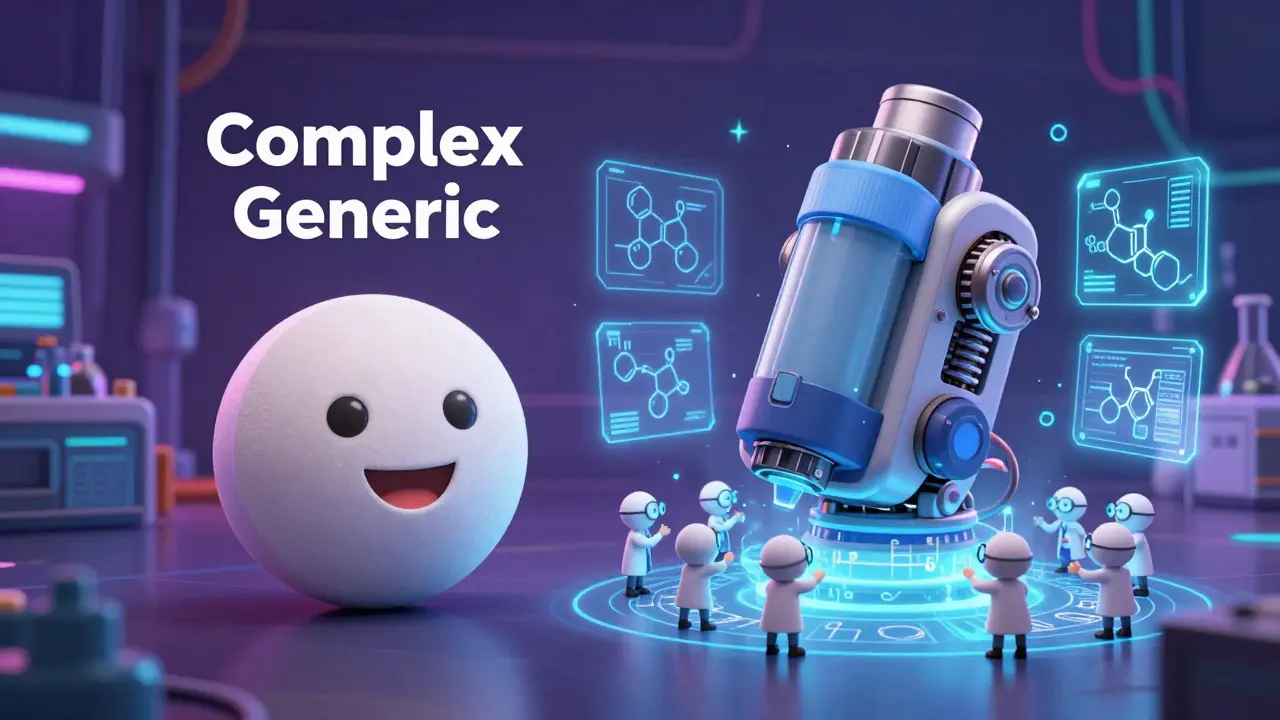
Not all generics are created equal. Creating a simple pill is one thing, but Complex Generics-like advanced inhalers or long-acting injectables-are a different beast. To get these approved, manufacturers must prove "sameness" across critical quality attributes, which often requires expensive "bridging studies."
This creates a "complexity advantage." Only the biggest pharmaceutical firms have the cash and technical gear to navigate these hurdles. When the barrier to entry is this high, you might see "multiple" competitors on paper, but in reality, only two or three giants are fighting. This effectively limits competition and keeps prices higher than they would be for a simple chemical compound. For example, in oncology, drugs like imatinib and dasatinib often show much wider price gaps between the brand and generics because the manufacturing process is so demanding.
The Invisible Hand of PBMs and Authorized Generics
You can't talk about drug prices without mentioning Pharmacy Benefit Managers (PBMs). These middlemen handle the vast majority of pharmaceutical purchasing-some reports suggest up to 90%. Because PBMs negotiate rebates and formulary placements, the "list price" of a drug often doesn't reflect the actual cost. A brand company might keep its price high to offer a bigger rebate to a PBM, ensuring their drug stays on the preferred list, even if there are five generic versions available.
Then there are Authorized Generics (AGs). An AG is basically the brand-name drug sold in a generic bottle, often launched by the original company to capture some of the generic market. If the brand company owns the AG, the brand price tends to be lower (by about 8-12%). However, if a third party owns the AG, the brand price can actually be 22% higher. It's a strange game of ownership that determines whether you pay more or less at the pharmacy counter.
Supply Chain Resilience vs. Price War
While we usually focus on the cost, there is a hidden benefit to having a crowded market: reliability. A market with only one or two generic suppliers is fragile. If one factory has a quality issue or a fire, the drug disappears from shelves. This is where the "robust generic market" model pays off. Data shows that drugs with three or more manufacturers experienced 67% fewer shortages between 2018 and 2022 than those with a single source.
There is a tension here. Extreme price competition-where prices drop to near zero-can actually drive manufacturers out of the market. If it's no longer profitable to make a drug, companies stop producing it. This is a growing concern with the Inflation Reduction Act (IRA) and its Medicare price negotiations. If the government sets a "Maximum Fair Price" that is too low, generic makers might lose the incentive to enter the market, potentially trading lower prices for more frequent drug shortages.
The Future: Biosimilars and the Next Frontier
The rules we've discussed mostly apply to "small-molecule" drugs (the typical pills). But the industry is shifting toward biologics-huge, complex molecules grown in living cells. These aren't "generics" in the strict sense; they are Biosimilars. Because biologics are so expensive to develop, we won't see the same 95% price drops we see with generics. The competitive landscape for biosimilars will likely involve fewer players, higher prices, and a much slower descent from the brand-name peak.
Does more generic competition always mean lower prices?
Generally, yes, but it's not a guarantee. While more competitors usually drive prices down, phenomena like "mutual forbearance" can lead companies to stop competing on price to protect their profit margins. In some rare cases, brand companies may even raise prices to signal higher quality when generics enter the market.
What is an authorized generic and how does it affect the price?
An authorized generic is the brand-name drug marketed as a generic. If the brand company owns the authorized generic, they often lower the brand's wholesale price by 8-12%. If a third party owns the authorized generic, the brand price may remain significantly higher-sometimes 22% more-than when the originator controls it.
Why are some generic drugs more expensive than others?
This is often due to the "complexity advantage." Complex generics, such as specialized inhalers or biologics, require more expensive research, bridging studies, and manufacturing processes. This creates a high barrier to entry, meaning fewer companies can compete, which keeps prices higher compared to simple pills.
Can too much competition be a bad thing?
Yes, in terms of supply chain stability. If price competition becomes too aggressive and profits vanish, manufacturers may stop producing the drug. This leads to drug shortages. Having at least three stable manufacturers is generally seen as the "sweet spot" for balancing low prices with a reliable supply.
How do PBMs influence generic competition?
Pharmacy Benefit Managers (PBMs) act as middlemen who negotiate prices and decide which drugs are covered by insurance. Because they control access to patients, they can influence how brands and generics price their products through rebate deals, sometimes decoupling the actual price paid from the listed retail price.
Next Steps and Troubleshooting
If you are a policymaker or healthcare provider trying to navigate these dynamics, keep these rules of thumb in mind:
- For Supply Stability: Prioritize therapeutic classes that have 3+ generic manufacturers to avoid the 67% higher shortage risk associated with single-source generics.
- For Price Forecasting: Don't expect a linear price drop. The most significant savings happen with the first two entrants; after that, price declines slow down significantly.
- For Complex Drugs: Be aware that "approved" generics don't always lead to lower prices if the drug is a complex biologic or has a high regulatory barrier (like those requiring bridging studies).

pbs are the real issue here
Obviouseley people dont get how big pharma works. Its all a scam to keep us paying’ premiums for basic meds while the pbm's just eat the diffrence. If you actually study the market you'd see the first mover advantage is just a way to gatekeep the whole system before the govt steps in with their useless regs.
Wait, you're telling me that adding MORE companies can actually RAISE prices?! This is absolutely insane! I can't believe we live in a world where the basic laws of economics are just tossed out the window for the sake of a corporate board meeting. It's a nightmare! A complete and utter nightmare!
Oh sure, because the "invisible hand" of the market is totally working for the patients. I'm sure those PBMs are just doing this out of the goodness of their hearts and not because they're extracting every last cent from people who are literally fighting for their lives. Truly heartwarming stuff.
It is laughable that anyone believes the FDA's "estimates" on savings. These figures are curated to keep the public docile while the real games are played behind closed doors. The so-called "complexity advantage" is simply a convenient narrative to justify artificial price inflation. If you look at the patterns, it is clear that these "biosimilars" are just the next phase of a long-term plan to ensure that truly affordable medicine never reaches the masses. The entire structure is designed to simulate competition while maintaining a strict oligopoly. Why else would a brand-name company raise prices when a generic hits? It is a signal to other players to keep the floor high. Everything is coordinated, from the patent minefields to the rebate schemes, ensuring that the profit margins remain untouched regardless of how many "competitors" are listed on a spreadsheet. The system is not broken; it is working exactly as intended for those at the top.
One must acknowledge the absolute necessity of a robust regulatory framework to prevent such market failures. It is imperative that we demand higher standards of transparency from these pharmaceutical entities immediately. We cannot allow the guise of competition to mask the exploitation of the sick. This data proves that we need a complete overhaul of the procurement process to ensure that the patient is the primary beneficiary of generic entry. I strongly urge every concerned citizen to push for legislation that mandates price ceilings based on actual production costs rather than these strategic games of mutual forbearance. This is a matter of fundamental human rights and justice.
Honestly, only in America could we have such a convoluted mess of middlemen and PBMs 🙄. It's just peak inefficiency. Our system is a joke compared to how it should be, but hey, at least the CEOs get their yachts while we fight over who owns the "authorized generic" version of a pill 💅✨.
The analysis of the supply chain resilience is an essential point. We must aggressively pursue a strategy that ensures at least three manufacturers per drug to stop these pathetic shortages. Any company prioritizing profits over the basic availability of life-saving medication is acting in bad faith and should be penalized by the government. It is time to stop playing nice with these corporations.