
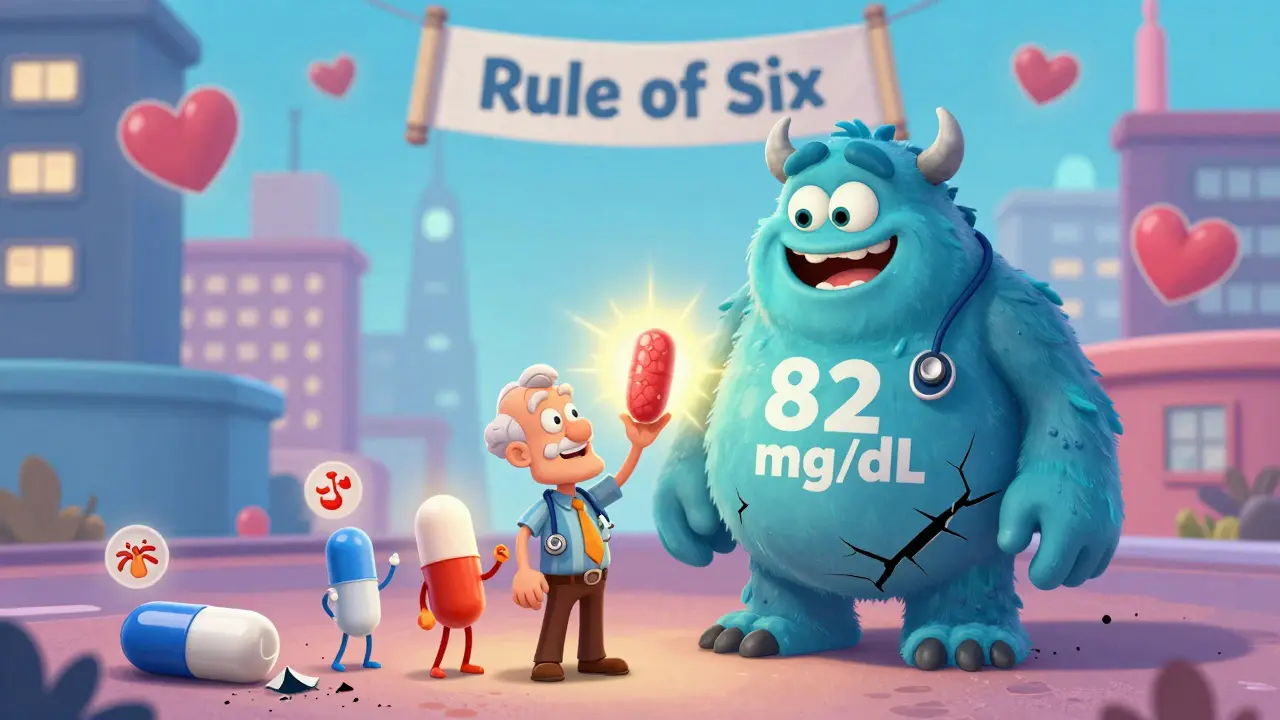
For years, doctors reached for higher statin doses when LDL cholesterol stayed too high. But doubling the dose didn’t double the results. In fact, it barely moved the needle. A 2023 analysis in the Journal of the American College of Cardiology showed that going from 10mg to 20mg of atorvastatin only lowered LDL by another 6% - not 50%. That’s the rule of six: every time you double a statin dose, you get about six extra percentage points of LDL reduction. After a certain point, it’s not worth the risk.
Why High-Dose Statins Don’t Work as Well as You Think
High-dose statins like atorvastatin 80mg or rosuvastatin 40mg are often prescribed for people with heart disease, diabetes, or very high cholesterol. But they come with a cost - muscle pain, fatigue, liver enzyme changes, and sometimes full-blown statin intolerance. About 1 in 10 people stop statins because of side effects. And even if they stick with them, many still don’t hit their LDL targets.
Take a 68-year-old man who had a heart attack. He’s on atorvastatin 80mg, but his LDL is still at 82 mg/dL. His doctor wants it under 70. He’s already on the highest dose. Raising it further isn’t an option. He’s already got muscle aches. What now?
The answer isn’t more statin. It’s less statin - plus something else.
The Power of Combining Medicines
Combination therapy means using a lower, better-tolerated statin dose along with a non-statin drug. The two work together in a way that’s not just additive - it’s multiplicative. Here’s how it works: if a statin lowers LDL by 50%, and ezetimibe lowers it by another 20%, you don’t get 70%. You get 60%. Why? Because ezetimibe works on the remaining 50% of cholesterol still being absorbed. It’s like shutting two doors instead of just one.
That’s why moderate-dose statin (like atorvastatin 20mg or rosuvastatin 10mg) plus ezetimibe 10mg gives you the same LDL reduction as a high-dose statin alone - but with fewer side effects. In a 2024 study published in the European Heart Journal, 78.5% of high-risk patients hit their LDL target with this combo. Only 62.3% did with high-dose statin alone. That’s a 16% jump in success.
Who Benefits Most from This Approach?
This isn’t for everyone. But it’s a game-changer for three groups:
- People with statin intolerance - those who get muscle pain, weakness, or cramps even on low doses. Bempedoic acid, a newer non-statin drug, works in the liver like statins but doesn’t enter muscle tissue. When paired with a moderate statin, it cuts LDL by about the same as a high-dose statin - but with 25% fewer muscle-related problems, according to the CLEAR Harmony trial.
- People with familial hypercholesterolemia - a genetic condition where LDL is sky-high from birth. These patients often need LDL reduced by 70% or more. No single pill can do that safely. But a triple combo - moderate statin + ezetimibe + PCSK9 inhibitor - can slash LDL by 84%.
- Very high-risk patients - anyone who’s had a heart attack, stroke, or has multiple blocked arteries. Their target LDL is now below 55 mg/dL. To get there, you need more than a statin. The 2023 ACC Expert Consensus says: start with combination therapy, not a high-dose statin.
Cost vs. Benefit: Is It Worth It?
Yes - but not always at first glance.
Ezetimibe is cheap. Generic, under $20 a month in the U.S. PCSK9 inhibitors? Those cost $10,000 a year. Insurance often blocks them unless you’ve tried everything else. But here’s the truth: every 1 mmol/L (39 mg/dL) drop in LDL - no matter how you get it - cuts your risk of heart attack or stroke by 22%. That’s from 20 years of data from the Cholesterol Treatment Trialists’ Collaboration.
One study found that adding ezetimibe to a statin saved more lives than doubling the statin dose - and cost less over time. Why? Because fewer people quit their meds. In Europe, 85% of statin-intolerant patients stayed on combination therapy after a year. Only half stayed on high-dose statins after repeated attempts.
Cost isn’t just about the pill. It’s about hospital stays avoided, emergency rooms skipped, and lives saved.
Why Isn’t Everyone Doing This?
Because old habits die hard.
Most doctors still follow the old playbook: start low, then ramp up. But the data now says: start smart. A 2023 study in JAMA Internal Medicine found that primary care doctors only used combination therapy in 25% of patients who clearly needed it. Why? Lack of training. Confusion over the math. Insurance delays. Fear of prescribing “something new.”
Cardiologists are ahead of the curve. In academic hospitals, 45% of high-risk patients get combination therapy. In community clinics? Just 32%. That gap is closing - slowly.
Guidelines are changing. The European Society of Cardiology’s 2023 position paper says: for very high-risk patients, start with a moderate statin plus ezetimibe - not a high-dose statin. The 2025 ESC/EAS guidelines are expected to make this a top recommendation. The FDA updated statin labels in 2023 to say: “Use the lowest effective dose.” That’s a quiet revolution.

What Does This Look Like in Real Life?
Here’s how it works in practice:
- For someone with recent heart attack and LDL of 110 mg/dL: Start with atorvastatin 20mg + ezetimibe 10mg. Check LDL in 6 weeks. Most hit target by then.
- For someone with muscle pain on simvastatin 40mg: Switch to rosuvastatin 10mg + bempedoic acid 18mg. Muscle symptoms usually vanish. LDL drops 45-50%.
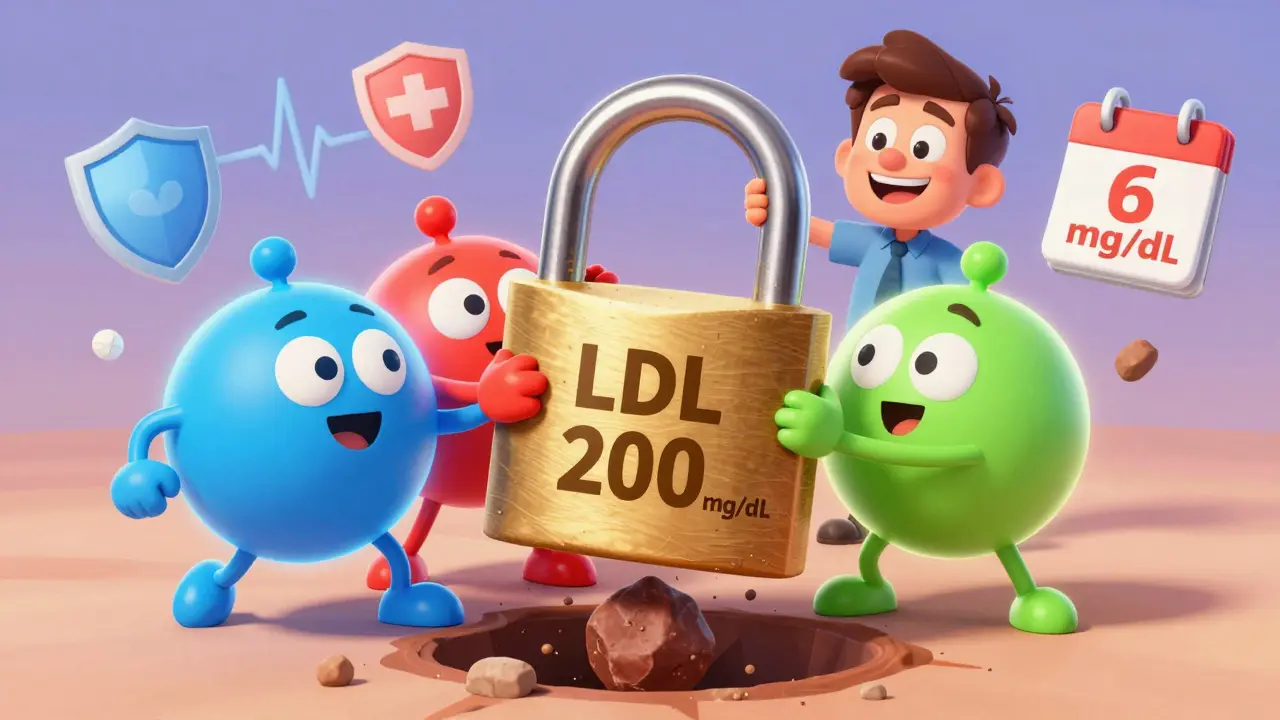
- For someone with familial hypercholesterolemia and LDL of 200 mg/dL: Add a PCSK9 inhibitor (alirocumab or evolocumab) to moderate statin + ezetimibe. LDL often drops below 50 mg/dL.
Follow-up is key. Get a lipid panel after 4-6 weeks. Don’t wait six months. If you’re not close to target, add the next agent - don’t crank up the statin.
What About Natural Remedies or Supplements?
Plant sterols, omega-3s, red yeast rice - these can help a little. But not enough. Red yeast rice contains a natural statin and carries the same side effect risks. Omega-3s help triglycerides, not LDL. Plant sterols lower LDL by 5-10% - useful as a bonus, not a replacement.
If you’re on combination therapy, don’t swap it for supplements. You’re not “naturalizing” your treatment - you’re risking your heart.
The Future Is Combination
By 2025, combination therapy won’t be the exception - it’ll be the standard for high-risk patients. Seven out of ten lipid specialists now start with it. The market for these drugs is growing at nearly 9% a year - while statin-only prescriptions barely move.
It’s not about more pills. It’s about smarter pills. Less risk. Better results. And for the first time, we’re not just lowering cholesterol - we’re lowering the chance of a heart attack without making people feel worse.
Can I just take ezetimibe without a statin?
Ezetimibe alone lowers LDL by about 15-20%. That’s not enough for most people with heart disease or very high cholesterol. It’s meant to be paired with a statin. For those who truly can’t take any statin, bempedoic acid or PCSK9 inhibitors are better options. Ezetimibe by itself is only recommended for very low-risk patients who can’t tolerate any lipid-lowering drugs.
Does combination therapy cause more side effects?
No - it usually causes fewer. High-dose statins cause muscle pain in 10-15% of users. Moderate-dose statins plus ezetimibe cause muscle issues in only 5-8%. Bempedoic acid has even lower muscle side effect rates. The main side effect of ezetimibe is mild stomach upset in about 3% of people. PCSK9 inhibitors may cause injection site reactions or flu-like symptoms, but these are rare and usually mild.
How long does it take to see results?
You’ll see your LDL drop within 2-4 weeks. Most patients hit their target by 6 weeks. A 2024 study showed that combination therapy got patients to goal 4.2 months faster than high-dose statin monotherapy. That’s critical for people who’ve just had a heart attack - every day counts.
Is this covered by insurance?
Ezetimibe and bempedoic acid are usually covered as generics or preferred brands. PCSK9 inhibitors often require prior authorization - your doctor may need to show you tried other options first. If you’re denied, ask for a letter of medical necessity. Many insurers approve it if you have a history of statin intolerance or very high-risk disease.
Should I ask my doctor about this if I’m on a high-dose statin?
Yes - especially if you’re still not at your LDL goal, or if you’re having side effects. Bring up the rule of six and ask if switching to a moderate statin plus ezetimibe might work better. Most doctors haven’t been trained on this approach, but the evidence is clear. You’re not asking for a new treatment - you’re asking for a better one.

so like... uhh i read this whole thing and my brain just went *click*?? like why did no one tell me this before?? i been on 80mg atorvastatin for 2 years and still at 85... and my legs feel like wet noodles. whyyyyyyyy??
This is one of the clearest explanations I’ve seen on statin therapy. The rule of six is such an under-discussed concept. Combining moderate statins with ezetimibe isn’t just smart-it’s evidence-based medicine at its best.
OMG YES 😭 I’ve been telling my doc for months to switch me from 80mg to 20mg + ezetimibe and she kept saying 'but we need to go harder!'... i finally got her to listen after i printed this out. my muscle pain is GONE. 🙌
You know what’s wild? In the UK, we’ve been doing this for ages-low-dose statin plus ezetimibe is basically Step 1 for anyone with familial hypercholesterolemia. But here in the States? It’s like doctors are still using dial-up. I’ve seen patients on rosuvastatin 40mg with LDL at 90, and no one dares touch the statin dose. Meanwhile, ezetimibe costs less than a latte. It’s not rocket science, it’s just... stubbornness.
So let me get this straight. You’re saying we’ve been giving people mega-doses of statins like they’re energy drinks... just because ‘more is better’? And the real solution is… less? And cheaper? And actually works? Wow. I feel like I just discovered the government was lying about Big Pharma the whole time. 🤯
In India, we don’t even have access to PCSK9 inhibitors. But ezetimibe + 10mg rosuvastatin? Totally doable. My uncle went from 140 to 58 in 8 weeks. No muscle pain. Just... better. This combo is the real MVP.
This is all a scam. Statins are just a way for Big Pharma to keep people hooked. The real cause of heart disease is sugar and stress. They don’t want you to know that. Why do you think they push pills instead of telling people to eat less donuts? 🤔
I’ve been on atorvastatin 20mg + ezetimibe for 18 months. LDL down 60%. Muscle pain? Gone. Cost? $15/month. My GP didn’t even know about the 2024 European Heart Journal study. Just shrugged and said 'well, you’re not dead yet.'
I think what’s really missing from this conversation is how much emotional burden this puts on patients. You’re told to take a high-dose statin, you feel awful, you’re scared your heart’s going to give out, but your doctor says 'it’s just side effects, you’ll adjust'... and then you find out there’s a better way that doesn’t make you feel like a zombie? It’s not just medical-it’s psychological. We’ve been gaslit by the system for years.
Start with combo therapy. End of story. If LDL isn’t at goal in 6 weeks, add bempedoic acid or PCSK9. Don’t crank the statin. Simple. Effective. Evidence-based.
The ACC 2023 consensus update explicitly recommends combination therapy for very high-risk patients as first-line. Yet primary care providers still default to high-dose monotherapy. This is a systemic failure in guideline dissemination. We need CME modules, EHR prompts, and payer alignment-not just another blog post.
I’ve been on 80mg for 5 years. My doctor says I’m ‘doing great’ even though my LDL is 92. I asked about ezetimibe. She said ‘why fix what isn’t broken?’ Bro. I’m not broken. I’m just being ignored. This isn’t medicine. It’s negligence dressed in a white coat.
Let me be blunt: if you’re a high-risk patient on a high-dose statin and you’re not at goal, your doctor is either lazy, uninformed, or scared of change. The data is clear. The guidelines are updated. The drugs are available. The cost savings are proven. This isn’t a debate-it’s a moral obligation. Stop waiting for permission to ask for better care. You deserve it.
My mom switched to 10mg rosuvastatin + ezetimibe last year. Her LDL dropped from 115 to 54. She stopped feeling tired all the time. She’s 72. She says she feels like she’s 55 again. I wish someone had told us this sooner