
Statin Exercise Safety Calculator
This tool helps you determine the safest exercise intensity based on your statin type, fitness level, and exercise goals. Moderate exercise (like brisk walking or cycling) is generally safe for statin users, while high-intensity activities may increase muscle injury risk.
Your Safe Exercise Recommendation
Based on your inputs, moderate intensity exercise is recommended to minimize muscle injury risk while taking statins.
Recommended Exercises
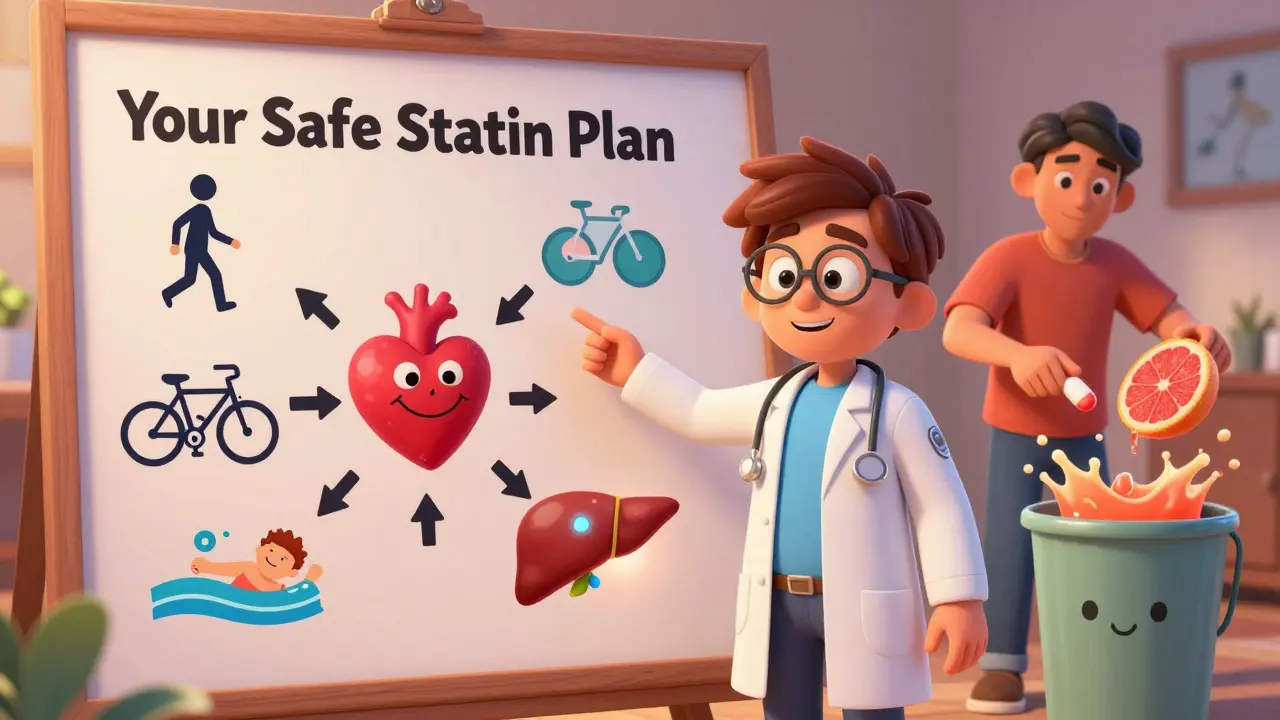
- Cycling at 60% VO2 max (brisk pace)
- Brisk walking at 5-6 on the Borg scale
- Swimming at a steady pace
Important Safety Tips
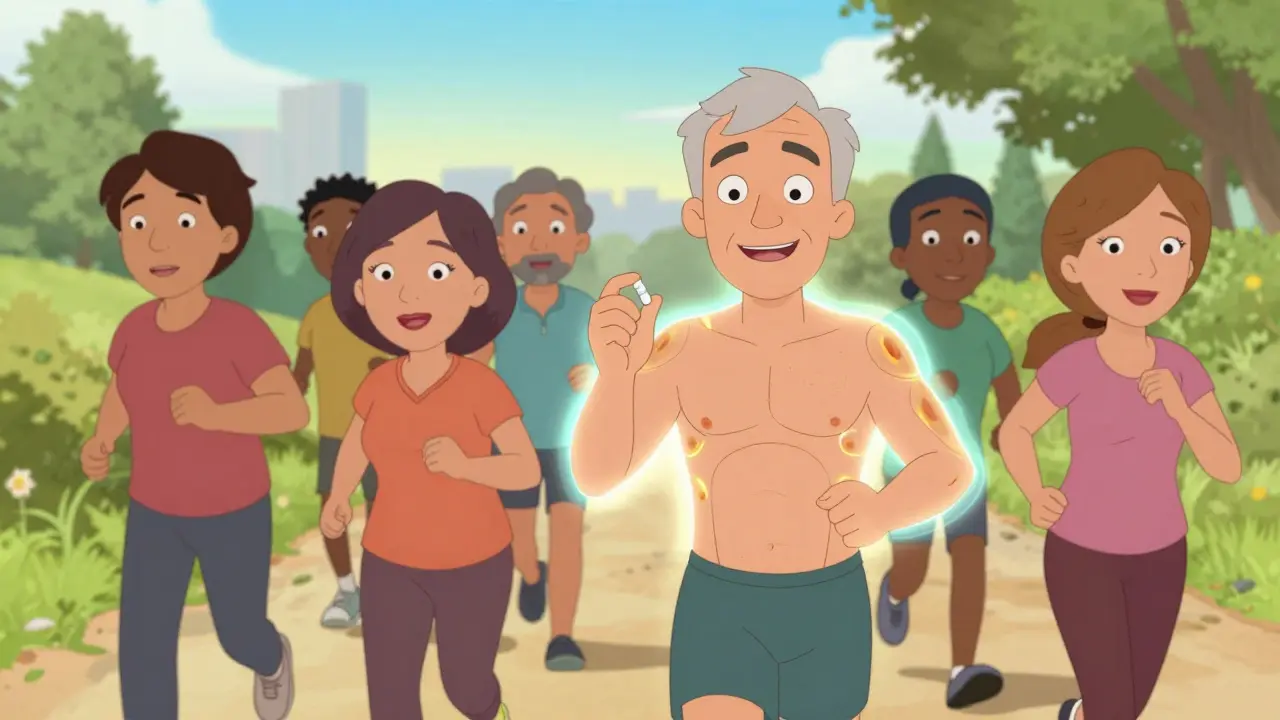
More than 38 million Americans take statins every month. These drugs save lives by lowering bad cholesterol and cutting heart attack risk by up to 35%. But for many, a nagging fear holds them back: statins and exercise might hurt their muscles. You’ve probably heard stories-people who started taking statins and then couldn’t run, lift weights, or even walk up stairs without aching. The truth? It’s not as simple as it sounds. Most people can and should stay active while on statins. The key is knowing how to do it safely.
Why Do Statins Cause Muscle Issues?
Statins work by blocking an enzyme in your liver that makes cholesterol. But that same enzyme is also involved in making coenzyme Q10 (CoQ10), a compound your muscles need for energy. When CoQ10 drops, some people feel more tired, stiff, or sore-especially after physical activity. This isn’t muscle damage from tearing fibers. It’s more like your muscles are running on low fuel.
Not everyone experiences this. Studies show only about 10-15% of statin users report noticeable muscle pain. And here’s the twist: in many cases, the pain isn’t even caused by the statin. A 2023 study found that people who thought their muscle aches were from statins often felt the same pain even when they were taking a sugar pill instead. Your brain can link discomfort to the new medication, even if it’s not the real cause.
Exercise Intensity Matters-A Lot
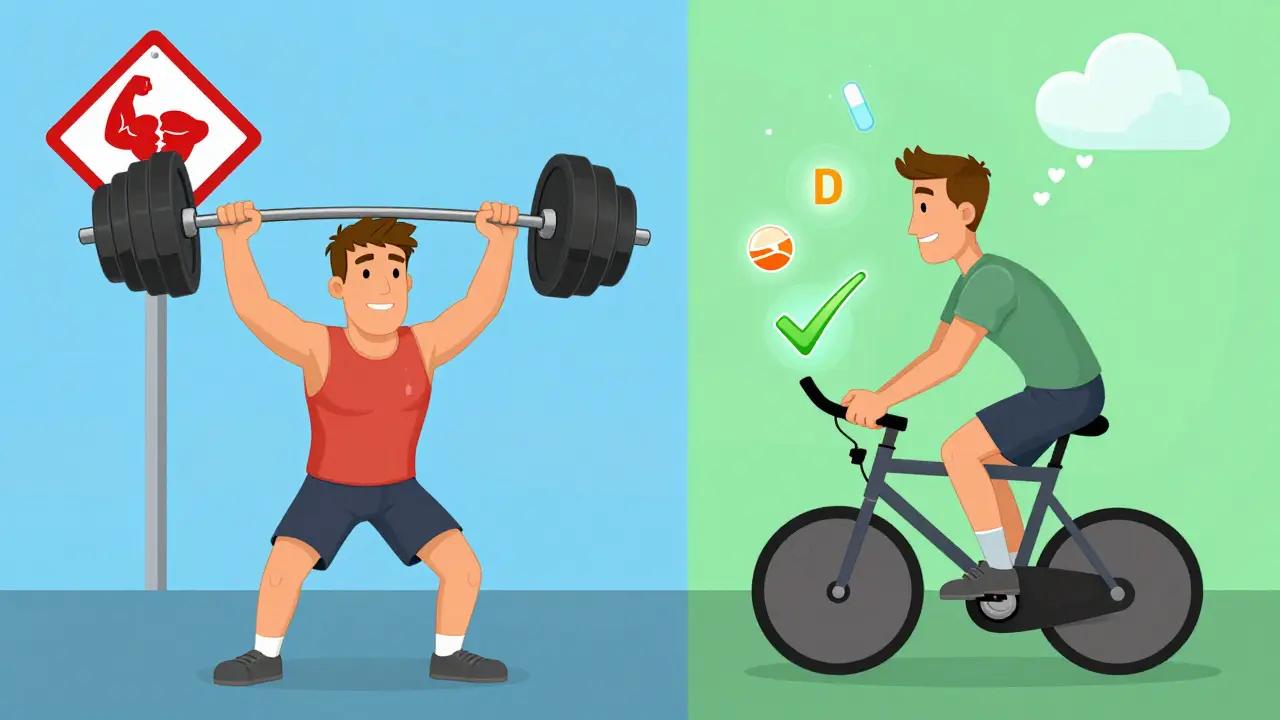
Not all exercise is created equal when you’re on statins. High-intensity workouts like sprinting, heavy weightlifting, or HIIT can spike creatine kinase (CK) levels-a marker of muscle stress-in statin users. One study of Boston Marathon runners found statin users had 42% higher CK levels than non-users after the race. Older runners were even more affected.
But moderate exercise? That’s a different story. In the same 2023 study, participants cycled at 60% of their maximum oxygen capacity (VO2 max) for 45 minutes-about the pace of a brisk, steady bike ride. No increase in muscle damage. No drop in strength. Even people who said they had muscle pain before the workout felt the same amount of soreness as everyone else afterward.
So if you’re on statins, don’t quit exercise. Just change the kind. Swap sprints for slow jogs. Replace heavy squats with bodyweight lunges. Choose cycling over CrossFit. Your heart will thank you more than your muscles will complain.
How to Exercise Safely on Statins
Here’s what actually works, based on real studies and expert advice:
- Keep it moderate. Aim for 5-6 on the 10-point Borg scale-where 10 is “can’t talk at all.” If you can still sing along to your playlist, you’re in the right zone.
- Build up slowly. If you’re new to exercise or returning after a break, increase your time or intensity by no more than 10% per week. Your muscles adapt over time. One mouse study showed that animals trained for two weeks before taking statins didn’t lose muscle strength at all.
- Time your workout. Most statins peak in your bloodstream 2-4 hours after you take them. Try exercising 6-8 hours after your dose, or in the evening if you take your pill in the morning. It won’t eliminate risk, but it might reduce it.
- Check your vitamin D. Low vitamin D is linked to worse statin muscle symptoms. Get your levels checked. If you’re under 30 ng/mL, a simple supplement (1,000-2,000 IU daily) can help.
- Avoid certain combos. Never mix statins with fibrates (like gemfibrozil) or high-dose niacin. These increase muscle injury risk by 3 to 5 times. Also, avoid grapefruit juice with simvastatin or lovastatin-it can spike statin levels in your blood.
- Watch for red flags. Normal soreness fades in 24-48 hours. If pain lasts longer, or if your urine turns dark (like cola), stop exercising and call your doctor. That could be rhabdomyolysis-a rare but serious condition.
Not All Statins Are the Same
There are seven statins on the market. Some are more likely to cause muscle issues than others. Lipophilic statins-like simvastatin, atorvastatin, and lovastatin-penetrate muscle tissue more easily. Hydrophilic statins-like pravastatin and rosuvastatin-stay mostly in the liver.
A 2024 review found that people taking pravastatin or rosuvastatin had 23% fewer muscle symptoms during exercise than those on simvastatin or atorvastatin. If you’re struggling with muscle pain, talk to your doctor about switching. You might not need to stop the statin-just change which one you take.
What About Dosing?
Many people take statins daily. But you don’t always need to. Rosuvastatin has a long half-life-meaning it stays active in your body for days. Some studies show that taking it every other day (e.g., 20 mg on Monday, Wednesday, Friday) works just as well for lowering cholesterol, with fewer muscle side effects.
One trial had people on 10 mg of rosuvastatin daily. Their VO2 max (a measure of aerobic fitness) went up 29% after 10 weeks of training. Same result as those on higher doses. So if you’re active and having trouble, ask if you can cut your dose or go every-other-day. It’s not a gamble-it’s a proven option.
Real People, Real Results
Online forums are full of people who gave up running because of statin pain. But here’s what happened when they tried again, smarter:
- A 62-year-old man in Ohio switched from simvastatin to pravastatin and started walking 30 minutes a day. Within three months, his muscle pain dropped 70%.
- A woman in Texas stopped doing HIIT and began cycling at a steady pace. She went from avoiding exercise to completing a 5K.
- On Reddit’s r/Statins, users who switched from high-intensity training to moderate activity reported a 60% drop in muscle symptoms.
These aren’t outliers. They’re examples of what happens when you adjust-not quit.
Don’t Stop Moving
The biggest danger isn’t statins. It’s inactivity. People who stop exercising because they’re scared of muscle pain raise their heart attack risk more than if they stayed on statins. The American Heart Association says the combo of statins and regular physical activity cuts cardiovascular events by up to 50%-far more than either one alone.
Think of it this way: statins protect your arteries. Exercise strengthens your heart and muscles. They’re partners, not enemies. If you’re having trouble, it’s not a reason to give up. It’s a signal to adjust.
When to Talk to Your Doctor
You don’t need to suffer. If you notice:
- Muscle pain that lasts more than 72 hours after exercise
- Weakness in your arms or legs that doesn’t go away
- Dark urine or extreme fatigue
Call your doctor. They can check your CK levels, test your vitamin D, and help you switch statins or adjust your dose. Never stop your statin without talking to them first. The risk of a heart attack or stroke from stopping is much higher than the risk of muscle injury.
Bottom Line
Statins and exercise can work together-safely and powerfully. You don’t need to be an athlete. You just need to move regularly, at a pace that lets you breathe. Skip the sprints. Skip the heavy lifts. Stick with walking, cycling, swimming, or light resistance training. Stay consistent. Monitor your symptoms. Talk to your doctor. And keep going. Your heart is counting on it.
Can I still run if I take statins?
You can, but it depends. If you’re running at a high intensity-like racing or doing sprints-you’re more likely to raise muscle injury markers. For most people on statins, steady, moderate running (like a 30-minute jog at a conversational pace) is safe. If you’ve had muscle pain before, try switching to cycling or brisk walking first. If symptoms improve, you can slowly reintroduce running.
Do statins make you weaker?
Not in a meaningful way. Studies show statins don’t reduce muscle strength. People on statins can lift the same weights, bike the same distances, and climb the same stairs as those not taking them. What changes is how their muscles feel afterward. They may report more soreness, but their actual performance stays the same. This is important: feeling sore doesn’t mean you’re losing strength.
Which statin causes the least muscle pain?
Pravastatin and rosuvastatin are linked to fewer muscle symptoms than simvastatin or atorvastatin. This is because they’re hydrophilic-they don’t penetrate muscle tissue as easily. If you’re experiencing muscle pain, ask your doctor if switching to one of these might help. Many people see improvement without losing cholesterol control.
Should I take CoQ10 supplements with statins?
Some people find relief, but the science isn’t clear-cut. Studies on CoQ10 supplements for statin-related muscle pain show mixed results. A few show slight improvement; most show no difference compared to placebo. If you want to try it, 100-200 mg daily is common. But don’t expect miracles. Focus first on exercise type, statin choice, and vitamin D-those have stronger evidence.
Can I stop taking statins if exercise hurts too much?
No-not without talking to your doctor. Stopping statins increases your risk of heart attack and stroke, especially if you’ve already had cardiovascular disease. Muscle pain from statins is usually manageable. There are options: switch statins, lower the dose, change your exercise routine, or adjust timing. Stopping is the last resort, not the first.


I took statins for a year. Stopped. Felt better. No heart attack. Coincidence? Maybe. But I’m not risking it again.
Done.
Honestly? I’ve been on atorvastatin for 5 years. I ride my bike 40 miles every weekend. No issues. Maybe it’s just me. Or maybe the fear is way bigger than the problem.
People act like statins turn you into a walking limp.
It is imperative to underscore that the pharmacokinetic profile of hydrophilic statins, namely pravastatin and rosuvastatin, demonstrably mitigates myopathic adverse effects through reduced myocellular penetration. The assertion that exercise intensity modulates creatine kinase elevation is empirically supported by contemporary clinical trials, particularly those conducted by the American College of Cardiology. One must, however, remain cognizant of confounding variables such as vitamin D status and concomitant medication use.
I switched from simva to rosuva and started walking daily 🚶♀️✨
My legs stopped screaming at me 😭
Now I can finally do yard work without crying. Thank you for writing this. Seriously. 🙏
so like… i was doing crossfit and statins and yeah it sucked. like my quads felt like they were full of sand after every workout. i thought i was just getting old. then i read this and switched to cycling. and guess what? i didn’t die. i didn’t even feel bad. i can now ride 20 miles without wanting to cry. also i stopped taking coq10 cause it was just a waste of money. vitamin d? yeah that helped. 2000iu a day. no magic pill. just dumb simple stuff. also i spell weird. sorry.
Y’all are overthinking this so hard 😭
Statins + moderate movement = your heart’s BFF
Stop turning fitness into a military operation.
Walk. Bike. Swim. Don’t be a hero. Don’t quit. Just… move.
And if your legs ache? Chill. It’s not damage. It’s your muscles saying ‘hey, we’re still here.’
WE’RE NOT BROKEN. WE’RE ADJUSTING. 🙌❤️
This is why America’s getting soft. People whine about a little soreness and quit. I worked construction in 100-degree heat on statins. Didn’t cry. Didn’t quit. Just worked harder. If you can’t handle moderate exercise, maybe your problem isn’t the statin - it’s your laziness.
There’s a deeper question here than muscle pain.
Why do we assume that discomfort equals damage?
Why do we equate physical sensation with biological failure?
Statins aren’t the enemy. Our fear of aging, of losing control, of not being ‘strong’ enough - that’s the real drug.
Maybe the real therapy isn’t changing statins…
It’s changing how we listen to our bodies.
Not to punish them.
Not to fear them.
But to understand them.