
Before you pick up a bottle of generic ibuprofen at the pharmacy, chances are you don’t think about how it got there. But the story behind those cheap pills is one of legal battles, life-saving reforms, and a system designed to put health within reach of everyone - not just the wealthy. Today, over 90% of prescriptions filled in the U.S. are for generic drugs. They’re safe, effective, and save billions every year. But this wasn’t always the case. For most of the 20th century, if you needed a medicine, you paid the brand-name price - no exceptions.
The Roots of Drug Standards: Before Generics Even Existed
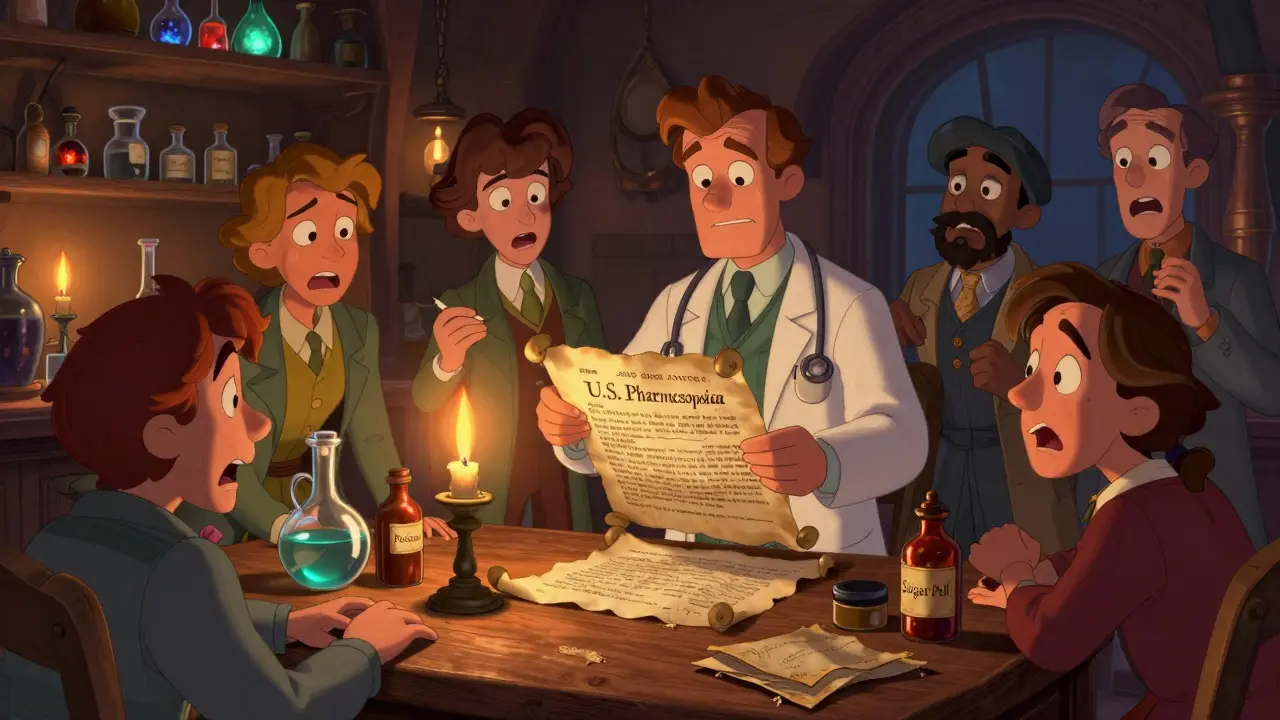
The story starts long before anyone talked about "generic drugs." In 1820, eleven doctors met in Washington, D.C., and created the first U.S. Pharmacopeia - a list of approved drug ingredients and formulas. Back then, medicines were mixed by hand, often with unknown or dangerous additives. Some were just sugar pills with a fancy label. The Pharmacopeia was the first attempt to bring order to chaos.
By 1888, the American Pharmaceutical Association added the National Formulary, a companion guide that helped pharmacists identify real drugs from fakes. These early efforts weren’t about lowering prices - they were about survival. People were dying from contaminated or fake medicines. In 1937, over 100 people, mostly children, died after drinking a toxic elixir called Sulfanilamide. The poison? Diethylene glycol, the same chemical used in antifreeze. That tragedy forced Congress to pass the Federal Food, Drug, and Cosmetic Act in 1938. For the first time, drug companies had to prove their products were safe before selling them.
The Efficacy Revolution: The 1962 Kefauver-Harris Amendments
Even after 1938, there was a huge loophole. Drugs approved between 1938 and 1962 didn’t have to prove they actually worked. They only had to be safe. That meant thousands of drugs were on the market with no real evidence they helped patients. In 1962, after public outcry over ineffective and overpriced drugs, Congress passed the Kefauver-Harris Drug Amendments. Now, every drug - brand or generic - had to prove both safety and effectiveness. This was a turning point. It didn’t create generics yet, but it set the stage for them.
At the same time, Medicare and Medicaid were launched. These government programs needed to stretch every dollar. They started pushing hospitals and pharmacies to use cheaper alternatives whenever possible. That’s when pharmacists and doctors began asking: "Why pay more for the same pill?" The idea of generics wasn’t new, but now there was a financial reason to make it happen.
The Hatch-Waxman Act: The Game Changer
Before 1984, getting a generic drug approved was a nightmare. Manufacturers had to run full clinical trials - the same expensive, multi-year studies brand-name companies did. That made generics too costly to produce. So only about 19% of prescriptions were for generics. The rest? Brand names, with prices set by whoever owned the patent.
That changed with the Drug Price Competition and Patent Term Restoration Act of 1984 - better known as the Hatch-Waxman Act. It created the Abbreviated New Drug Application (ANDA). Instead of redoing clinical trials, generic makers only had to prove their drug was bioequivalent: it worked the same way in the body as the brand-name version. No need to test it on thousands of patients. Just show the body absorbs it the same, at the same rate, in the same amount.
This was genius. It cut approval time from years to months. It slashed production costs. And it gave generic companies a clear path to market. The law also gave brand-name companies a 30-month patent extension if they sued a generic maker - a loophole that’s been abused ever since. But overall, Hatch-Waxman worked. By 2000, generics made up 49% of prescriptions. By 2010, it was 78%. Today? Over 90%.
How Generics Save Billions - and Why Prices Still Spike
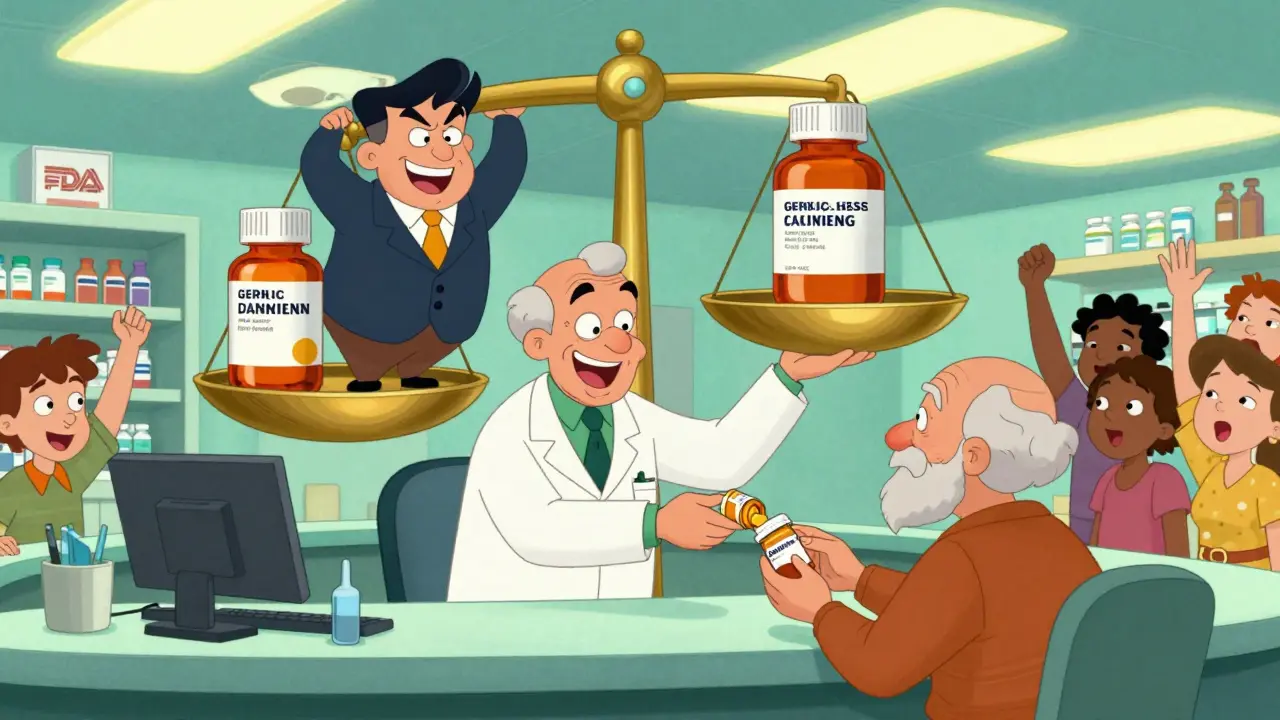
Here’s the math: In 2021, generic drugs saved the U.S. healthcare system $373 billion. Over the last decade, that total hit $3.7 trillion. The Congressional Budget Office found generics cut drug spending by 80-85% compared to brand names. That’s not a small number. It’s the difference between someone filling their prescription or skipping it.
But here’s the twist: even though most generics are cheap, some have become shockingly expensive. Between 2013 and 2017, prices for 15% of generic drugs jumped over 100%. Why? Because the market for certain drugs became a monopoly. If only one company makes a cheap antibiotic or blood pressure pill, they can raise prices with little pushback. In some cases, the same company bought up all competitors - then raised prices 500% overnight. The FDA and Congress have tried to fix this, but the system still has gaps.
Quality, Supply Chains, and the Global Problem
Most people assume generic means low quality. That’s not true. The FDA holds generics to the same standards as brand names. Same active ingredient. Same strength. Same shelf life. Same factory inspections.
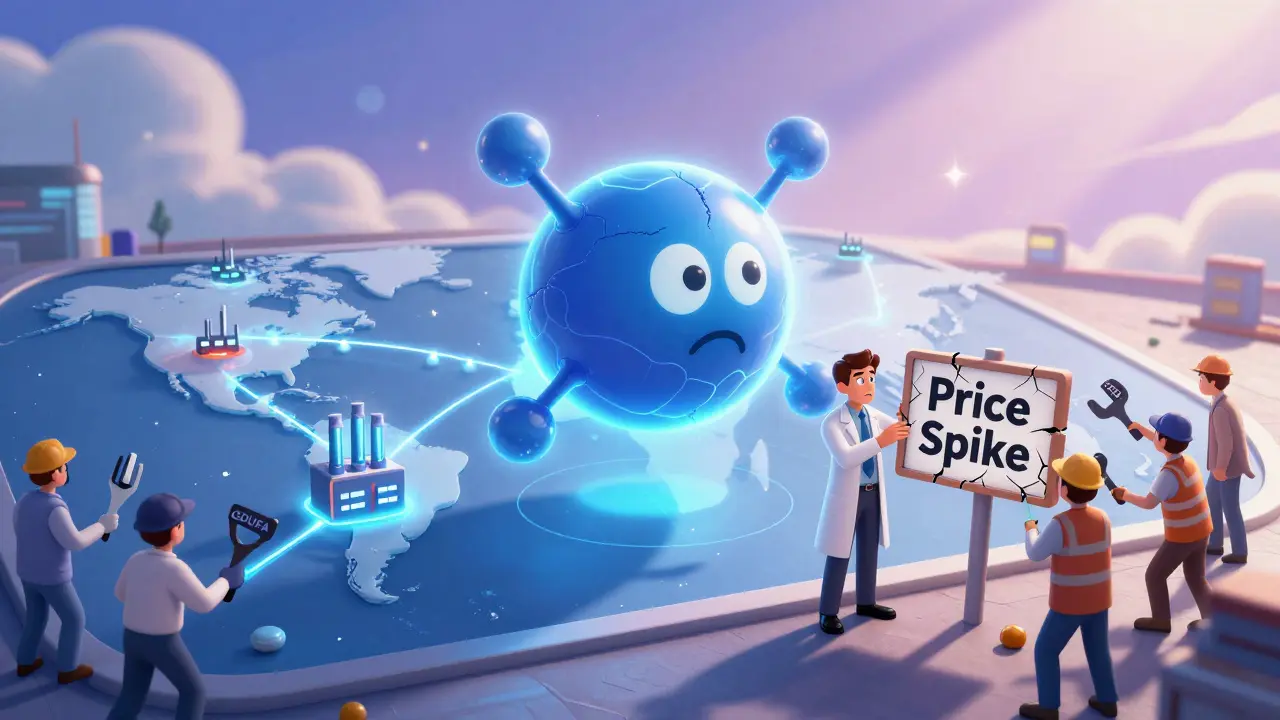
But here’s the catch: 80% of the active ingredients in U.S. drugs come from factories in China and India. The FDA inspects only a fraction of them each year. Between 2018 and 2022, 65% of all drug shortages involved generics. Why? Because supply chains are fragile. A factory shutdown in India, a shipment delay in China, or a quality control failure can leave hospitals without life-saving medicines.
The FDA’s Generic Initiative for Value and Efficiency (GIVE), launched in 2007, tried to fix this. Then came GDUFA - the Generic Drug User Fee Amendments - in 2012. Under GDUFA, generic companies pay fees to fund faster FDA reviews. Result? Approval times dropped from 30 months to 10. Approval rates jumped from 45% to 95%. That’s progress. But it’s not enough.
The Future: Biosimilars and the Next Frontier
Now, the next wave is coming: biosimilars. These are generic versions of biologic drugs - complex medicines made from living cells, like insulin, cancer treatments, and rheumatoid arthritis drugs. Unlike small-molecule generics, biosimilars aren’t exact copies. They’re highly similar. Making them takes years and billions in R&D. But once approved, they can cut prices by 30-50%.
Companies like Amgen and Pfizer are already bringing biosimilars to market. The FDA has approved over 40 so far. By 2027, analysts expect biosimilars to make up 10-15% of the generic drug market. That could save another $100 billion a year.
Meanwhile, laws like the CREATES Act (2019) are trying to stop brand-name companies from blocking generics by refusing to sell them samples for testing. The FDA has already taken 27 enforcement actions under this law. It’s a small step, but it matters.
Today, the FDA oversees more than 22,000 generic drug products and 13,000 manufacturing sites worldwide. Over 900 new generic applications are approved each year. The system isn’t perfect. But it works - for most people, most of the time.
Why This Matters to You
When you pay $4 for a month’s supply of metformin instead of $400, you’re not getting a bargain. You’re benefiting from 200 years of reform, tragedy, lawmaking, and public pressure. The same system that lets you buy cheap antibiotics also protects you from poisoned medicines. It’s not glamorous. But it’s essential.
Generics aren’t just about saving money. They’re about access. They’re about a diabetic in rural Ohio getting insulin. A veteran in Texas getting blood pressure pills. A single mom in Detroit filling her child’s asthma prescription. Without generics, millions would go without.
Are generic drugs as safe and effective as brand-name drugs?
Yes. The FDA requires generic drugs to have the same active ingredient, strength, dosage form, and route of administration as the brand-name version. They must also be bioequivalent - meaning they work the same way in the body. Generics go through the same manufacturing inspections and quality controls. The only differences are in inactive ingredients like color or shape - which don’t affect how the drug works.
Why are generic drugs so much cheaper?
Generic manufacturers don’t have to repeat expensive clinical trials. Thanks to the Hatch-Waxman Act, they only need to prove bioequivalence. That cuts development costs by up to 90%. Plus, once multiple companies make the same drug, competition drives prices down. Brand-name companies spend billions on marketing and patents. Generics don’t.
Why do some generic drug prices suddenly spike?
When only one or two companies make a particular generic drug, there’s little competition. If one company leaves the market or faces a supply issue, the remaining maker can raise prices. This happened with drugs like doxycycline and albuterol. The FDA tracks these cases and tries to encourage new manufacturers to enter the market, but it’s not always fast enough.
Can I trust generics made in China or India?
The FDA inspects all facilities that make drugs for the U.S. market - no matter where they are. About 80% of active pharmaceutical ingredients come from outside the U.S., mostly from China and India. While some facilities have had violations, the FDA has the authority to block imports and shut down plants. Most generic drugs are safe. But supply chain issues - like factory shutdowns or shipping delays - are the main cause of drug shortages, not poor quality.
What’s the difference between a generic and a biosimilar?
Generics are copies of small-molecule drugs made with chemicals - like aspirin or metformin. Biosimilars are copies of complex biologic drugs made from living cells - like insulin or Humira. Biosimilars aren’t exact copies because biologics are too complex to replicate perfectly. But they’re highly similar in structure and function. They’re also much harder and more expensive to develop, which is why they’re not as common yet. But they’re the next big wave in lowering drug costs.
If you’ve ever wondered why your prescription costs less than your coffee, now you know. It’s not luck. It’s the result of laws written in response to suffering, science, and stubborn resistance from powerful interests. Generics aren’t just a product. They’re a public health victory.
The FDA is a puppet of Big Pharma and the WHO. They let Chinese factories pump out fake generics while you think you're saving money. That metformin you took last week? Probably laced with heavy metals. I know because I read a whistleblower blog. Your insulin could be killing you slowly and you don't even know it.
What we're seeing here isn't just a regulatory win-it's a philosophical shift in how society values life over profit. The 1938 Act didn't just prevent poison; it said human beings deserve more than snake oil. Hatch-Waxman didn't just lower prices-it democratized biology. When a single mother in Detroit can afford her child's asthma inhaler because a law passed in 1984, that's not economics. That's justice. And yet, we still let monopolies strangle supply chains like corporate vampires. We built a system that saves trillions, then let greed carve holes in it. The real tragedy isn't the price spikes-it's that we still treat healthcare as a privilege instead of a right.
It's hilarious how people still think 'Made in India' means 'cheap and shady.' The FDA doesn't care where your pill comes from-it cares if it works. And guess what? Most Indian and Chinese facilities have better inspection records than some U.S. plants. But no, let's keep the fear-mongering. It's more entertaining than actual policy discussion. Also, biosimilars are coming. Get ready to stop crying about $4 pills.
USA made this system. China and India just got rich off it. We gave away our medicine patents and now we're begging for pills. This isn't globalization-it's surrender. We should be making our own drugs. Not letting foreign labs control our health. And don't get me started on how the FDA lets these foreign plants slide. Wake up, people. This is economic warfare.
ANDA loophole = corporate collusion. Hatch-Waxman was designed to be a Trojan horse. The 30-month patent extension? That's not a loophole-it's a backdoor monopoly engine. Big Pharma pays lawyers to sue every generic startup into oblivion. Then they buy the remaining competitors. Price spikes aren't accidents-they're engineered. GDUFA? Just a PR stunt. The FDA is outgunned. The system is rigged. And they want you to believe it's working.
People who trust generics are naive. You think the FDA checks every batch? Nah. They inspect 3% of foreign plants. The rest? Paperwork. And don't tell me about bioequivalence-that's just a lab test on 20 people. Real-world effects? Unknown. You're playing Russian roulette with your kidneys. And you call that progress? Pathetic.
Supply chain fragility is a systemic failure of vertical integration. The concentration of API manufacturing in two geopolitical regions creates non-linear risk exposure. The FDA's GDUFA framework, while improving throughput, does not address the structural vulnerability of monopsonistic procurement. Without diversification of sourcing or strategic stockpiling, systemic shortages are inevitable. The 65% statistic is not anomalous-it is deterministic under current policy architecture.
They don't want you to know this-but the real reason generics are cheap is because they're not made for you. They're made for Medicaid. For Medicare. For the poor. The rich still get the brand-name stuff. The same companies that make generics? They sell the brand versions for 10x the price. And they patent every minor tweak to keep you paying. This isn't a victory-it's a distraction. They gave you the crumbs so you wouldn't notice they stole the whole table.
It is with profound respect for the tireless efforts of public health advocates, regulatory scientists, and legislative pioneers that I acknowledge the monumental achievement represented by the widespread adoption of generic pharmaceuticals in the United States. The convergence of scientific rigor, legislative foresight, and economic pragmatism has yielded a public health infrastructure that is, by global standards, exemplary. We must not take this hard-won progress for granted. Continued investment in oversight, supply chain resilience, and innovation in biosimilar development is not merely advisable-it is an ethical imperative. Let us honor those who suffered so that we might now breathe easier.