

When your hand starts shaking for no reason-especially when you're at rest-it’s easy to brush it off as nerves or fatigue. But if that tremor won’t go away, and your muscles feel stiff like they’re wrapped in rubber bands, it might be something deeper. For over 10 million people worldwide, this isn’t just a passing phase. It’s Parkinson’s disease.
What’s Really Happening in the Brain?
Parkinson’s isn’t just about shaking hands. At its core, it’s a slow breakdown of brain cells that make dopamine. These cells live in a small area called the substantia nigra. When they die off, dopamine levels drop. By the time symptoms show up, most people have already lost 60 to 80% of their dopamine-producing neurons. That’s why movement becomes harder-dopamine is the brain’s signal to move smoothly, and without it, the system stutters.The result? Four main symptoms: tremor, stiffness, slowness, and trouble with balance. Of these, the tremor is the most recognizable. It’s not a shake when you’re using your hand-it’s a quiet, rhythmic movement when you’re sitting still. Often, it starts in one finger, thumb, or hand, like you’re rolling a pill between your fingers. It fades when you reach for a cup or wave hello. And it disappears completely when you sleep.
Stiffness, or rigidity, is just as common but less talked about. It’s not just tight muscles. It’s your arm or leg resisting when someone tries to move it for you. Doctors call it ‘cogwheel’ rigidity because it feels like gears catching as they turn. This stiffness makes everyday tasks painful or impossible: buttoning a shirt, writing a note, tying your shoes. One study found that 73% of people with Parkinson’s struggle with these small movements within three years of diagnosis.
Why Dopamine Replacement Is the Go-To Treatment
You can’t just swallow a dopamine pill. Your body breaks it down before it ever reaches the brain. So instead, doctors use levodopa-the chemical your body turns into dopamine. Levodopa slips through the blood-brain barrier like a key into a lock. Once inside, it becomes dopamine, and suddenly, movement gets easier.But levodopa alone causes nausea, dizziness, and other side effects because it turns into dopamine in your stomach and other parts of your body before it even gets to the brain. That’s why it’s almost always paired with carbidopa. Carbidopa blocks that early conversion, letting more levodopa reach the brain. Together, they form the most common Parkinson’s medication: carbidopa/levodopa.
Most people feel better within 30 to 60 minutes after taking it. In the first few years, many see up to 70% improvement in movement. That’s the ‘honeymoon period.’ For some, it’s life-changing. They can walk again, write again, hold their grandchild’s hand.
The Catch: It Doesn’t Last Forever
Here’s the hard truth: dopamine replacement doesn’t stop Parkinson’s from progressing. It just masks the symptoms. After 5 to 10 years, the same dose that once gave you 6 hours of good movement might only last 2. That’s called ‘wearing-off.’ You start to notice the tremor creeping back before your next pill.Then there’s dyskinesia-uncontrolled, jerky movements that happen when the drug peaks. It’s ironic: the medicine that helps you move now makes you move too much. One patient on a Parkinson’s forum said, “I can’t eat without my arm flailing like I’m conducting an orchestra.”
Not everyone gets dyskinesia, but about 40 to 50% of long-term users do. That’s why doctors now start with lower doses than they used to. The ‘start low, go slow’ approach is standard. A typical beginning dose is 25/100 mg (carbidopa/levodopa) one to three times a day. It’s increased gradually, based on how you respond.
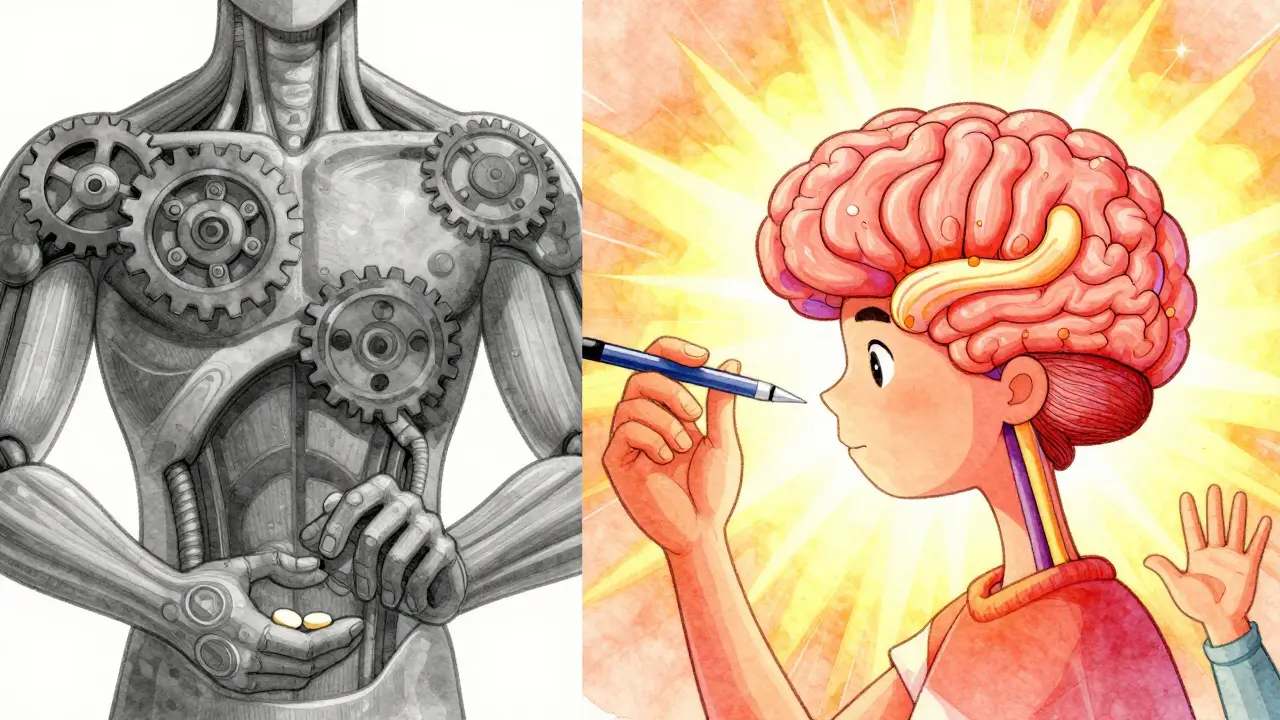
Alternatives to Levodopa
Some people start with dopamine agonists like pramipexole or ropinirole. These mimic dopamine directly in the brain. They’re not as strong as levodopa-about 30 to 50% as effective-but they carry a lower risk of early dyskinesia. That’s why they’re often used in younger patients, under 60, to delay the need for levodopa.But they come with their own problems: drowsiness, hallucinations, compulsive behaviors like gambling or overeating. One study found that 60% of patients eventually need both a dopamine agonist and levodopa to stay in control.
Then there’s Inbrija, an inhaled form of levodopa approved for sudden ‘off’ episodes. It works in about 10 minutes. But it costs $3,700 a month. Most people can’t afford it without insurance.
What You Can Do Every Day
Medication alone isn’t enough. Timing matters. High-protein meals-steak, eggs, cheese-can block levodopa from being absorbed. Many patients learn to take their pills 30 minutes before meals or wait an hour after. One Reddit user wrote, “I eat carbs for breakfast, protein for dinner. It’s the only way I stay steady all day.”Keeping a log helps too. Note when you feel ‘on’ and ‘off.’ Track your doses. Bring it to your doctor. A 2023 survey found that 56% of patients say managing medication timing is their biggest daily challenge.
And you’re not alone in this. Nearly 78% of people with Parkinson’s need help from a caregiver to manage their pills. What starts as 15 minutes a day turns into 45 minutes as the disease moves forward.

What’s Next?
Scientists aren’t standing still. There’s new research on continuous dopamine delivery through tiny pumps under the skin. One trial showed patients gained 2.5 extra ‘on’ hours per day compared to pills. Gene therapies are being tested to help the brain make its own dopamine again. And the Parkinson’s Progression Markers Initiative is looking at DNA to predict who’ll respond best to which drug.But for now, the best tool we have is still levodopa. It’s not perfect. It’s not a cure. But for millions, it’s the difference between staying in bed and walking outside.
What’s clear is this: Parkinson’s treatment isn’t one-size-fits-all. It’s a balancing act-between symptom control and side effects, between independence and dependence on pills. The goal isn’t just to move better. It’s to live better, for as long as possible.
Is tremor always the first sign of Parkinson’s?
No. While tremor is the most recognizable symptom, about 20% of people with Parkinson’s don’t have it at all. Some first notice stiffness, slowness, or trouble with balance. Others lose their sense of smell or have trouble sleeping years before movement symptoms appear. Parkinson’s doesn’t follow the same path for everyone.
Can you stop taking dopamine medication if symptoms improve?
No. Stopping dopamine replacement suddenly can lead to a dangerous condition called neuroleptic malignant syndrome, which causes high fever, muscle rigidity, and confusion. Even if you feel better, you must never stop these medications without your doctor’s guidance. Doses are adjusted slowly, not stopped abruptly.
Does levodopa make Parkinson’s worse over time?
No. Earlier theories suggested levodopa might speed up brain cell death, but large studies since 2015 have proven that wrong. Levodopa doesn’t accelerate the disease. The motor complications-like wearing-off and dyskinesia-are signs the disease is progressing, not that the medication is harming you. It’s the brain’s changing response, not the drug’s toxicity.
Why do some people get dyskinesia and others don’t?
It’s a mix of genetics, dosage, and how long you’ve been on treatment. People who start levodopa younger and take higher doses are more likely to develop dyskinesia. Genetic differences in enzymes like COMT and MAO-B also affect how quickly the body breaks down dopamine, influencing side effects. There’s no way to predict it exactly, but starting with lower doses reduces the risk.
Are there natural ways to boost dopamine for Parkinson’s?
Exercise is the most proven natural support. Regular walking, tai chi, or dancing improves mobility and may help the brain use dopamine more efficiently. Some supplements like coenzyme Q10 or vitamin D are studied, but none have been proven to replace medication. Avoid unregulated ‘dopamine-boosting’ products-they’re not FDA-approved and can be dangerous.




i think i might have parkinson’s… my thumb does that pill-rolling thing when i’m watching tv and i’ve been dropping stuff all the time. not saying it’s that but… yeah.
It’s critical to recognize that the dopaminergic deficit in Parkinson’s is not merely quantitative but also qualitative-presynaptic terminals lose vesicular storage capacity, leading to erratic, non-physiological dopamine release. That’s why pulsatile stimulation from oral levodopa induces maladaptive striatal plasticity over time, contributing to LID. Continuous delivery systems (like Duodopa or apomorphine pumps) restore tonic signaling, which is neuroprotective in theory, even if not yet proven clinically. The real issue is the lack of biomarkers to titrate therapy dynamically.
they don't want you to know this but dopamine meds are just a cover up for what the pharmaceutical industry really wants which is to keep you dependent on pills so they can sell you more drugs and the real cure is out there in essential oils and magnetic therapy but they suppress it because it's cheaper than surgery and the FDA is in their pocket i've read it on 3 different blogs and my cousin's neighbor's dog had parkinson's and got better with CBD oil and now he runs marathons
man i had a buddy in delhi who got diagnosed last year. he started doing yoga every morning and now he’s teaching classes. i mean i don’t know if it fixes it but at least he’s smiling again. that counts for something right?
we spend billions on this while our veterans can’t get mental health care. this is what’s wrong with america. why are we funding drug companies instead of fixing real problems?
hey if you're just getting started with meds-don’t panic. the honeymoon phase is real and it’s beautiful. i’ve seen people go from barely walking to dancing at their kid’s wedding after a few tweaks. keep a log, take it at the same time every day, and if your protein is wrecking your absorption-just shift your steak to dinner. small wins add up. also, find a support group. talking to someone who gets it? that’s medicine too. you’re not broken. you’re adapting. and that’s brave.
actually levodopa does accelerate neurodegeneration-there’s a 2011 paper in Neurology that got buried because the pharma lobby didn’t like it. and the ‘wearing off’ isn’t disease progression-it’s the drug poisoning the system. they just rebranded it to sell more pills. also, why is no one talking about the gut-brain axis? Parkinson’s starts in the vagus nerve. We’re treating the symptom, not the origin.
Levodopa is obsolete. We need targeted delivery. End of story.
i remember my gran taking her pills like clockwork-always with a sip of orange juice, never with milk. she’d say, ‘the body’s a garden, love, and some weeds choke the good stuff.’ she danced in the kitchen even when her hands shook. didn’t cure it, but made it hers. i miss her. still, that’s the real treatment right there-not the pill, but the person holding it.
thank you for writing this with so much care. i’ve been living with this for 8 years and most articles make it sound like a death sentence. this feels like a map, not a tombstone.
for anyone new to this-don’t let anyone tell you exercise isn’t medicine. i started with 10-minute walks. now i do tai chi twice a week and i swear, my rigidity drops after each session. and yes, i still take my meds-but the combo? magic. also, get a smartwatch that vibrates to remind you. i set mine for 8am, 12pm, 5pm. no more missed doses. you’ve got this.
you’re all naive. this is a government mind-control experiment. the tremors are caused by 5G towers and the pills are designed to keep you docile. if you want real answers, stop trusting doctors and start researching the dark web. i’ve seen the videos. they’re hiding the cure because it’s free.