
When a doctor says no to generics
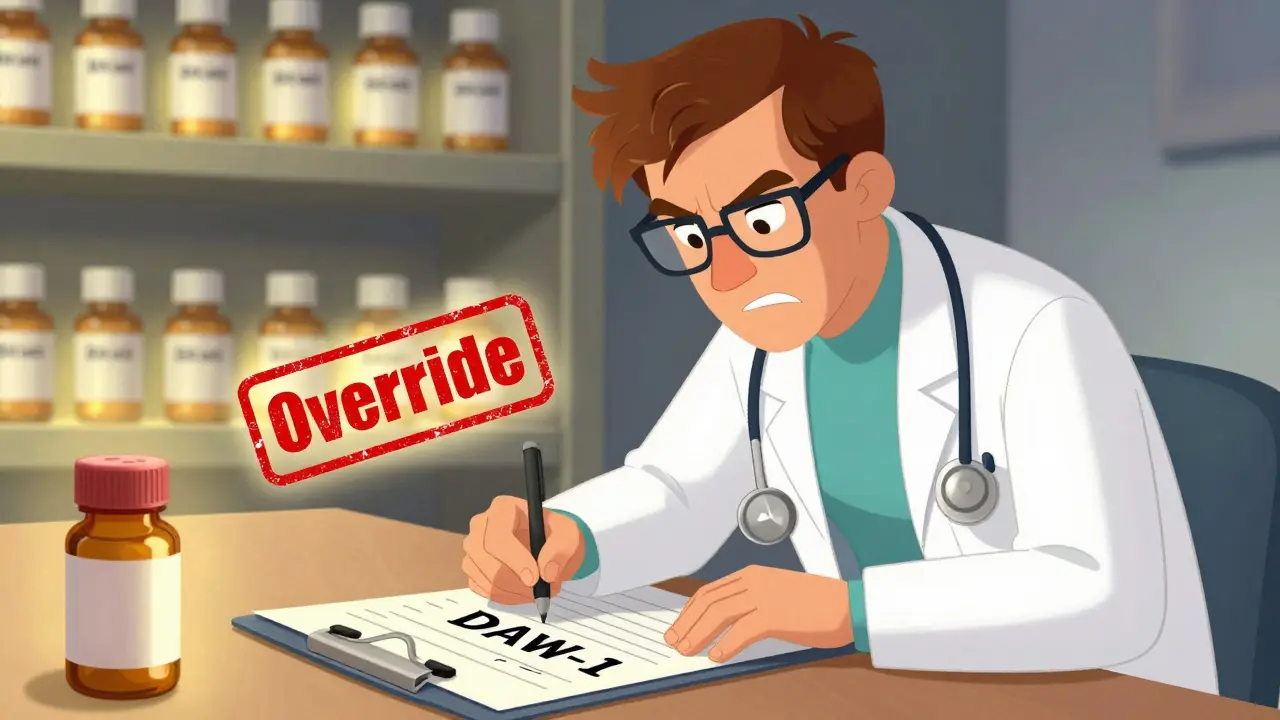
Most prescriptions today are filled with generic drugs. They’re cheaper, just as effective, and used in over 90% of cases. But sometimes, a doctor writes a prescription and adds a note: Dispense as Written. That’s not a suggestion. It’s a legal order. And it means the pharmacist must hand over the brand-name drug-even if a generic version is sitting right there on the shelf.
This is called a prescriber override. It’s not common. But when it happens, it’s usually because the patient’s health depends on it. Think of drugs like warfarin, levothyroxine, or phenytoin. These aren’t ordinary pills. They have what’s called a narrow therapeutic index. That means the difference between a dose that works and one that’s dangerous is tiny. Even small changes in how the drug is made-like different fillers or coatings in a generic version-can throw off a patient’s blood levels. And that can mean hospitalization, seizures, or worse.
How the system works
The U.S. doesn’t have one national rule for generics. Each state sets its own. As of 2023, 35 states require pharmacists to substitute generics unless the doctor says otherwise. In the other 15, pharmacists can choose whether to swap, but they still have to follow the doctor’s instructions if they’re clear.
The key is the DAW code. That’s short for Dispense as Written. It’s a number on the prescription that tells the pharmacy what to do. DAW-1 means: Do not substitute. Give the brand. That’s the override. It’s not just a scribble on the paper. It has to be entered correctly into the electronic system. If the doctor writes “no substitution” but the pharmacy’s software doesn’t recognize it, the generic still goes out. And that’s when things go wrong.
The FDA keeps a list called the Orange Book. It’s the official guide to which generics are considered therapeutically equivalent to brand drugs. Pharmacists are supposed to check this before swapping. But if the doctor says DAW-1, they don’t need to. The override overrides the system.
Why doctors override-when it’s necessary
Not every request for a brand drug is justified. But some are.
- Narrow therapeutic index drugs: Levothyroxine for thyroid disease. Warfarin for blood thinning. Phenytoin for seizures. These are the big ones. Even a 5% difference in absorption can cause major problems.
- Allergies to inactive ingredients: Some people react to dyes, gluten, or fillers in generics. If a patient has had a reaction before, the doctor must block substitution.
- Therapeutic failure: If a patient was stable on a brand drug, then switched to a generic and started having symptoms again-like seizures, irregular heartbeat, or mood swings-the doctor has to step in.
- Children and elderly patients: Their bodies process drugs differently. A change in formulation can be riskier.
A 2020 study found that DAW-1 overrides were most common in psychiatric drugs (12.3%) and anticonvulsants (14.8%). That’s not random. These are the drugs where stability matters most.
Where things go wrong
Here’s the problem: many doctors don’t know the rules.
A national survey found only 58% of physicians correctly understood their own state’s override requirements. That’s alarming. In states like Kentucky, the doctor must write “Brand Medically Necessary” by hand. In Michigan, it’s “DAW” or “Dispense as Written.” In Oregon, you can say it over the phone. But if you write “Do not substitute” in Texas, and the pharmacy’s system only recognizes “Brand Medically Necessary,” the override fails.
Electronic health records make it worse. Many EHR systems auto-fill the generic option. Doctors click through prescriptions without noticing. A 2022 survey found 41% of physicians said their EHR templates didn’t match their state’s rules. One doctor in Michigan told a Reddit thread: “I thought I checked the box for brand only. The pharmacy sent the generic. My patient had a seizure two days later.”
Pharmacists aren’t blameless. They’re under pressure to cut costs. Sometimes, they’ll call the doctor’s office to ask if they really meant to override. But if the doctor’s office is busy, they say “yes” without double-checking. That’s how mistakes happen.
The cost of overrides
Generics save money. A lot of it. Between 2010 and 2019, they saved the U.S. healthcare system $2.2 trillion. That’s huge.
But when a doctor overrides, the cost jumps. On average, a DAW-1 prescription costs 32.7% more than the generic. In some cases, it’s over 200% more. For drugs like Remodulin (used for pulmonary hypertension), the brand can cost $20,000 a month. The generic? Not available. So the override is necessary.
But not all overrides are necessary. Studies estimate that 18-25% of DAW-1 requests are inappropriate. That’s $7.8 billion a year spent on brand drugs when generics would have worked just fine. Payers like Express Scripts say these unnecessary overrides are one of the top reasons their drug costs keep rising.
And it’s not just about money. It’s about fairness. A patient on Medicaid might get denied a brand drug unless the doctor jumps through hoops. A patient with good insurance? They get it without a fight. That’s the hidden inequality in the system.
What doctors need to do right
If you’re a doctor, and you need to override, here’s what you must do:
- Know your state’s rules. Check your pharmacy board’s website. Don’t assume. Rules change.
- Use the right code. DAW-1 is the only code that legally blocks substitution. Write it clearly. Don’t use slang like “no generics.”
- Document the reason. Not just “patient preference.” Say “history of seizure recurrence after generic switch” or “confirmed allergy to FD&C Yellow No. 5.”
- Use your EHR properly. If your system doesn’t have a DAW-1 option, ask your IT team to fix it. Or use a custom template.
- Check the Orange Book. If the generic isn’t rated “A” (therapeutically equivalent), you don’t need to override-it’s already blocked.
Clincs in Michigan that created standardized override checklists reduced medication errors by over 40%. That’s not magic. That’s just doing the work.
The future: one system, one rule
Right now, if you practice in two states, you need two sets of instructions. That’s crazy. A 2021 study from Harvard Medical School called it a “patchwork nightmare.”
There’s movement to fix it. In 2023, Congress introduced the Standardized Prescriber Override Protocol Act. It would create one national standard for DAW codes, documentation, and EHR requirements. The FDA is also updating the Orange Book to include biosimilars-future overrides will need to account for these too.
By late 2024, e-prescribing systems will integrate override rules directly into the software. No more handwritten notes. No more guesswork. Just a checkbox: “Override: Yes/No.”
But until then, the burden is on the doctor. And the risk is on the patient.
What patients should know
If your pharmacist tries to switch your drug and you’re not sure why, ask. Say: “Is this a generic? Did my doctor allow it?”
If you’ve had a bad reaction to a generic before, tell your doctor. Write it down. Bring it up every time you refill.
And if your insurance denies your brand drug, don’t give up. Ask your doctor to file a prior authorization. Many overrides are denied not because they’re unnecessary-but because the paperwork wasn’t filled out right.
Generics are great. They save lives by making medicine affordable. But sometimes, the brand is the only safe choice. The system should make that clear-not confusing.


I can't believe doctors still get away with this. It's not 'medical necessity'-it's laziness wrapped in a white coat. My cousin got switched to a generic levothyroxine and ended up in the ER with atrial fibrillation. The doctor never even checked the Orange Book. Now he's on a $1,200/month brand drug because the system failed him. This isn't healthcare-it's a gamble with people's lives.
YESSSS this needs to be shouted from the rooftops! 🙌 I'm a pharmacist in Ohio and I see this EVERY DAY. Some docs think 'no substitution' is a suggestion. Nope. It's a legal directive. And if your EHR doesn't auto-populate DAW-1? That's YOUR fault. Stop blaming the pharmacy. We're just trying to keep people alive AND not bankrupt them. 🤦♀️💊
My grandma’s on warfarin. She’s been on the same brand for 8 years. We had to fight her insurance for a prior auth last year. They wanted to switch her to generic. She started getting dizzy, her INR went wild. Doc had to step in. It wasn’t about money-it was about her not falling and breaking her hip again. I get generics save cash, but some folks just can’t afford the risk.
This is all a Big Pharma scam. The FDA is in bed with the drug companies. The 'Orange Book' is a joke. Generics are just as good. They’re poisoning us with fillers so they can sell more brand names. They want you dependent. They want you paying $20k a month. Wake up. The system is rigged.
From a clinical pharmacology standpoint, the therapeutic index (TI) of drugs like phenytoin and levothyroxine is < 2, which necessitates bioequivalence within 90-110% Cmax and AUC0-t ranges per FDA guidelines. However, in vitro dissolution profiles often diverge between manufacturers due to excipient heterogeneity, leading to clinically significant fluctuations in serum concentrations. Hence, DAW-1 is not merely administrative-it’s pharmacokinetic safeguarding.
It's interesting how we treat medicine like a commodity. We optimize for cost, efficiency, scalability-but when it comes to human bodies, maybe the equation isn't so simple. A pill isn't just chemistry. It's trust. It's routine. It's the quiet stability that lets someone sleep at night. Maybe we need to ask not just 'Is it equivalent?' but 'Is it safe for *this* person?'
i read this article and it made me think about my uncle. he had a seizure after switching to generic phenytoin. the doctor said he wrote 'no substitution' but the pharmacy said they didn't see the code. i dont think the ehr system was set up right. this is so frustrating. why is it so hard to get this right?
Let’s be honest: the only reason 'prescriber override' exists is because the medical-industrial complex refuses to acknowledge that pharmacists are trained professionals who can make clinical judgments. No, no, no-we must have the physician, the overpaid, overworked, sleep-deprived, EHR-addled physician, as the final arbiter of bioequivalence. How quaint. How archaic. How utterly, laughably, patronizing.
My dad’s on levothyroxine. We switched him to generic because insurance said so. He got really tired. Then depressed. We switched back-boom, he was himself again. I don’t care about the cost. I care that he’s okay. If your system makes you choose between money and sanity, the system’s broken.
Oh wow, so doctors are *finally* being held accountable? Took long enough. I bet 90% of these overrides are just because the doctor doesn’t want to deal with a patient who says 'my last generic made me feel weird.' Maybe the patient should’ve just… stayed on the brand? Or maybe the doctor should’ve said 'try it for 3 months' instead of just slapping DAW-1 on everything?
Thanks for writing this. It’s easy to get angry about costs, but this reminds me that behind every prescription is someone trying to stay alive. 🙏 Maybe the real win isn’t cutting costs-it’s making sure the system doesn’t make people choose between affordability and safety. We can do better.
You think this is bad? Wait till you hear about the compounding pharmacies that are making 'generic' versions of warfarin in backrooms with no FDA oversight. I’ve seen the lab reports. The active ingredient varies by up to 28%. That’s not a generic-that’s Russian roulette with a pill. And now we’re supposed to trust these things because they’re cheaper? The FDA’s been asleep at the wheel since 2012. And don’t even get me started on how insurance companies pressure pharmacists to switch even when the DAW-1 is clearly marked. It’s not incompetence-it’s corporate greed with a side of malpractice.
So… if the doctor writes 'no substitution' but the pharmacy still gives the generic, is that a medical error? Or just a system glitch? I’m trying to figure out who’s really at fault here.