

When you’re struggling to breathe, it’s easy to assume all lung problems are the same. But asthma and COPD - while both cause wheezing and shortness of breath - are fundamentally different diseases. They affect different people, stem from different causes, and need totally different treatments. Confusing one for the other can lead to dangerous mistakes in care.
What Exactly Is Asthma?
Asthma is an inflammatory condition where the airways become overly sensitive and react strongly to triggers like pollen, cold air, or exercise. The airways swell, tighten, and produce extra mucus, making it hard to breathe. What makes asthma unique is that these episodes come and go. Between flare-ups, many people feel completely normal. That’s why asthma is often called a "reversible" disease - the blockage can clear on its own or with quick-relief inhalers like albuterol.
Most people with asthma are diagnosed young. Half of all cases show up before age 10, and 80% are diagnosed before age 30. It’s common to have other allergic conditions too - about 65% of asthma patients also have hay fever, and 30% have eczema. If you’re a child or young adult with recurrent coughing at night or wheezing after running, asthma is likely the culprit.
Pulmonary function tests show this clearly. When someone with asthma uses a bronchodilator (like albuterol), their lung function typically improves by 12% or more. A methacholine challenge test - which irritates the airways to see how easily they tighten - triggers strong reactions in 85% of asthma patients at very low doses. Blood and sputum tests often show high levels of eosinophils (a type of white blood cell) and elevated fractional exhaled nitric oxide (FeNO), usually above 50 ppb. These are signs of allergic, Th2-driven inflammation.
What Exactly Is COPD?
COPD stands for chronic obstructive pulmonary disease. It’s not one disease - it’s a group of conditions, mainly emphysema and chronic bronchitis, that slowly destroy lung tissue and narrow airways. Unlike asthma, the damage in COPD is mostly permanent. The airways are constantly inflamed, the tiny air sacs (alveoli) break down, and mucus builds up. This leads to a steady decline in breathing ability.
COPD usually shows up later in life. Over 90% of cases are diagnosed after age 45. The biggest risk factor? Smoking. About 90% of COPD patients are current or former smokers. Even if you quit decades ago, the damage lingers. That’s why COPD is often called a "smoker’s lung disease."
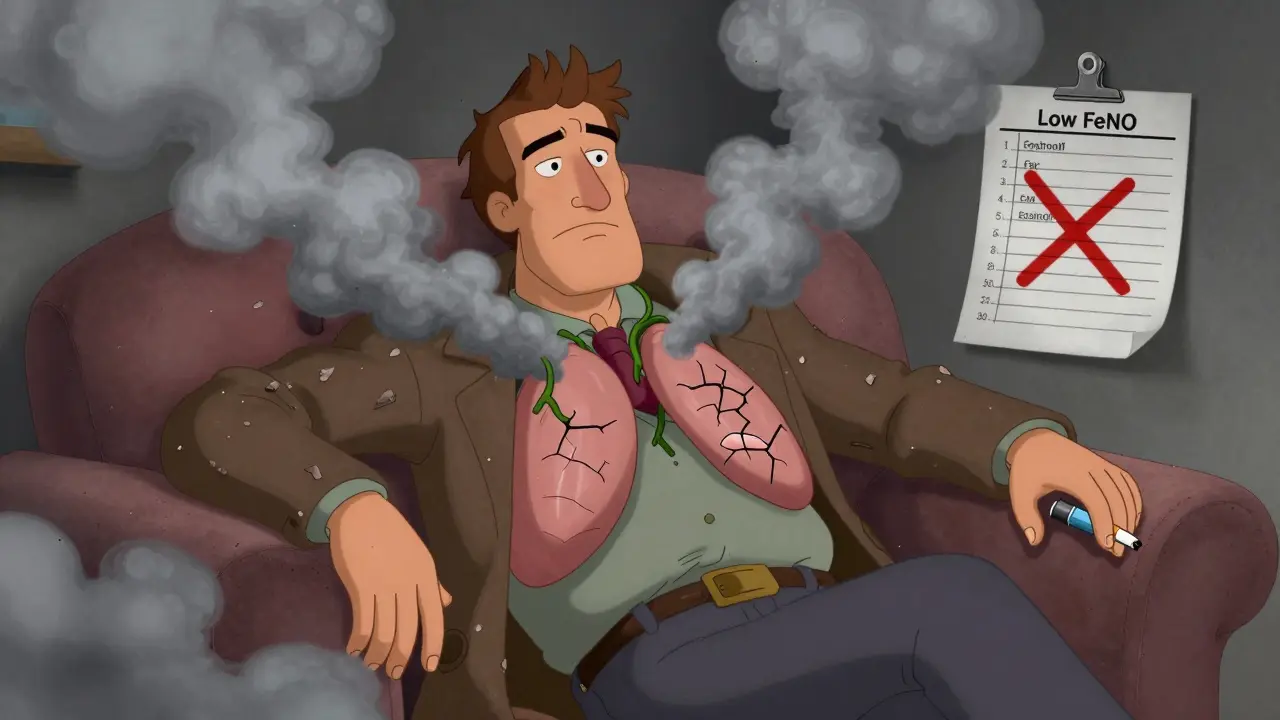
Symptoms don’t come and go like asthma. People with COPD wake up with a chronic cough that produces thick mucus - 87% of them do. They get winded just walking across a room. Cyanosis - a bluish tint around the lips or fingernails - appears in 41% of advanced cases because the lungs can’t get enough oxygen into the blood. Their lung function doesn’t improve much with bronchodilators. Only about 15% show meaningful reversibility on spirometry. FeNO levels are typically below 25 ppb, and eosinophil counts are low, under 100 cells/μL.
Side-by-Side: Symptoms Compared
At first glance, asthma and COPD sound similar. But when you look closer, the patterns are distinct:
- Onset: Asthma usually starts in childhood; COPD rarely before 40.
- Cough: Asthma = dry cough (73% of cases); COPD = wet, phlegmy cough (87%).
- Timing: Asthma symptoms worsen at night or after triggers; COPD symptoms are constant and get worse over time.
- Recovery: Asthma patients often have symptom-free periods - 68% do. Only 12% of COPD patients get real relief.
- Triggers: Asthma flares from allergens, cold air, or exercise. COPD flares from infections, pollution, or cold weather - but symptoms are always there, even without triggers.
- Other signs: Asthma often comes with allergies. COPD often comes with heart disease, osteoporosis, or weight loss.
How Diagnosis Works
Doctors don’t just guess. They use tests to tell them apart.
Spirometry is the gold standard. It measures how much air you can force out in one second (FEV1) and how much you can exhale total (FVC). In asthma, FEV1 drops during an attack but improves sharply after a bronchodilator. In COPD, FEV1 is low and doesn’t bounce back much - usually less than 12% improvement.
High-resolution CT scans help too. In COPD, you’ll see holes in lung tissue (emphysema) in 75% of cases. In asthma? Only 5% show that. Blood tests for eosinophils and FeNO levels are becoming routine. If your FeNO is above 50 ppb and eosinophils are over 300 cells/μL, it’s likely asthma or a mix. If both are low, it’s probably COPD.
Still, 25% of people over 40 with breathing problems get misdiagnosed. That’s why doctors now combine history, symptoms, and multiple tests - not just one.
How Treatment Is Different
Treatment isn’t one-size-fits-all. Using the wrong meds can make things worse.
Asthma treatment starts with rescue inhalers (SABAs) for quick relief. For persistent asthma, daily inhaled corticosteroids (ICS) reduce inflammation. For severe cases, biologics like omalizumab or mepolizumab target specific immune cells - these work for about 5-10% of patients with high eosinophils. The goal? Complete control. Eighty-nine percent of asthma patients can achieve near-normal life with proper treatment.
COPD treatment focuses on long-acting bronchodilators - either LABAs (like salmeterol) or LAMAs (like tiotropium). These open airways for 12-24 hours. ICS are only added if the patient has frequent flare-ups. Why? Because steroids don’t help much in COPD unless there’s an eosinophilic component. Oxygen therapy, pulmonary rehab, and quitting smoking are critical. Pulmonary rehab helps COPD patients walk 54 meters farther in six minutes - a huge gain in daily function.
Smoking cessation is the single most effective treatment for COPD. Quitting cuts disease progression by 50%. In asthma, smoking doesn’t change much unless the person also has COPD.
What About ACOS?
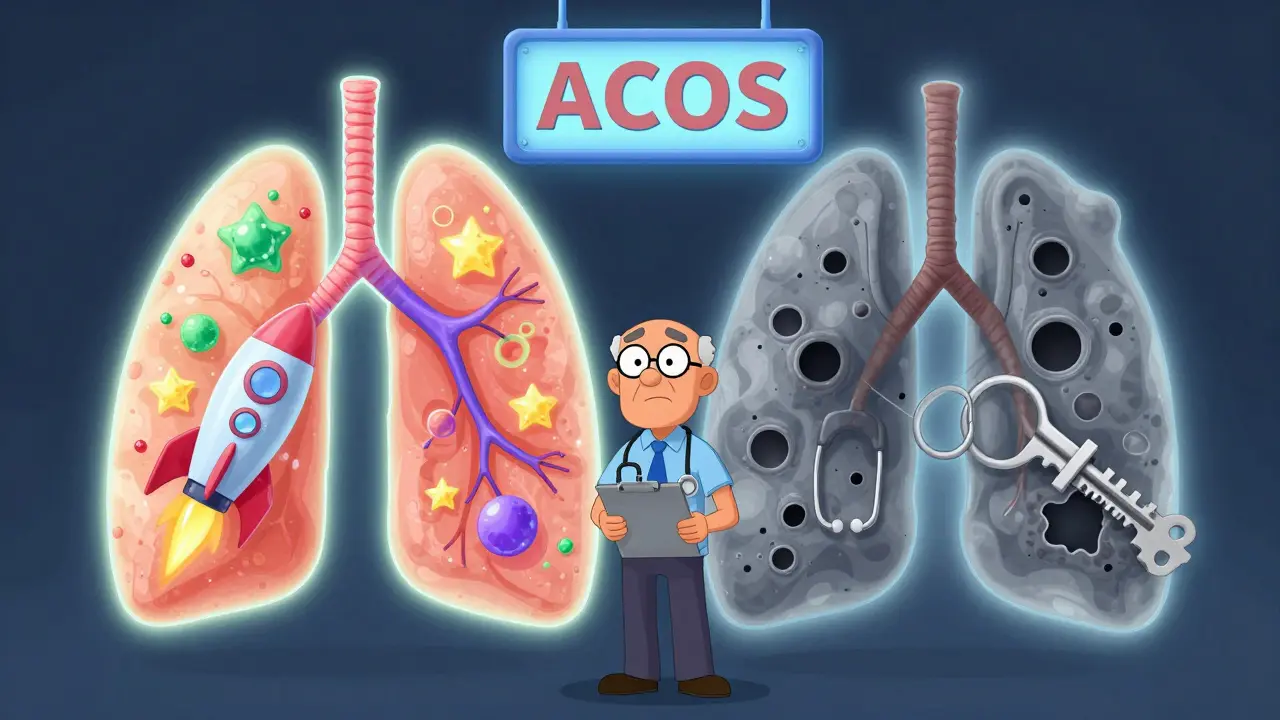
Some people have features of both asthma and COPD. This is called Asthma-COPD Overlap Syndrome (ACOS). It affects 15-25% of people with obstructive lung disease.
ACOS patients are usually older adults with a history of asthma who started smoking later in life. They have high eosinophils (like asthma) but fixed airflow blockage (like COPD). They get sicker faster - 2.3 times more exacerbations than asthma alone. Emergency visits are common: 1.8 per year, compared to 0.7 for asthma and 1.2 for COPD.
Treatment is tricky. Most specialists use triple therapy - a LABA, a LAMA, and an ICS - even though evidence is still limited. Blood eosinophil counts above 300 cells/μL help guide whether to add steroids.
Prognosis and Long-Term Outlook
Life expectancy differs sharply. The 10-year survival rate for moderate asthma is 92%. For moderate COPD, it’s 78%. That’s because COPD keeps getting worse. Even with treatment, lung damage doesn’t heal.
But there’s hope. People with asthma rarely die from it today - only about 3,500 deaths per year in the U.S., thanks to better meds and awareness. COPD is the fourth leading cause of death, killing 152,000 Americans annually. The good news? Quitting smoking slows COPD progression. Getting pulmonary rehab improves quality of life. Early diagnosis matters more than ever.
What Should You Do If You’re Not Sure?
If you’re over 40 and have long-term breathing trouble - especially if you smoked - don’t assume it’s just asthma. See a pulmonologist. Get spirometry. Ask about FeNO and eosinophil tests. If you’re under 30 with sudden wheezing after exercise or allergen exposure, asthma is likely - but still get checked.
Never ignore persistent cough, constant shortness of breath, or bluish lips. These aren’t normal. And never use someone else’s inhaler. Asthma meds can make COPD worse. COPD meds won’t stop an asthma attack.
Can asthma turn into COPD?
Asthma doesn’t directly "turn into" COPD. But if someone with asthma smokes for many years - especially over 20 years - they can develop fixed airway narrowing that looks like COPD. Studies show 15-20% of long-term asthma patients develop this. It’s not a progression of asthma, but a second disease caused by smoking.
Is COPD only caused by smoking?
Mostly, yes - about 90% of cases are linked to smoking. But about 10% of COPD patients never smoked. In these cases, long-term exposure to air pollution, chemical fumes, or genetic factors (like alpha-1 antitrypsin deficiency) can cause it. It’s rare, but it happens.
Can I use my asthma inhaler for COPD?
A short-acting inhaler like albuterol can help relieve sudden shortness of breath in COPD, but it’s not the main treatment. Relying on it alone won’t slow disease progression. COPD needs long-acting bronchodilators and sometimes steroids - not just rescue inhalers. Using asthma-only meds for COPD can delay proper care.
Why do some people with asthma need steroids?
Asthma is driven by chronic inflammation in the airways, especially from eosinophils and IgE. Inhaled corticosteroids reduce this inflammation, preventing flare-ups. Without them, frequent attacks can damage the lungs over time. For severe cases, biologic injections target specific immune signals to stop attacks before they start.
Can you have both asthma and COPD at the same time?
Yes - this is called ACOS (Asthma-COPD Overlap Syndrome). It’s not rare. People with a history of childhood asthma who later smoke are at highest risk. They have features of both: airway hyperresponsiveness and fixed obstruction. Diagnosis requires spirometry, blood tests, and sometimes FeNO. Treatment usually combines long-acting bronchodilators with inhaled steroids.




I’ve had asthma since I was 5. Seriously, this post nailed it. I can tell when a storm’s coming just by how my lungs feel. No inhaler? No way I’d be running marathons at 38. Grateful for modern meds.
People still don’t get it. COPD isn’t just 'smoker’s lung'-it’s a death sentence if you ignore it. And no, your neighbor who smoked 2 packs a day for 40 years and still hikes isn’t 'immune.' Luck isn’t a treatment.
It’s fascinating how the immune system’s signature differs so starkly between asthma and COPD. The eosinophil/FeNO dichotomy isn’t just clinical-it’s almost poetic. One is a hypersensitive alarm system; the other, a slow-burning collapse. We treat symptoms, but the root is a story of biology vs. behavior.
I must emphasize, based on peer-reviewed literature from the American Thoracic Society and the European Respiratory Journal, that the diagnostic criteria for ACOS remain controversial. Many experts argue it's not a distinct entity but rather a phenotypic overlap. Misclassification leads to inappropriate steroid use, which increases fracture risk and cataract formation. Please consult guidelines before prescribing.
Spirometry is the gatekeeper. If your doctor won’t do it, find another. No guesswork. No 'I think it’s asthma.' You need numbers. FEV1/FVC ratio below 0.7? That’s COPD until proven otherwise. Asthma? Reversibility. Period.
In India, we see so many cases mislabeled as asthma because inhalers are cheap and accessible. But when someone’s 55, smoked for 30 years, and can’t climb stairs without stopping? It’s COPD. We need more community lung screenings. No one should die because they thought wheezing was just 'bad allergies.'
Wait… so you’re telling me Big Pharma and the AMA are hiding the truth? I read a blog that said asthma meds are secretly designed to keep people dependent. And COPD? They don’t want you quitting smoking because then they lose revenue. Also, FeNO machines? Probably just measuring your WiFi signal. I’m not buying this.
The data presented here, while statistically significant, lacks longitudinal validation across diverse socioeconomic cohorts. Furthermore, the reliance on FeNO as a biomarker is confounded by environmental particulate exposure, which may artificially elevate readings. One must question the generalizability of U.S.-based diagnostic thresholds to global populations.
Simple rule: If you’re young and wheeze after running, it’s asthma. If you’re older and always coughing up gunk, it’s COPD. Don’t overthink it. Get tested. Quit smoking if you do. That’s 80% of the battle.
I’m so tired of people saying 'just use your inhaler' like it’s a magic wand. My cousin used her asthma inhaler for her COPD for 5 years. Then she ended up in the ER three times. Now she’s on oxygen. You don’t fix a broken pipe with duct tape.
I’ve been living with this for 17 years. I remember the first time I couldn’t breathe after climbing two flights of stairs. I thought I was just out of shape. Turns out, I had asthma. Then I got sick with pneumonia. Then I started smoking to calm my nerves. Then I got COPD. Now I’m 48 and I can’t hug my grandkid without gasping. It’s not just lungs. It’s grief. It’s regret. It’s the quiet, daily cost of choices you didn’t know were killing you.
So let me get this straight: Asthma is 'oh no, I’m allergic to my own life' and COPD is 'oh no, I made peace with cigarettes.' And we call this medicine? I’m just here for the drama.
Get tested. Don’t self-diagnose. Treatment is different. That’s all.
i had asthma as a kid. quit sports. got fat. started smoking. now i wheeze all day. guess what? i got both. not cool. doc says triple med. i just want to walk to the fridge without dying.