
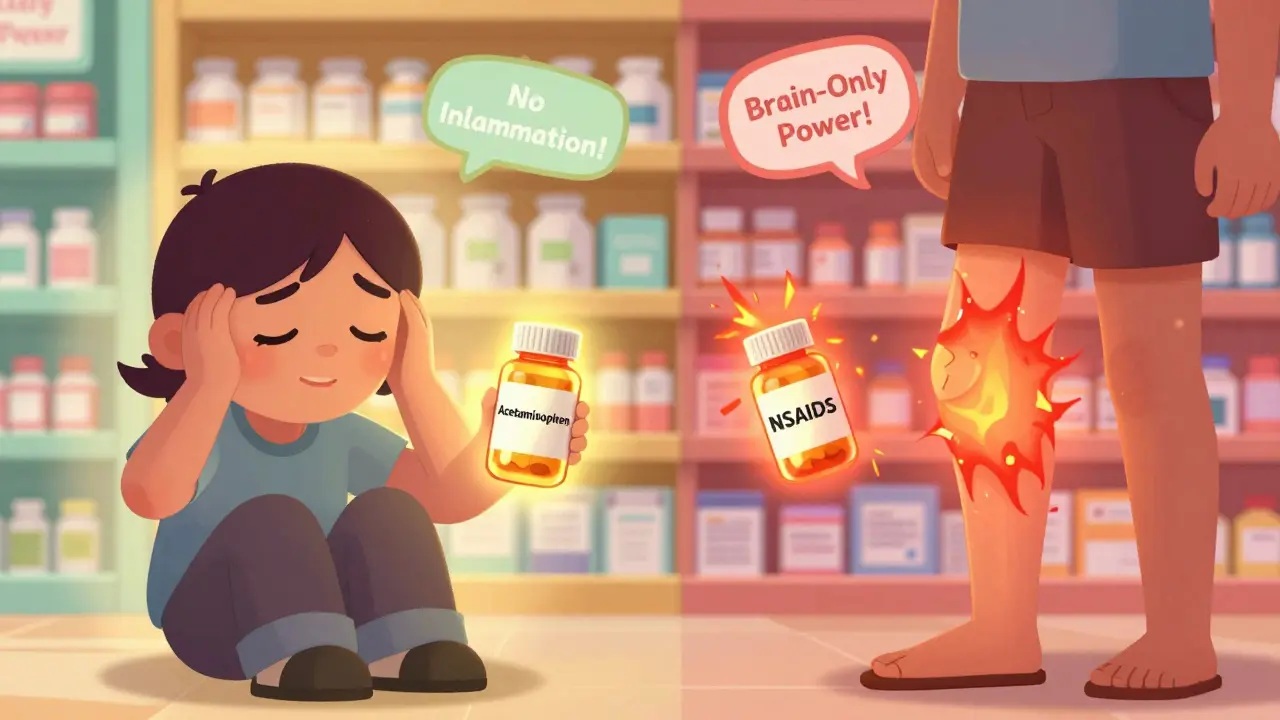
When you have a headache, sore muscles, or a fever, reaching for an OTC pain reliever seems simple. But not all painkillers work the same way-and choosing the wrong one could mean less relief or even harm. Two main types dominate the shelf: acetaminophen and NSAIDs. Knowing the difference isn’t just helpful-it could keep you safe.
What’s the Real Difference Between Acetaminophen and NSAIDs?
Acetaminophen (sold as Tylenol, Panadol, and generics) and NSAIDs (like ibuprofen, naproxen, and aspirin) both reduce pain and fever. But that’s where the similarity ends.
Acetaminophen works mainly in your brain. It doesn’t touch inflammation at all. If your knee is swollen from arthritis, acetaminophen might ease the ache, but it won’t calm the redness or heat. NSAIDs, on the other hand, block enzymes called COX-1 and COX-2 throughout your body. That means they reduce pain, fever, and inflammation. That’s why ibuprofen or naproxen works better for sprains, tendonitis, or menstrual cramps-conditions where swelling is part of the problem.
Harvard Health and the Mayo Clinic both confirm: only NSAIDs reduce inflammation. If you’re treating something inflamed, skip acetaminophen and go straight to an NSAID.
Which One Works Better for Common Ailments?
Not all pain is the same. Here’s what the data says about real-world use:
- Headaches and migraines: Acetaminophen is often more effective. About 70% of migraine sufferers report relief with acetaminophen, per Mayo Clinic data. NSAIDs help too, but acetaminophen has fewer side effects for occasional use.
- Arthritis (knee or hip): NSAIDs win. Clinical trials show they reduce pain scores by 30-50% compared to just 10-20% with acetaminophen. The American Academy of Family Physicians found NSAIDs cut swelling by 25-40% in osteoarthritis patients-acetaminophen barely budged it.
- Menstrual cramps: NSAIDs are the go-to. They lower prostaglandin levels, the chemicals that cause uterine contractions. Acetaminophen might help a little, but it won’t stop the cramping like ibuprofen or naproxen can.
- Fever: Both work equally well. No clear winner here.
- Back pain: If it’s muscular and not inflamed, acetaminophen is fine. If there’s swelling or nerve irritation, NSAIDs are stronger.
For kids under 12? Only acetaminophen is recommended. The same goes for pregnant women-NSAIDs are avoided after 20 weeks because they can affect fetal circulation. Acetaminophen is the only OTC pain reliever approved for infants as young as two months, with dosing based on weight (10-15 mg per kg per dose).
Safety: What You Can’t Ignore
Both types are safe when used correctly. But misuse can lead to serious problems.
Acetaminophen’s hidden danger: It’s easy to overdose. The maximum daily dose is 4,000 mg-but experts like Harvard Health now recommend staying under 3,000 mg for safety. Why? Because liver damage can happen even within the “safe” range, especially if you drink alcohol, have liver disease, or take multiple products that contain acetaminophen. The FDA says 40% of acetaminophen-related liver injuries come from people taking more than one medicine with acetaminophen-like cold pills, sleep aids, or prescription painkillers. Since 2011, all acetaminophen packaging must carry bold liver warning labels. Over 15,000 people are hospitalized each year from accidental overdose, per CDC data.
NSAIDs’ risks: These drugs irritate the stomach lining. About 2-4% of regular users develop ulcers annually. That risk jumps with age, alcohol use, or long-term use. NSAIDs also raise blood pressure and can increase heart attack risk-especially with ibuprofen. The FDA warns that chronic high-dose ibuprofen use can raise heart attack risk by 10-50%. Naproxen appears to carry lower cardiovascular risk than ibuprofen, according to a 2021 study in the European Heart Journal. Since 2015, all NSAID labels must include heart and stomach risk warnings.

When to Use One Over the Other
Here’s a simple guide:
- Use acetaminophen if: You have a headache, mild fever, or general body aches; you’re pregnant; you’re giving medicine to a child under 12; you have a history of stomach ulcers or are on blood thinners; or you want the gentlest option.
- Use NSAIDs if: You have swelling, joint pain, arthritis, muscle strains, menstrual cramps, or inflammation-related pain; you’re not at risk for stomach or heart problems; and you’re not taking other NSAIDs or blood thinners.
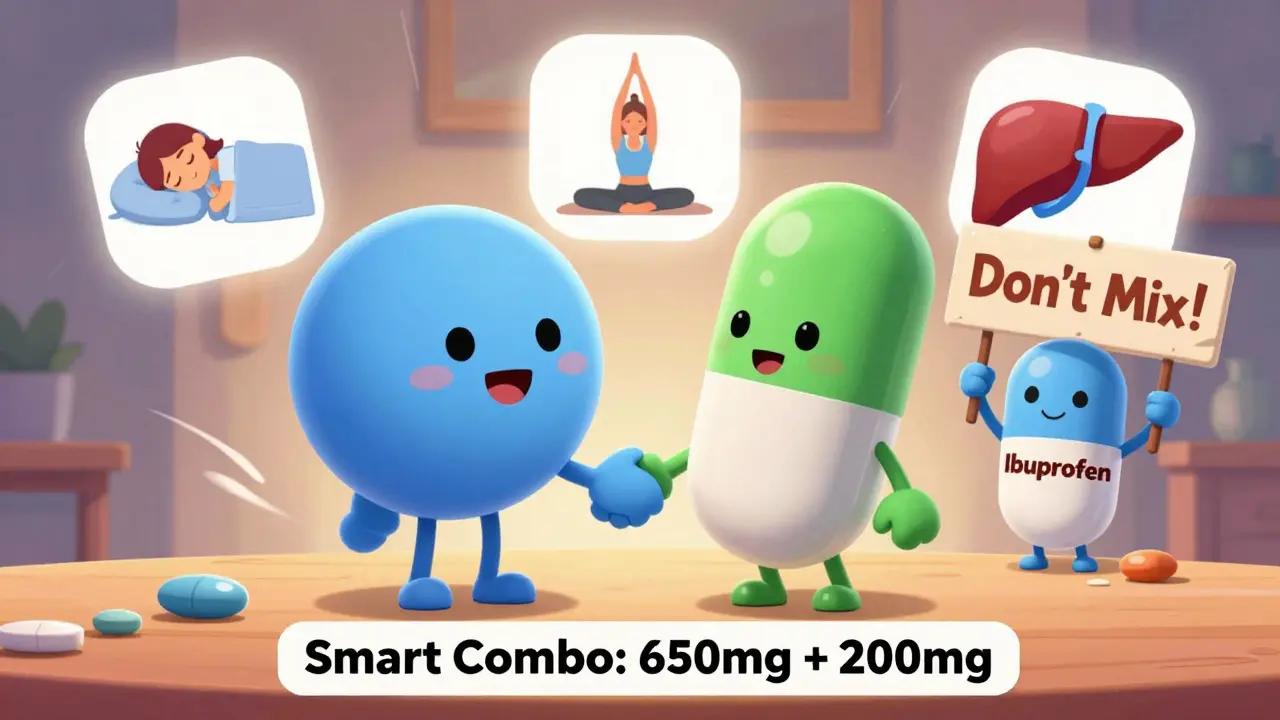
And here’s a key tip: Don’t mix NSAIDs. Taking ibuprofen and naproxen together doesn’t give you better pain relief-it triples your risk of stomach bleeding, according to FDA analysis. Stick to one NSAID at a time.
Can You Take Both Together?
Yes-and sometimes, you should.
Harvard Health recommends combining acetaminophen and an NSAID for stronger pain control with lower doses of each. For example: 650 mg acetaminophen + 200 mg ibuprofen every 6-8 hours. This combo can give you pain relief equal to a higher dose of either drug alone, while cutting down on side effects. It’s a smart strategy for post-surgery pain, severe back pain, or chronic conditions where one drug isn’t enough.
Just be careful: Track every pill you take. Many cold and flu meds contain acetaminophen. Check labels. Write down your doses. Don’t assume “natural” or “herbal” pain relievers are safe to mix-some contain hidden NSAIDs or liver-toxic ingredients.
Cost and Availability
Generic versions of both are dirt cheap. A bottle of 100 acetaminophen 500 mg tablets costs about $3-$5, or $0.03-$0.05 per pill. Ibuprofen 200 mg runs $0.04-$0.07 per pill. You’re not paying for brand names-you’re paying for convenience.
NSAIDs like naproxen (Aleve) last longer-up to 12 hours per dose-so you take fewer pills. Ibuprofen (Advil, Motrin) needs dosing every 4-6 hours. Acetaminophen lasts 4-6 hours too. If you’re sleeping through the night and need pain control, naproxen might be more convenient.
As of 2023, Americans spend $1.5 billion yearly on OTC pain relievers. Acetaminophen makes up about 40% of sales. Ibuprofen is at 35%, naproxen at 25%. The market favors acetaminophen because it’s seen as safer for casual use.
What’s Changing in 2026?
Guidelines keep evolving. The American Heart Association now advises avoiding NSAIDs entirely in patients with heart disease unless absolutely necessary. The FDA updated acetaminophen labeling again in 2022 to make liver warnings even harder to miss. Research is ongoing-NIH has 17 active clinical trials exploring new pain pathways that could one day replace both acetaminophen and NSAIDs. But for now, these two remain the gold standard.
Experts agree: Start with acetaminophen for mild pain. If it doesn’t help and inflammation is present, switch to an NSAID. Don’t take either longer than directed. And if you’re unsure-ask your pharmacist. They see this every day.
Can I take acetaminophen and ibuprofen together?
Yes, and it’s often recommended. Taking 650 mg acetaminophen with 200 mg ibuprofen can provide better pain relief than either alone, while lowering the total dose of each. This reduces side effects. Just make sure you’re not taking other medicines that also contain acetaminophen or NSAIDs, and don’t exceed the daily limits for either.
Is acetaminophen safer than NSAIDs for the stomach?
Yes. Acetaminophen doesn’t irritate the stomach lining like NSAIDs do. NSAIDs carry a 2-4% annual risk of causing ulcers, especially with long-term use. Acetaminophen users have less than a 0.5% risk. If you have a history of stomach ulcers, acid reflux, or are on blood thinners, acetaminophen is the safer first choice.
Why is acetaminophen the only option for kids and pregnant women?
NSAIDs can interfere with fetal development and reduce amniotic fluid levels after 20 weeks of pregnancy. They’re also not approved for infants under 6 months. Acetaminophen has decades of safety data in these groups. Pediatric dosing is based on weight (10-15 mg per kg), and it’s the only OTC pain reliever recommended for children under 12 by the American Academy of Pediatrics and University of Utah Health.
Which NSAID is safest for the heart?
Naproxen (Aleve) appears to carry the lowest cardiovascular risk among OTC NSAIDs, according to a 2021 study in the European Heart Journal. Ibuprofen increases heart attack risk by 10-50% with chronic high-dose use, per FDA warnings. If you have heart disease or high blood pressure, naproxen may be a better option-but still avoid long-term use without medical advice.
How do I avoid accidentally overdosing on acetaminophen?
Always check the labels of every medicine you take-cold remedies, sleep aids, and prescription painkillers often contain acetaminophen. Never take more than one product with acetaminophen at the same time. Keep your total daily intake under 3,000 mg, even if the bottle says 4,000 mg is safe. If you drink alcohol regularly, stick to 2,000 mg or less. Write down your doses or use a pill tracker app.
Can I take NSAIDs every day for chronic pain?
Not without medical supervision. Daily NSAID use increases risks of stomach bleeding, kidney damage, and heart problems. For chronic pain like osteoarthritis, doctors often recommend short-term NSAID use combined with physical therapy, weight management, or acetaminophen on off days. Long-term daily use should only happen under a doctor’s watch.
Does it matter if I take NSAIDs with food?
Yes. Taking NSAIDs on an empty stomach increases stomach irritation and ulcer risk. Always take them with food, milk, or an antacid. Some people also take a stomach-protecting drug like famotidine (Pepcid) if they need daily NSAIDs. Acetaminophen can be taken with or without food-it doesn’t irritate the stomach.




Let’s be real-acetaminophen isn’t ‘safe,’ it’s just the default choice because people are too lazy to read labels. The liver doesn’t care if you think it’s ‘gentle.’ You take three cold meds, a sleep aid, and a Tylenol for your back, and suddenly you’re in the ER with transaminases through the roof. The FDA warning is bold for a reason. And yet, 90% of people I know still take 1000mg every 4 hours like it’s candy. It’s not a virtue. It’s negligence wrapped in a plastic bottle.
NSAIDs are the real American hero. You want to fix pain? You don’t whisper to it-you crush it. Ibuprofen doesn’t ask permission. It doesn’t apologize. It reduces inflammation, period. The Europeans want to baby you with naproxen? Fine. But if you’re an American who lifts weights, plays basketball, or just hates feeling weak, you take what works. The stomach? You eat a sandwich. The heart? You stop being a couch potato. Stop over-medicalizing simple solutions.
Oh wow, so acetaminophen is ‘safe’ for kids because it doesn’t hurt the stomach? That’s like saying a loaded gun is ‘safe’ because it doesn’t shoot unless you pull the trigger. The real question is-why are we still letting corporations sell poison with a smiley face on the label? And why does no one ask who wrote the guidelines? Hint: it wasn’t your pediatrician. It was someone who got paid by Big Pharma to say ‘it’s fine.’
There’s a critical oversight here: the pharmacokinetic differences between acetaminophen and NSAIDs are not just clinical-they’re metabolic. Acetaminophen is metabolized primarily via glucuronidation and sulfation, with a minor CYP2E1 pathway that becomes toxic under alcohol or fasting conditions. NSAIDs inhibit COX-1 constitutively expressed in gastric mucosa, hence ulcer risk. The real issue isn’t choice-it’s context. Individual metabolic variation, comorbidities, and polypharmacy are rarely considered in OTC advice. This post is good, but it’s still too generalized.
Oh so now I’m supposed to believe that naproxen is ‘safer’ for the heart? That’s rich. You know what’s really dangerous? Trusting a study published in some European journal that’s funded by a company that makes naproxen. And don’t even get me started on ‘natural’ pain remedies-my cousin took ‘turmeric capsules’ and ended up in the hospital because they had hidden celecoxib. Wake up, people.
I’ve been taking ibuprofen daily for my arthritis for five years. My stomach? Fine. My kidneys? Checked. My blood pressure? A little high, but I manage it. So don’t scare people with stats. You don’t need to be terrified of NSAIDs-you need to be informed. And if you’re not willing to monitor your health, then yeah, maybe stick to acetaminophen. But don’t pretend the ‘safe’ option is always the right one.
Just a quick note: combining acetaminophen and ibuprofen? Brilliant. But please, please, please write down what you take. Use a note app. Set alarms. I’ve seen too many people take 650mg of Tylenol at 8am, then another at noon, then a cold med at 4pm that has 325mg… and boom, 2600mg by dinner. Then they wonder why they’re dizzy. It’s not magic. It’s math. And math doesn’t forgive.
i just want to say... i took tylenol for my period and it did nothing... then i took advil and i cried because the pain was gone... but then i felt guilty... like i was being selfish for choosing something that 'might hurt my stomach'... but my cramps were worse than my fear... and now i just want to know... am i the only one who feels like this? like we're supposed to suffer quietly so the doctors don't get mad at us?
As someone who’s lived in both the US and India, I’ve seen how differently pain is treated. In the US, it’s all about ‘which pill?’ In India, it’s ‘which tea?’ Turmeric, ginger, ashwagandha-people use these for years without a single ER visit. I’m not saying replace science with tradition, but maybe we’re overcomplicating this. Sometimes, a warm compress and rest are just as effective as any pill. Let’s not forget the simplest solutions.
I just take what works. If my head hurts, Tylenol. If my knee is swollen, Advil. I don’t overthink it. I check the label once, and that’s enough. I’m not a pharmacist. I’m just a person who doesn’t want to feel like garbage. If you’re scared of pills, maybe you shouldn’t take them. But don’t make me feel bad for using what helps.
EVERYTHING YOU’RE TOLD IS A LIE. THE FDA? IN BED WITH PHARMA. THE ‘SAFE’ DOSE OF ACETAMINOPHEN? DESIGNED TO KEEP YOU ADDICTED TO PAINKILLERS WHILE THEY SELL YOU MORE MEDS FOR THE LIVER DAMAGE. NSAIDS? THEY’RE MAKING YOU HEART ATTACK-PRONE SO YOU NEED BETA BLOCKERS. THIS ISN’T HEALTHCARE. IT’S A BUSINESS MODEL. AND WE’RE ALL THE PRODUCT.
Acetaminophen + ibuprofen combo? Yes. But only if you’re not drinking. And don’t even think about mixing with alcohol. I did that once. Woke up in the ER. No joke. The nurse said, ‘You’re lucky you didn’t die.’ So yeah, it works. But it’s not a party trick. 🤖
I used to hate taking pills. Then I got chronic back pain. Now I take 650mg Tylenol and 200mg ibuprofen together every 8 hours. It’s life-changing. I can play with my kids. I can sleep. I don’t feel guilty. I just make sure I’m not drinking, I’m not taking anything else with acetaminophen, and I give my body a break every few weeks. It’s not perfect, but it’s sustainable. And honestly? I’d rather be alive than ‘perfectly safe.’
Start with acetaminophen. If it doesn’t work after two doses, switch to NSAID. Don’t wait three days. Don’t suffer through a whole weekend. Your body isn’t a test subject. You’re not being weak if you need help. Just be smart. Track it. Read the label. And if you’re unsure? Ask your pharmacist. They’ve seen it all. And they won’t judge you.