
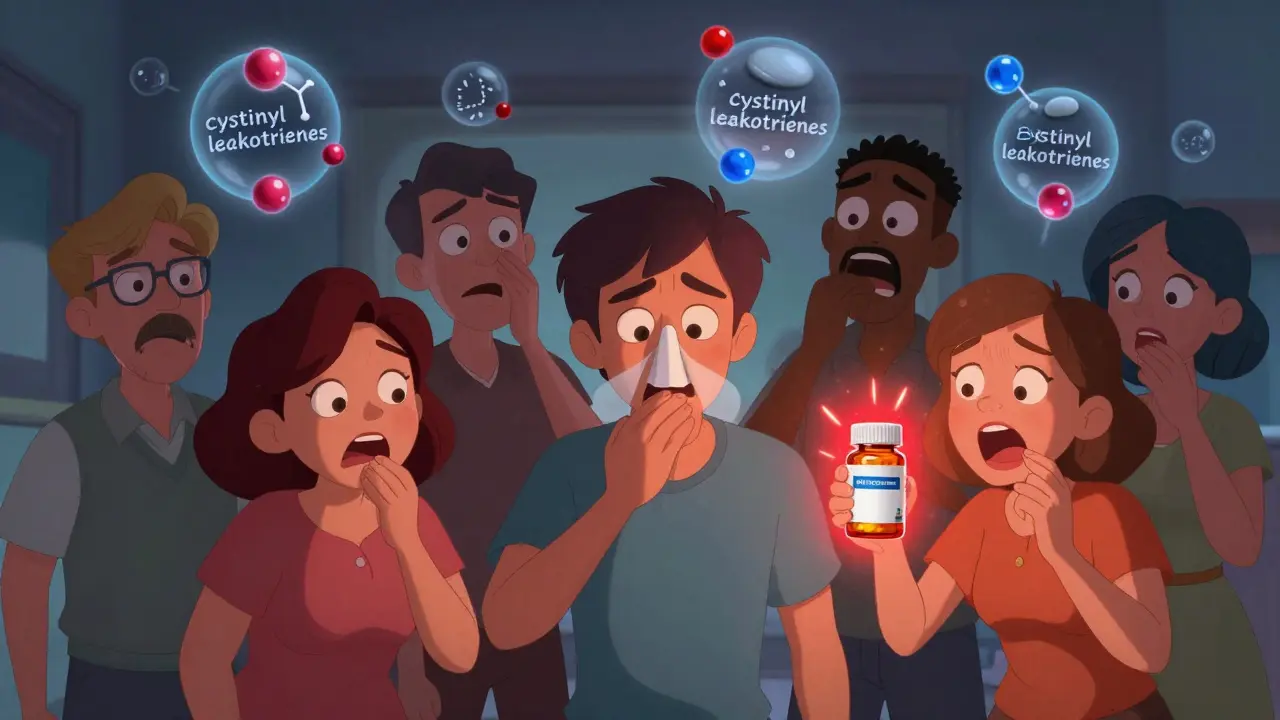
For many people with asthma, taking a common painkiller like ibuprofen or aspirin isn’t just a minor risk-it can be life-threatening. This isn’t a rare side effect. It’s a well-documented condition called NSAID-Exacerbated Respiratory Disease (NERD), also known as Aspirin-Exacerbated Respiratory Disease (AERD). About 7% of all asthma patients have it. But if you have chronic sinus problems with nasal polyps, that number jumps to 40-50%. And most people don’t even know they’re at risk until they have a serious reaction.
What Happens When NSAIDs Trigger Asthma?
NSAIDs like aspirin, ibuprofen, and naproxen work by blocking an enzyme called COX-1. That’s how they reduce pain and inflammation. But for people with NERD, this simple action sets off a chain reaction in the body. Instead of making protective prostaglandins, the body shifts into overdrive producing something called cysteinyl leukotrienes-powerful chemicals that tighten airways, swell nasal passages, and trigger asthma attacks.
The timing is fast. Symptoms usually hit within 30 minutes to 3 hours after taking the drug. People report sudden nasal congestion, runny nose, wheezing, chest tightness, and in severe cases, full-blown asthma attacks that land them in the ER. Some describe it as feeling like their throat is closing. Others say they can’t catch their breath even after using their inhaler.
What makes this especially dangerous is that it’s not an allergy in the traditional sense. There’s no rash or hives. It’s a biochemical meltdown triggered by a common medication. And once it happens once, it will happen again-with every NSAID.
Who’s Most at Risk?
You’re not equally at risk if you have asthma. Certain patterns show up again and again in clinical data:
- You’re likely female-about 70% of diagnosed cases are women.
- You’re between 30 and 40 years old. Most people aren’t diagnosed until their 30s, even if symptoms started earlier.
- You have nasal polyps or chronic sinusitis. This is the biggest red flag. If you’ve had sinus surgery or constantly feel blocked up, you’re in a high-risk group.
- You’re overweight. Studies consistently link higher BMI with worse NERD outcomes.
- You smoke or used to smoke. Long-term smoking increases the chance of developing this sensitivity.
And here’s something many don’t realize: upper airway symptoms often come before asthma. People report years of stuffy noses, loss of smell, or recurring sinus infections before their asthma gets worse. That’s a clue. If you’ve had nasal polyps for years and now your asthma is harder to control, it’s time to talk to your doctor about NERD.
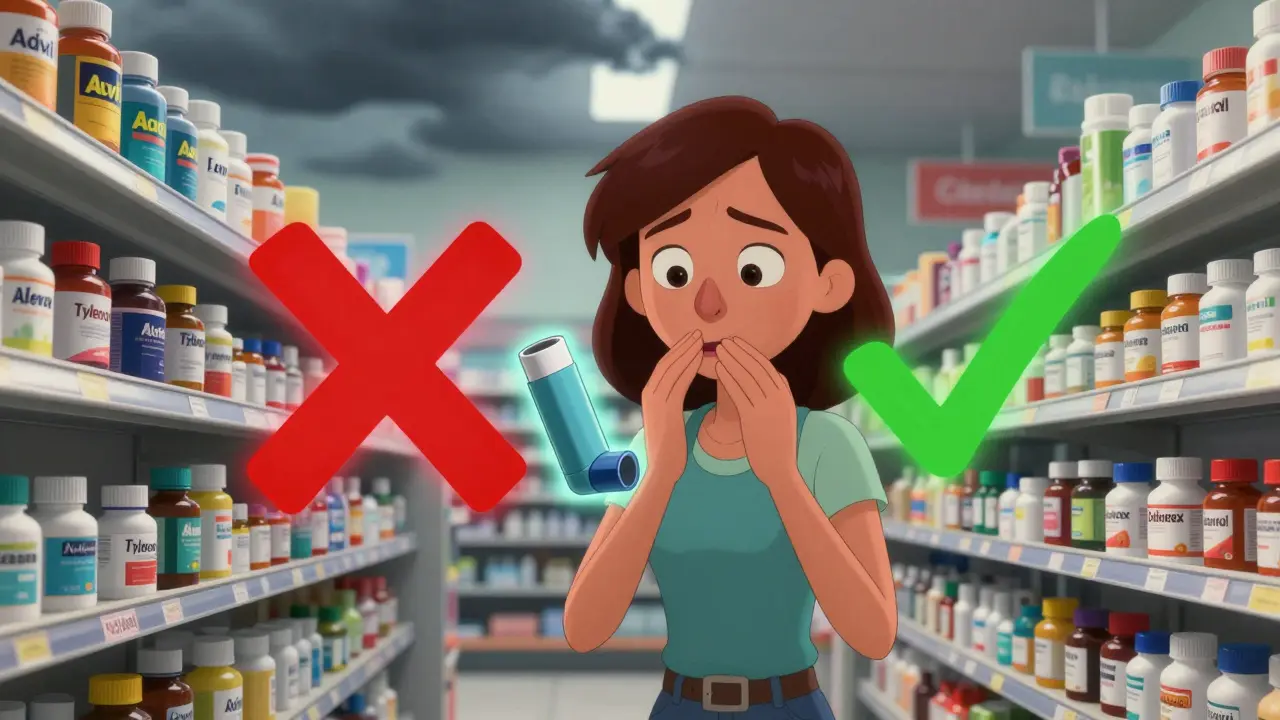
Which Medications Are Safe? Which Are Not?
Not all pain relievers are created equal. The key is understanding which drugs block COX-1 and which don’t.
AVOID: Aspirin, ibuprofen (Advil, Motrin), naproxen (Aleve), diclofenac, ketoprofen, indomethacin. These are strong COX-1 inhibitors. If you’ve had a reaction to one, you’ll react to all of them.
Generally Safe: Acetaminophen (Tylenol) is the go-to for most NERD patients. Doses under 1,000mg are usually fine. But here’s the catch: 5-10% of people still react to acetaminophen at higher doses. So don’t assume it’s 100% safe.
Also Safe: Celecoxib (Celebrex) and other COX-2 selective inhibitors. These don’t touch COX-1, so they rarely trigger reactions. They’re not for everyone-especially if you have heart risks-but they’re a solid alternative for pain control.
Here’s where things get tricky: NSAIDs hide in plain sight. Cold medicines, flu remedies, migraine pills, and even some arthritis creams contain ibuprofen or naproxen. You can’t just look for "pain reliever" on the label. You need to scan the active ingredients list every single time.
What to Do If You Suspect You Have NERD
If you’ve ever had a sudden asthma attack after taking a painkiller, don’t ignore it. Keep a log: what you took, how much, and what happened. Note how fast symptoms started and how long they lasted. Bring this to your allergist or pulmonologist.
There’s no blood test for NERD. Diagnosis usually comes from:
- Your medical history (especially nasal polyps and asthma onset timing)
- Excluding other causes
- Controlled aspirin challenge in a specialist clinic
A supervised aspirin challenge isn’t something you do at home. It’s done in a hospital setting with emergency equipment on standby. If you react, it confirms NERD. If you don’t, it rules it out. Either way, you get clarity.
Some patients go further and choose aspirin desensitization. This involves slowly increasing doses of aspirin under medical supervision until the body adapts. It’s not for everyone-but for those who complete it, asthma symptoms often improve, nasal polyps shrink, and steroid use drops. It’s a long process, but for some, it’s life-changing.

How to Stay Safe Every Day
Living with NERD means being hyper-aware of what’s in your medicine cabinet. Here’s a practical checklist:
- Always read the active ingredients on OTC and prescription labels-not just the brand name.
- Keep a list of safe alternatives: acetaminophen, celecoxib (if approved by your doctor).
- Wear a medical alert bracelet that says "NSAID Sensitivity" or "Aspirin Allergy".
- Ask your pharmacist to review all your medications quarterly.
- Carry your rescue inhaler with you at all times-even if your asthma feels controlled.
- Inform every doctor, dentist, and emergency room staff about your condition before any procedure.
And remember: if you’ve had one reaction, you’re not just "sensitive." You’re at risk for another-and it could be worse. Don’t wait until you’re struggling to breathe to act.
What’s Next for NERD Treatment?
Researchers are looking at ways to block the inflammatory cascade at its source. One promising area involves LXA4 and 15-epi-LXA4-natural compounds that calm inflammation without triggering leukotrienes. Early studies show they might help restore balance in the airways.
There’s also work on biomarkers-like measuring leukotriene levels in urine or eosinophil counts in blood-that could make diagnosis faster and more accurate. Right now, many cases are missed because doctors don’t connect the dots between chronic sinusitis and worsening asthma.
For now, the best defense is awareness. If you have asthma and nasal polyps, assume you’re at risk until proven otherwise. Don’t assume your doctor will ask. Bring it up. Ask for screening. Ask about alternatives. Your airways depend on it.





i legit had no idea about this. took ibuprofen for years and never thought twice. last year i had a full asthma attack after a headache pill. thought it was just bad luck. turns out i might have nerdd?? my dr never asked. dumb.
ps: sry for typos. typing on phone with one hand while baby screams.
so wait. acetaminophen is safe but only under 1000mg? what if you have a killer migraine and need 1300? is that a gamble? also, why isn't this in every drug warning? i feel like this should be on every box like 'may cause cancer' or whatever.
OMG THIS IS SO IMPORTANT!! I just found out last month after my 3rd ER trip and honestly? I'm so glad someone wrote this. My doc said 'maybe allergies' but never mentioned this. Now I'm telling EVERYONE. Seriously, if you have sinus polyps + asthma? STOP taking ibuprofen. Go get checked. You could save your life. 💪❤️
I'm a pulmonology nurse and I see this way more than people realize. The delay in diagnosis is heartbreaking. Patients come in with 15 years of uncontrolled asthma and chronic sinusitis and we're like 'did you ever take Advil?' and they say 'yes, every week for 12 years.'
And then you tell them about COX-1 inhibition and leukotriene surge and their face lights up like 'ohhhhh THAT'S why.' It's not just asthma. It's a systemic biochemistry thing. You need to treat the whole pathway, not just the symptom. And yeah, aspirin desensitization? Game changer for the right candidates. Not magic. But transformative.
I mean, it's kinda wild, right? Like, we have all these drugs, and we're just... throwing them out there? No one checks if you've got nasal polyps before you buy Motrin? That's like handing someone a grenade and saying 'hey, this might explode, but we're not sure.'
Also, I had a coworker who got hospitalized after a flu med. She didn't even know it had naproxen. Like... why isn't there a color code? Red for NSAIDs? Green for safe? A symbol? Something? We need better labeling. Like, a skull and crossbones next to ibuprofen. I'm serious.
This is why modern medicine is a scam. Big Pharma doesn't want you to know this because they make billions off your asthma inhalers and ER visits. They'd rather keep you dependent than fix the root cause. And they hide it in fine print. You think your doctor cares? No. They get paid per visit. You're a revenue stream. Wake up. The system is designed to keep you sick.
The fundamental issue here is not merely pharmacological, but epistemological. The medical paradigm, rooted in reductionist biochemistry, fails to account for the emergent phenomenology of respiratory dysregulation in chronic inflammatory states. NERD is not an 'adverse reaction'-it is a systemic recalibration of the arachidonic acid cascade, a manifestation of homeostatic collapse precipitated by exogenous inhibition of COX-1. The body, in its innate wisdom, responds not with allergic IgE, but with a cascade of leukotrienes-evolutionary relics repurposed as inflammatory sentinels in the context of mucosal dysbiosis. The fact that this condition is underdiagnosed is not an oversight; it is a symptom of a medical culture that prioritizes symptom suppression over systemic coherence. We must move beyond the pharmacological silo and embrace a holistic, systems-based model of respiratory pathophysiology. Until then, we are merely bandaging the wound while the hemorrhage continues.
I’m a researcher in airway inflammation and this is spot on. The real kicker? The leukotriene overproduction isn't just local-it’s systemic. That’s why you see worsened nasal polyps AND asthma. It’s one disease, two presentations. And yes, urinary LTE4 is emerging as a biomarker. We’re validating a point-of-care test right now. If you have polyps + asthma, get your leukotriene levels checked. It’s cheaper than 5 ER visits.