
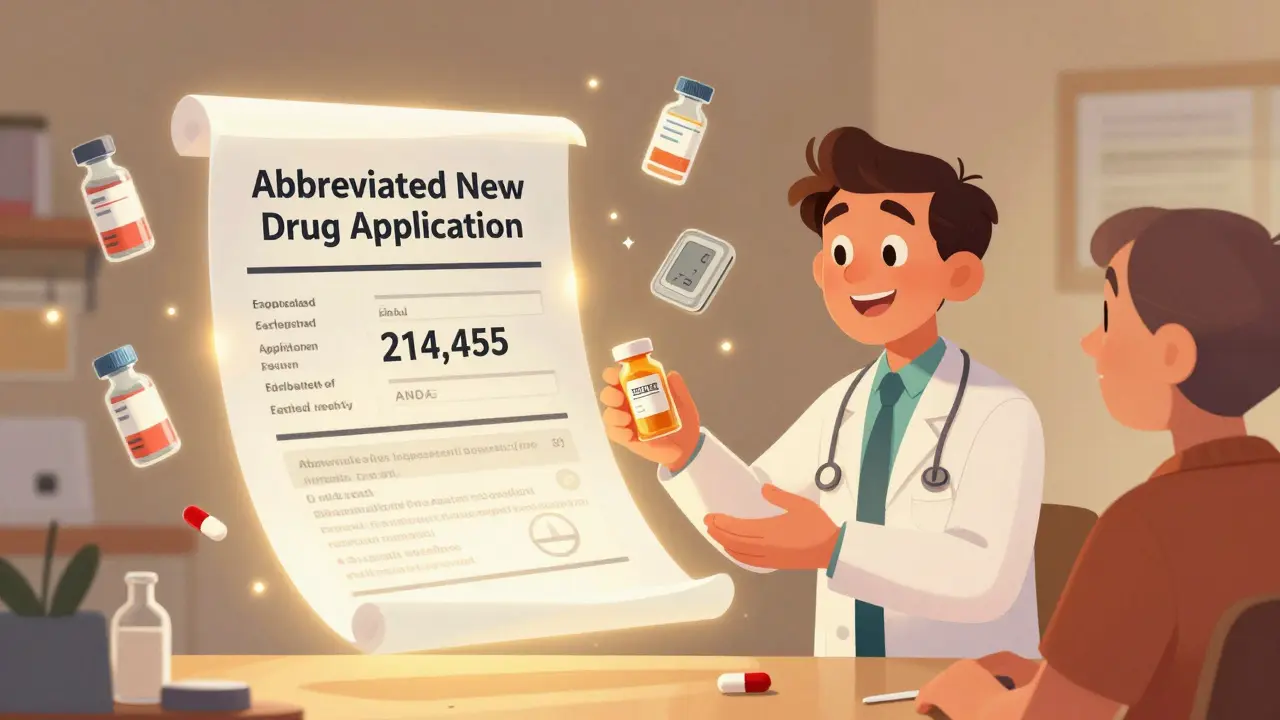
Every time you pick up a generic pill at the pharmacy and pay a fraction of what the brand-name version costs, you’re seeing the result of something called an ANDA. It stands for Abbreviated New Drug Application - a quiet but powerful system that changed how medicine is priced and accessed in the United States. This isn’t just bureaucratic jargon. It’s the reason millions of people can afford insulin, blood pressure meds, antibiotics, and antidepressants today.
What Exactly Is an ANDA?
An ANDA is a formal request submitted to the U.S. Food and Drug Administration (FDA) asking permission to sell a generic version of a brand-name drug. But here’s the key: unlike the original drug maker, a generic company doesn’t have to start from scratch. They don’t need to run new clinical trials on humans to prove the drug works or is safe. Instead, they prove their version is the same - in every way that matters.
The ANDA pathway was created by the Hatch-Waxman Act of 1984. Before that, generic drugs faced huge legal and scientific barriers. The law changed everything. It gave generic manufacturers a clear, faster, cheaper route to market - as long as they could show their product matched the original in active ingredient, strength, dosage form, and how the body absorbs it. That’s it. No extra studies. No repeating decade-long trials.
How Does an ANDA Work?
Let’s say you want to make a generic version of Eliquis, the blood thinner. The brand-name version was approved under a New Drug Application (NDA). That original NDA had years of animal studies, dozens of human trials, and millions in costs. The generic company doesn’t redo any of that. Instead, they do three things:
- Identify the original drug in the FDA’s Orange Book - that’s the official list of approved drugs and their patents.
- Prove their version has the exact same active ingredient - apixaban, in this case - at the same strength and in the same form (a tablet, taken by mouth).
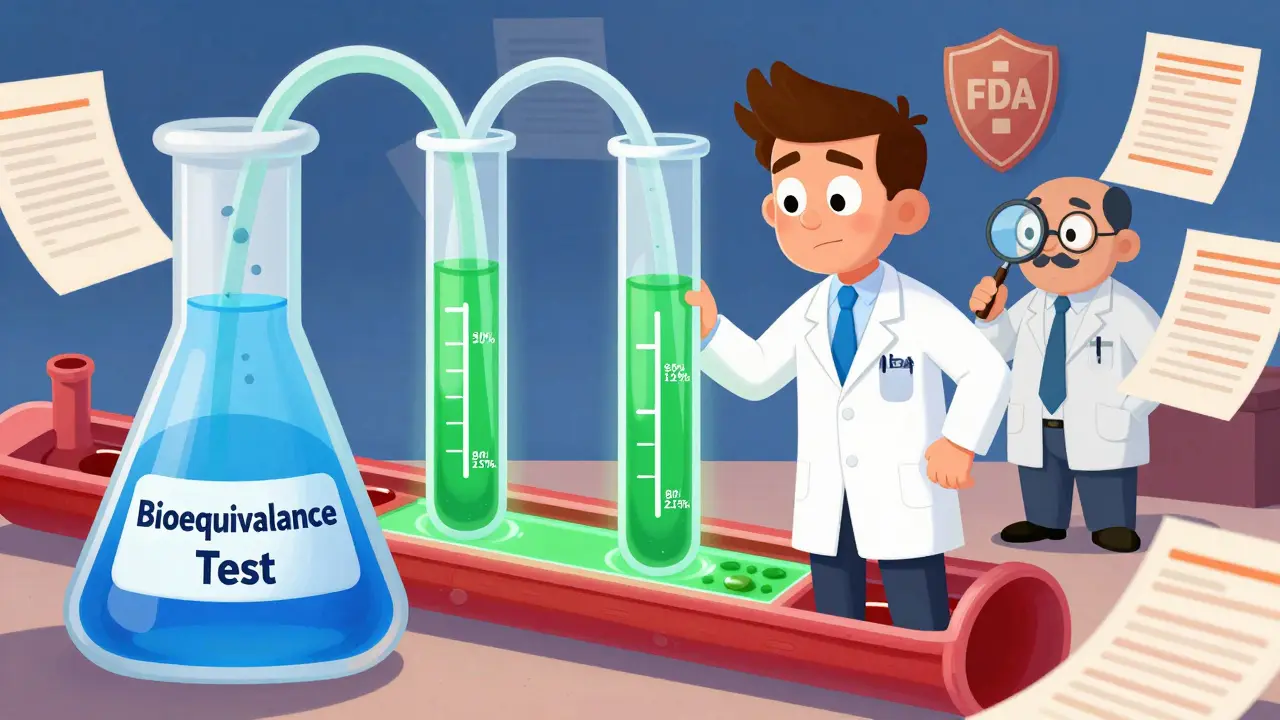
- Prove it’s absorbed into the bloodstream at the same rate and to the same extent. This is called bioequivalence.
Bioequivalence sounds technical, but it’s simple in practice. They give the generic pill and the brand pill to 24-36 healthy volunteers. Then they measure how much of the drug enters the blood over time. The generic’s absorption levels must fall within 80% to 125% of the brand’s. That’s the magic range. If it’s outside that, the FDA says no.
They also have to show their manufacturing process is clean, consistent, and controlled. The pills must be stable for at least two years. The packaging must protect the drug. The labeling must match the brand’s - except for the company name and logo.
Once approved, each ANDA gets a six-digit number. For example, generic versions of Eliquis carry ANDA 214,455. That number is the official record that this drug is legally approved as a safe, effective substitute.
ANDA vs. NDA: The Big Difference
Think of the New Drug Application (NDA) as building a house from the ground up. You dig the foundation, lay the bricks, install the wiring, and test every system. That’s what brand-name companies do. It takes 10 to 15 years and costs around $2.6 billion.
An ANDA is like buying a blueprint of that house and rebuilding it exactly the same - just with a different paint color and a new roof. You still need to use the same materials, follow the same design, and make sure everything works. But you skip the original research. That cuts the timeline to 3-4 years and the cost to just $1-5 million.
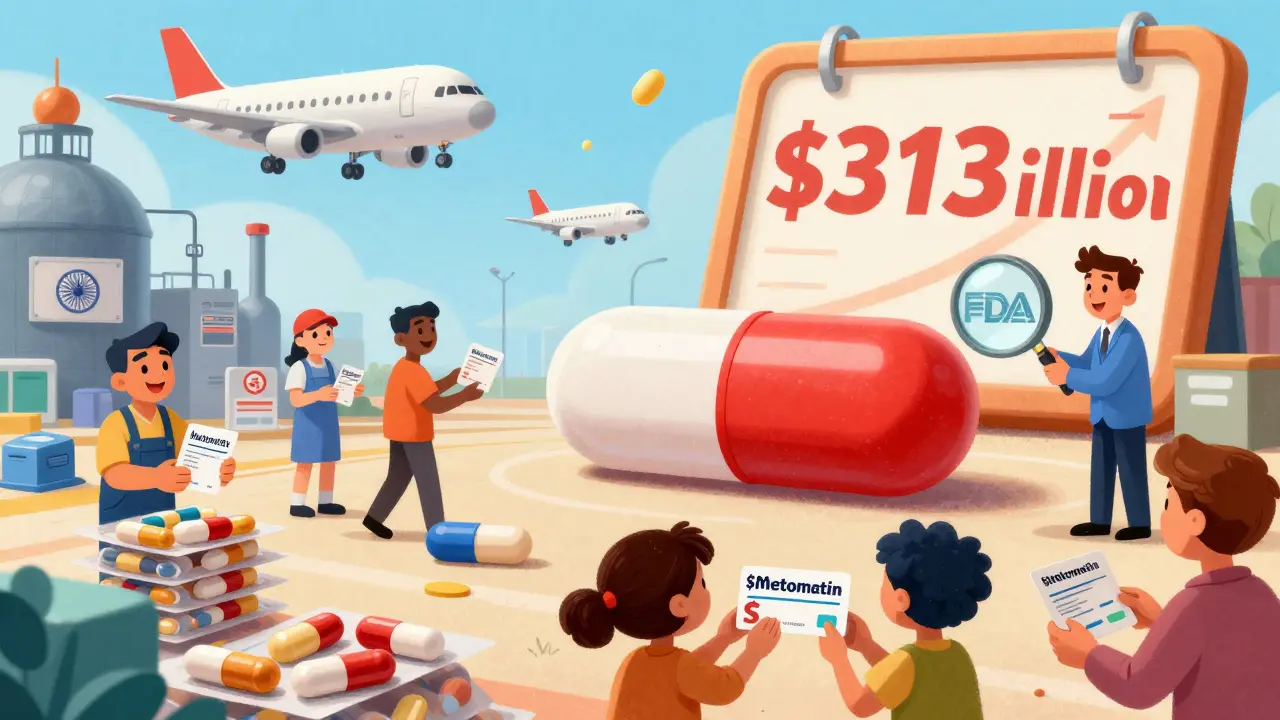
That’s why 90% of all prescriptions in the U.S. are filled with generic drugs - but they only make up 23% of total drug spending. The savings are massive: $313 billion a year, according to the Association for Accessible Medicines.
Who Can File an ANDA?
Any company with the right expertise and resources can file an ANDA. But it’s not easy. You need:
- A team of regulatory affairs specialists who know FDA rules inside out
- Access to bioequivalence testing labs
- Manufacturing facilities that meet FDA quality standards
- Patent lawyers to navigate the complex patent certification process
The Hatch-Waxman Act lets generic companies challenge patents on brand-name drugs. If they’re the first to file an ANDA and successfully challenge a patent, they get 180 days of exclusive market rights. That’s why companies like Teva, Mylan (now Viatris), and Sandoz race to be first. In 2023, 12 generic versions of Humira were approved all at once because of this rule.
But there’s a catch. If a patent lawsuit is filed, the FDA can delay approval for up to 30 months. That’s why many ANDAs sit in review limbo for years - not because the drug isn’t good, but because of legal battles.
Why Some Drugs Can’t Use ANDA
Not every drug can go generic through ANDA. Complex drugs - like inhalers, topical creams, injectables, or drugs with narrow therapeutic windows - are harder to copy. Why? Because small differences in how they’re made can change how they work in the body.
Take an asthma inhaler. It’s not just about the drug inside. The propellant, the spray mechanism, the particle size - all of it matters. A generic version might have the same chemical, but if the spray doesn’t deliver the right dose to the lungs, it’s useless. The FDA’s ANDA rules weren’t designed for these kinds of products.
That’s why the FDA launched the Complex Generic Drug Product Development program in 2022. It’s trying to update the rules for these tricky drugs. But progress is slow. As of 2023, only about 15% of generic approvals were for complex products. That number is expected to hit 25% by 2028.
What Happens After ANDA Approval?
Approval doesn’t mean instant market dominance. The generic company still needs to:
- Set up distribution channels
- Negotiate with pharmacies and insurers
- Train sales reps
- Handle patient education
And they often face fierce competition. Once one generic hits the market, others follow. Within a year, prices for that drug can drop 80-85% compared to the brand. That’s what happened with Lipitor, Plavix, and now Humira.
But there’s a downside. Many generic drugs are made in India or China. The FDA inspects these facilities, but supply chain issues can cause shortages. In 2023, over 200 generic drugs had shortages because of manufacturing problems or raw material delays. That’s a growing concern for regulators and patients alike.
How Effective Are Generic Drugs?
People worry: are generics really the same? The answer is yes - and the data backs it up.
Studies show generic drugs are 97% as effective as their brand-name counterparts. The FDA requires them to meet the same standards. In fact, many brand-name companies make their own generics. Pfizer, for example, sells both the brand-name drug and the generic version - just under different labels.
Doctors, pharmacists, and patients have trusted generics for decades. A 2022 FDA report found no difference in outcomes between patients taking brand-name or generic versions of heart meds, antidepressants, or diabetes drugs.
Dr. Janet Woodcock, former head of FDA’s drug center, said the Hatch-Waxman Act has saved the U.S. healthcare system $2.2 trillion over the past decade. That’s not a guess. That’s a number tracked by the government.
What’s Changing in 2026?
The FDA is pushing to improve the ANDA process. Under GDUFA IV (the latest user fee agreement), the goal is to approve 90% of original ANDAs on the first try by 2027. Right now, only about 65% get approved on the first submission.
Why? Because many applications are incomplete. Common mistakes include:
- Missing or unclear manufacturing details (32% of rejections)
- Inadequate bioequivalence data (27% of rejections)
- Incorrect patent certifications
- Poorly written labeling
Companies that hire experienced regulatory teams have a 42% first-cycle approval rate. Those without specialized staff? Only 28%.
The FDA is also making it easier to submit applications electronically. Since 2017, all ANDAs must be filed in the eCTD format. This has cut administrative errors by 60%.
Why This Matters to You
If you or someone you know takes medication regularly, the ANDA system is working for you. It’s why you can get a 30-day supply of metformin for $4 instead of $400. It’s why a month’s supply of sertraline costs $10 instead of $300. It’s why people aren’t choosing between buying medicine and paying rent.
Behind every cheap generic pill is a long, complex, highly regulated process. It’s not glamorous. It doesn’t make headlines. But it saves lives - every single day.
And it’s not going away. With drug prices still rising and healthcare costs climbing, the ANDA pathway remains the most powerful tool we have to keep medicines affordable. The next time you fill a prescription and see a generic label, remember: that’s not a compromise. It’s the result of one of the smartest public health policies ever written.
Is an ANDA the same as a generic drug?
No. An ANDA is the application submitted to the FDA to get approval for a generic drug. The generic drug is the actual product you take. The ANDA is the paperwork that proves it’s safe and effective. Once the FDA approves the ANDA, the generic drug can be sold.
Can any drug become a generic through ANDA?
No. Only drugs that are no longer under patent or exclusivity protection can be copied via ANDA. Also, complex drugs like inhalers, injectables, and topical creams often can’t be approved through the standard ANDA process because bioequivalence is hard to prove. These require special pathways.
How long does ANDA approval take?
Under current FDA rules, the review time for a standard ANDA is 10 months. But if the application is incomplete or has issues, the FDA can issue a “complete response letter,” which delays approval. On average, it takes 18-24 months from submission to approval because of revisions and resubmissions.
Are generic drugs as safe as brand-name drugs?
Yes. The FDA requires generic drugs to meet the same strict standards for quality, purity, strength, and stability as brand-name drugs. They must be bioequivalent - meaning they work the same way in the body. Studies show no difference in safety or effectiveness between generics and brands.
Why are generic drugs cheaper?
Generic drugs are cheaper because manufacturers don’t have to pay for expensive clinical trials or marketing campaigns. They use the existing safety and efficacy data from the brand-name drug. Their main costs are manufacturing and regulatory filings - which are far lower than developing a new drug from scratch.
Can I trust a generic drug from another country?
Yes - if it’s approved by the FDA. All generic drugs sold in the U.S., no matter where they’re made, must meet the same FDA standards. The FDA inspects foreign manufacturing facilities just like U.S. ones. If a generic drug is on the market here, it’s been checked.
For more information, the FDA’s Drugs@FDA database lists every approved ANDA with its number, applicant, and approval date. You can search by drug name or ANDA number to see exactly what’s been approved and when.
So let me get this straight - we’re paying $4 for insulin because some genius in 1984 said, 'Hey, why rebuild the wheel?' 🙌 Thank you, Hatch-Waxman. Also, if your generic looks different, it’s not broken - it’s just wearing a new shirt. 😎💊
Funny how we call it 'abbreviated' when it's really just regulatory arbitrage. The system doesn't prove safety - it assumes it. And yet, we treat generics like holy scripture. Isn't that just blind faith dressed up as science? The body isn't a spreadsheet. Bioequivalence is a statistical illusion wrapped in FDA approval.
I used to be skeptical about generics too - until my dad started taking them for his blood pressure. He went from paying $300/month to $12. His health didn’t change. His stress levels? Plummeted. Sometimes the most revolutionary thing isn’t a new drug - it’s making the old one affordable. 💙
If you're not buying American-made generics, you're supporting foreign factories with sketchy inspections. This isn't 'affordable' - it's risky.
I just want to say... thank you to the people who file these ANDAs. 🙏 It’s not glamorous work. No parades. No headlines. Just quiet, meticulous science that keeps millions alive. And yes, I know the supply chain is fragile - but that’s a policy problem, not a product one. Let’s fix the system, not fear the pills. 🌱
The FDA is a puppet. The real power lies with Big Pharma’s shell companies in Delaware. ANDA? Just a distraction so you don’t ask why your insulin still costs $400. The 'generic' you buy? Made in a factory owned by the same company that made the brand. They just changed the label.
The bioequivalence threshold of 80–125% is a regulatory abdication. That’s a 45% variance window - which is statistically nonsensical for narrow-therapeutic-index drugs. You’re not 'saving money' - you’re normalizing suboptimal pharmacokinetics under the guise of 'equivalence'. This is not science. It’s cost-driven compromise dressed in bureaucratic language.
I don’t care what the FDA says. If it’s not made in the USA, it’s not safe. And don’t even get me started on India. You think your generic is 'the same'? You’re just gambling with your life. I’d rather pay $400 than risk dying because some factory in Mumbai skipped a QC step.
I read the entire post. I’ve got 17 years in regulatory affairs. You missed the part about ANDA submission volumes spiking 300% since 2020 because of GDUFA funding. Also, the 180-day exclusivity loophole? It’s been weaponized. The first filer often doesn’t even launch - they just sell the right to another company. That’s why Humira generics took 5 years to hit the market. It’s not about science. It’s about money.
You say '90% of prescriptions are generics' like it’s a win. But have you ever tried to get a refill and the pharmacy switched your brand to a generic you’ve never taken? And then your anxiety spiked? Or your sleep got worse? No study can capture that. Your body knows. And your body doesn’t care about FDA statistics.
If you’re worried about generics, check Drugs@FDA. Every single one has a public inspection report. The FDA inspects foreign plants more often than domestic ones now. And guess what? Most failures happen in U.S. facilities. The real issue isn’t where it’s made - it’s whether the company is cutting corners. And that’s true for brands too. Don’t let fear replace facts.
While the utilitarian benefits of the ANDA pathway are undeniable, one must also acknowledge the epistemological limitations inherent in bioequivalence paradigms. The assumption of pharmacokinetic interchangeability does not necessarily entail pharmacodynamic equivalence across heterogeneous patient populations. Furthermore, the increasing prevalence of polypharmacy in elderly cohorts introduces confounding variables that are neither captured nor controlled within the current regulatory framework. A more granular, stratified approval mechanism may be warranted.